Costa News Spain Breaking News | English News in Spain.

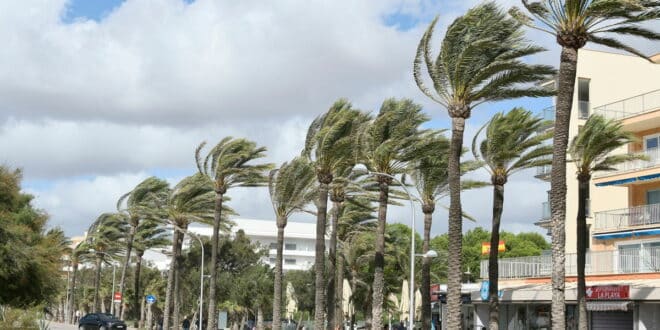
Strong winds sweep through a coastal town in Castellón as gusts exceed forecast levels.
Credit : Joan Llado, Shutterstock
Residents in Castellón province experienced wind gusts far stronger than officially forecast on Saturday February 14, after Spain’s state weather agency AEMET had warned of hurricane-force winds around 100 km/h – but actual gusts later exceeded 170 km/h in several areas.
According to data collected by the Asociación Valenciana de Meteorología (AVAMET), wind speeds reached 172 km/h in Vilar de Canes and Bel, with similarly extreme readings across the interior of the province. The discrepancy raised questions regarding forecast accuracy, especially since the region was under red Weather alert.
This article explains the forecast, what was recorded and how emergency services responded. It also explains to residents what they can expect in future severe weather events.
What AEMET forecast – And what was actually recorded in Castellón
On Friday 13 February, AEMET issued a red alert for Castellón province, warning of hurricane-strength gusts of around 100 km/h due to Atlantic storm systems crossing the Peninsula.
Measurements collected by AVAMET showed far stronger gusts:
- Vilar de Canes, Bel and Bel
- 163 km/h in Sierra Engarcerán
- 151 km/h is the speed limit in Llucena
- 145 km/h is Xert
- Culla and Sant Jordi: 142 km/h
The conditions are expected to be unstable throughout the afternoon.
AEMET warned of dangerous wind, but the intensity in certain inland municipalities was much higher than the projections.
How authorities responded to extreme winds in Castellón
Extreme weather conditions caused major disruptions across the province.
RENFE suspended rail services along the Mediterranean Corridor and between Valencia and Castellón on Saturday as a precaution.
The Generalitat Valenciana’s Emergency Coordination Centre sent alerts directly to mobile devices in Castellón province, urging residents to avoid unnecessary travel and to limit calls in order to prevent emergency line congestion.
By 1pm, the Castellón Provincial Fire Consortium had responded to 118 wind-related incidents, mostly involving fallen trees, loose structures and debris.
Castellón Provincial Council President Marta Barrachina attended an operational coordination meeting with fire services to assess ongoing risks and response measures.
Authorities have warned residents not to go near parks, wooded areas or scaffolding.
Is This a Single Missed Forecast?
The forecasts of AEMET have not been criticized for the first time in recent weeks.
Snowfall in Madrid ended January with major transportation disruptions, even though forecasts had indicated only a low likelihood of minor accumulations in the metropolitan region. The forecast classification of the time meant that the emergency planning thresholds weren’t fully activated.
In December, AEMET’s seasonal outlook suggested winter 2025–2026 would likely be warmer and drier than average, particularly in the southwest of the Peninsula. Spain has been experiencing a series of Atlantic storms since late December. Ten named systems have been recorded.
Weather forecasting is a complex process, particularly for wind gusts on mountainous terrain. Even small changes in the storm track, topography, or gradients of atmospheric pressure can have a significant impact on local outcomes.
Why wind forecasting is particularly difficult in interior Castellón
Castellón’s inland geography includes mountainous terrain that can intensify wind through funnel effects. It means that, while a general forecast may indicate strong gusts in a particular province, certain valleys or high areas can experience even higher speeds.
In the same storm, coastal towns could record wind speeds below 120 km/h. Meanwhile, exposed ridges inland may reach 170 km/h.
The variability of the wind makes it difficult to accurately predict gusts, even in conditions of red alert.
Timeline of Events in Castellón
Morning – Red alert issued for gusts around 100 km/h.
Late morning – AVAMET records gusts exceeding 170 km/h in inland areas.
Midday – Fire services report over 100 wind-related incidents.
Saturday – RENFE suspends rail services in affected routes.
What does this mean for future alerts?
Operationally, the difference between 100 km/h vs 170 km/h can be significant. Red alert was set correctly and indicated serious risks.
Emergency planning protocols had already been implemented in practice. Critics are more concerned about the underestimation of gust intensity than the level of alert.
Models that are updated constantly are used by weather agencies. AVAMET, for example, is a real-time network that captures local extremes which models are unable to accurately predict.
What this means for residents in Castellón and Valencia region
The main message for residents is not to blame anyone, but to understand the variability.
Conditions can quickly deteriorate and exceed expectations when red alerts are issued for mountainous regions of Spain. Following official guidance – avoiding travel, securing loose objects, and limiting outdoor activity – remains the safest course of action regardless of forecast margins.
While Saturday’s winds exceeded expectations in parts of Castellón, emergency systems were activated and no widespread structural disaster has been reported.
Severe Atlantic Storms As new systems continue to develop, authorities are on high alert.