Costa News Spain Breaking News | English News in Spain.

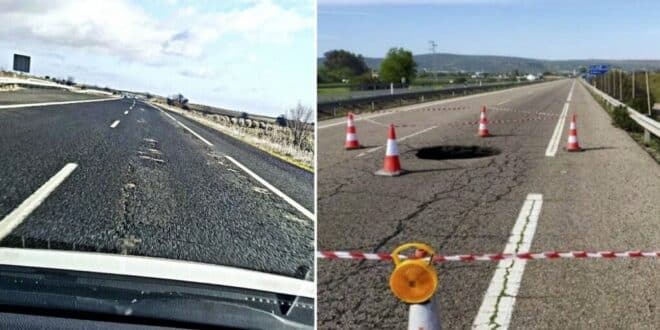
Spain’s extensive highway network, which covers 165,000 kilometers and is responsible for 96% of the freight traffic and 84% of the passenger traffic, faces its worst conditions since 1980.
Recent storms exposed structural problems, and sand bases were washed out. Drivers reported hundreds of tyres blowing out, huge potholes and dangerous sinkholes.
Recent storms expose long-standing decay
In February 2026 successive storms (DANAs), which ravaged the country and weakened already fragile pavements, wreaked havoc. On the A-4, in Jaen Province, as many as 25 flat tyres have been reported in one night. Hundreds more were reported over several weeks. Workshops and tow trucks near Santa Elena were overwhelmed. In areas like Cadiz’s Sierra, landslides have caused villages to be isolated. And in Cordoba, the irregular surface of secondary roads has forced drivers to drive cautiously, reducing speed limits.
Experts in the Asociación Española de la Carretera (AEC) The wet weather is accelerating the damage already done. AEC’s most recent assessments show that more than half of the network (52%) is in a serious state of disrepair. These structural issues include crocodileskin cracking and long fissures. Deep potholes are also a problem.
The Rot Factors
Underinvestment in maintenance is the primary reason, particularly in Andalucia and Aragon. The road surface lasts about 15 years, but is damaged by heavy traffic from freight trucks. Spain heavily relies upon roads for the transport of goods, and since 2008-2009 financial crisis has had insufficient repairs.
The accumulated deficits have risen dramatically: from 13,000 km of “very poor” condition in 2022, to 34,000 km in 2025. This is a nearly tripling. The AEC estimates a maintenance deficit of around €13,000 to €13,500 million needs covering, with urgent reconstruction needed on 33,966 km within a year.
Industry groups such as Asefma warn of a 225-million-tonne asphalt shortfall since 2011, while annual needs hover at €5 billion for the entire network, much bigger than recent budgets can handle, even with some increases and EU recovery funds. Heavy rains can exacerbate this problem by infiltrating the cracks in the foundations and eroding them. However, the real cause is deferred maintenance.
Who is responsible for Spain’s roads?
Responsibility is divided based on road type and administrative level
- State Roads (Red de Carreteras del Estado): The big motorways (A-autovías, AP-autopistas, N-nacionales) connecting regions or of general interest. The Ministry of Transport, and its Directorate General of Roads are responsible for managing the roads. These roads handle about 50 per cent, including the majority of heavy vehicles.
- Regional Roads (Red Autonómica): Routes entirely within one autonomous community, often marked with regional codes (e.g., CM- in Castilla-La Mancha). Each autonomous community is responsible for its own roads department, or equivalent councillorship. The condition of these roads can be seen when driving between provinces.
- Provincial Roads (Red Provincials): Local connectors in the provinces. Usually secondary conventional roads. Regional governments or foral communities, such as Navarra or Basque Country, are responsible for the supervision of these roads.
- Municipal or local roadsThe following are included in the definition of minor roads: Local councils are responsible for the maintenance of these routes.
You can either complain to them or your insurance company may try to make a claim.
The multi-level system can lead to blame shifting during crises even though there is coordination for the inter-linking of networks. Critics argue inconsistent funding across levels has allowed decay to reach dangerous levels, with the worst-affected areas including Aragon, La Rioja, Castilla-La Mancha, Castilla y León, and Galicia.
Drivers are increasingly calling for investment plans that will reverse decades of neglect.
No es Cuba, ni Venezuela, ni Egipto, ni Somalia… Son las carreteras en España 🇪🇸 pic.twitter.com/PcttRyAv6W
— Muy.Mona/🇪🇸💚 (@Capitana_espana) January 31, 2026