Costa News Spain Breaking News | English News in Spain.

Spanish police report: Adamuz rail tracks broke day before fatal crash
Melchor Saíz-Pardo and Mateo Balín
Wednesday, 8 April 2026, 13:45
The report of the Guardia Civil’s Cordoba judicial unit, which was submitted to the judge who is investigating the Adamuz rail accident, shows that the tracks had broken 22 hours prior to the fatal accident.
Investigators claim that an error in the configuration of safety systems at Adif infrastructure prevented an automatic alarm from being triggered.
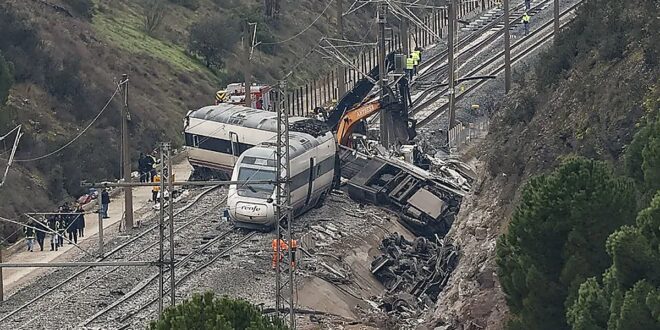
This alert should have prevented the 18th January collision between Iryo’s and Alvia’s trains. The accident claimed 46 lives, and injured dozens more after a Malaga to Madrid train derailed into a Alvia service that was travelling in the opposite direction towards Huelva.
In a 70-page report the Guardia Civil concludes “the accident began on the rail line near kilometer marker 318 […] As a result, a derailment was caused by a broken steel rail.” Investigators confirm the focus of their investigation remains a broken rail, or a weld.
Analyzing the technical data, it was revealed that signalling systems had detected an electrical disturbance well before the first derailed train. The voltage of the track circuits should be maintained at two volts. Nevertheless, “from 9.46pm 17 January there was a fall to around 1.5 Volts and the normal voltage didn’t recover until after the accident”. The Guardia Civil reports that this variation in voltage is consistent with the presence of a crack, or a break, in the steel.
Despite technical evidence, Sam (maintenance system) passively recorded the voltage loss at the Hornachuelos, near Adamuz base without sending any warnings to traffic control staff. In the police report it is stated that the “signaling system wasn’t configured to automatically alert to a voltage drop due to unreliability on this railway infrastructure”.
Related Article
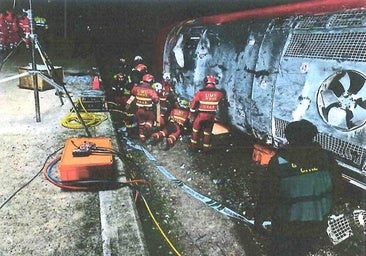
Adamuz Train Crash: First Court Summary reveals Emergency Units’ Titanic efforts
According to statements Adif’s Hitachi Rail provided to the Police, the system only emits an alert if the voltage drops under 0.780 volts. As it was still at 1.5 volts the system considered the track to be clear and safe.
This subtle voltage drop is considered by investigators. Adif’s technical specifications for 2017 state that “the system must be designed to detect rail breaks”. Guardia Civil claim that Adif did not “demand” the capacity necessary to run this high-speed rail line with the necessary rigor, despite Adif’s own regulations.
Discarded Theories
As the investigation progresses, the possible causes for the fatal accident have also been narrowed. The official report states unequivocally that theories of reckless or negligent driving by train drivers are “definitely ruled out”. The toxicology tests and analysis by the Legal Registrars (RJU), confirmed that the two professionals acted correctly. They described the accident as being “completely unplanned and with no time to react”.
In the same way, investigators have also ruled any evidence of “sabotage or terrorist activity” following the negative results of chemical analyses in the forensic laboratory.
The focus now shifts to the technical execution. A probe is underway to determine whether there was “poor weld, due to either the welders’ actions or the incorrect use of the welding kits”. Investigators have discovered that at the kilometre mark of the accident, a 350HT welding kit was used to join rail coupon whereas Adif regulations specified the use of a R260 welding kit.
Although Adif submitted a ‘correction’ alleging a recording mistake by the welder. The railway accident inquiry commission (CIAF) detected ‘inconsistencies, and raised doubts regarding the validity on the documents provided by the subcontractors.
The report also casts serious doubts on the effectiveness and efficiency of previous inspections. While ultrasonic surveys in June 2025 deemed the area as “safe”, Guardia Civil discovered the technicians responsible did not meet the strict requirement to “demonstrate a minimum two-year experience” during the inspection. Redalsa told the investigators there was no digital recording of the data collected during these inspections due to technical limitations with the handheld equipment.
Just two months before this tragedy, an inspection dynamic detected a “vertical speed defect” at exactly the point where the crack occurred. These data were incorporated into the monitoring efforts, which in light of events proved inadequate to detect material fatigue, ultimately causing the collapse of Ensidesa’s rail line in 2023.