Costa News Spain Breaking News | English News in Spain.

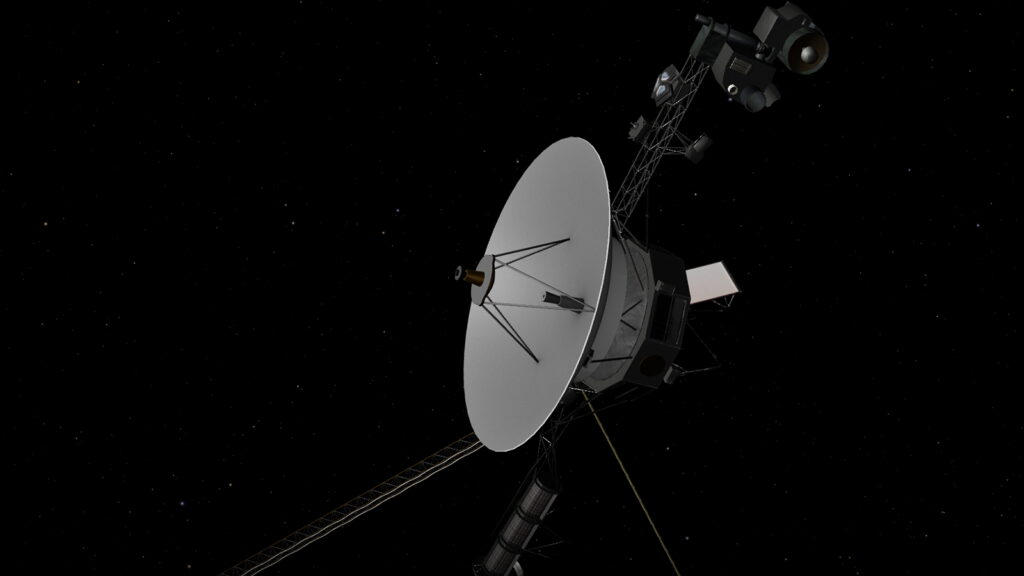
Voyager 1 approaches a light-day milestone that redefines the reach of humanity in space.
NASA Science Credited Photo
NASA’s Voyager 1 space probe, launched in 1977, is the first to have ever reached a distance of a light-day, which is 25,9 billion km away. Voyager 1, a technological marvel of the human race, has been so far from Earth for nearly 50 years that it takes 24 hours at light speed to send a message to it. It will then take another 24 hours for it to respond.
A 24-hour delay … even at the speed of light
“If I send a command and say, ‘good morning, Voyager 1,’ at 8 a.m. on a Monday, I will receive Voyager 1’s response on Wednesday morning at around 8 a.m.,” said Suzy Dodd, the Voyager project manager at NASA’s Jet Propulsion Laboratory.
Dodd says that due to the distance between us, and the probe, signals are delayed and need multiple antenna arrays in order to be collected, as they weaken along the way. NASA’s space probes transmit data roughly at dial-up speed, or 160 bits per second.
It is impossible to fix any probe quickly due to the slow pace of the process. The probes are intelligent and have technology that allows them to go into a “safe” state until NASA can communicate with them, diagnose the problem, and fix it. Due to the 24-hour delays, last year it took weeks to solve one of Voyager 1’s technical problems.
Voyager 1 travels through space with incredible speed
In the vacuum of outer space, according to the physics of the universe, there is no way for anything to move faster than 299,337 kilometers per second. Voyager 1 is not moving anywhere near the speed at which light travels, but it won’t be losing any races anytime soon. It currently moves at an impressive 17,7 kilometres per hour.
On November 15, 2026 the spacecraft, after 49 years of accelerating into the stars, will be officially one light-day away from Earth. Voyager 1’s robust engineering will be celebrated, but it is also a testament to human curiosity, tenacity and ambition.
Space’s vastness and human curiosity versus its unfathomable size
Voyager 1 serves as a constant reminder that space is unfathomably vast. For reference, a light year is equivalent to approximately 9 trillion kilometers. NASA’s Apollo 10 spacecraft reached an unmatched speed of 40.233 kilometres per minute in 1969. Even at these speeds it would still take Apollo 10 5 months to travel 147.16 millions kilometres from Earth to the Sun.
Voyager 1 would require nearly 40,000 year to travel halfway to Proxima Centauri – our nearest neighbour. As of now, traveling these vast distances is still only a dream.
Two sister probes that launched before Internet, mobile phone, and Star Wars
Voyager 1 began its journey in the late 70s, just months after the first Voyager spacecraft. This was before mobile phones, personal computers, or the Internet were widely used. Star Wars The film was released. It was a rare opportunity for the probe to explore Jupiter and Saturn, as Neptune and both planets lined up in an alignment that occurs only once every 175 year. NASA’s spacecraft was able to reach every planet by gaining momentum through gravitational pulls.
The pioneering space probe was able, through its exploration of Jupiter and Saturn between 1979 and 80, to collect groundbreaking data. Voyager 2 was launched in 1977 and is its sister probe. It became the only spacecraft that has visited Jupiter, Saturn, Uranus and Neptune.
Voyager 1 is the most advanced human-made spacecraft to date. It has visited the gas giants and crossed into interstellar (the vast region between the stars in a galaxy).
Voyager 1 set to run out of juice in 2030s … but its legacy will continue
NASA will be in contact with the probe on November 15th, this year. This is when the probe reaches one light-day. But aerospace engineers are aware that Voyager 1 is running out of light-days. Even if it doesn’t encounter any further technical problems, the probe’s three generators would run out in the 2030s.
Until then, the space probe continues on its brave journey, reminding engineers at NASA – and indeed all of humankind – of the wonders, discoveries, and unfathomable vastness of the cosmos.
Click here to read more technology news.
World News – Read More You can read more about it here.