Costa News Spain Breaking News | English News in Spain.

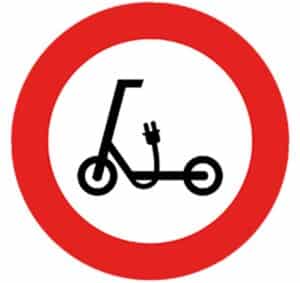
Spain’s new R 118 traffic sign allows cities to ban electric scooters from certain streets and issue €200 fines to riders who ignore it.
Credit : r.classen, Shutterstock
Many electric scooter riders in Spain have suddenly realised that they are unable to ride along some streets, which they had used almost daily before.
New traffic signs have appeared across Spanish cities and now allow councils the ability to ban scooters, and other personal mobility device from certain areas. These include pedestrian streets and historic centers. And if riders ignore it, they can be fined €200.
The sign is known as R 118Although most people refer to it simply as the new scooter-ban sign.
The new law officially took effect on 1 July 2025. However, several cities already have begun to install it in areas where local authorities believe scooters are creating increasing problems with pedestrians and traffic.
The change is confusing for scooter users who are used to the current rules.
In the last few years, the scooter has gone from being a modern and eco-friendly urban transport, to one of the most controversial parts of Spanish city life. Many people like them because they’re fast, inexpensive and practical. Some people are frustrated with riders who weave through crowded sidewalks or speed through pedestrian areas.
Councils are now attempting to tighten their control over the places where people can go.
New sign prohibits scooters on certain streets
Once people know what to look for, the sign is quite simple.
The sign is circular and red-bordered, with a black silhouette of an electric scooter. Scooters and other personal mobility devices cannot be entered where the sign is displayed.
It is not just scooters that are affected.
Hoverboards, Segways and Electric Monocycles can all be included in the restriction. Electric bikes and traditional bicycles are not covered by the same rule, unless there is a separate sign that says otherwise.
Signs are placed by cities primarily in areas that local authorities consider dangerous for scooters, such as pedestrians crossing the road or tourist traffic.
This often includes old town districts, narrow streets, bustling plazas, and pedestrian shopping areas where tensions have steadily increased between walkers and riders in recent years.
Barcelona, along with Madrid, Valencia, and Sevilla, is one of the cities that has already implemented the new restrictions. And authorities do not allow much flexibility after the sign is in place.
If a rider enters a restricted area despite the sign being clearly visible, the standard penalty is €200.
The biggest problem for many people is that they don’t recognise the sign.
Many riders are unaware of the fines until they see them or hear from someone else.
The scooter laws in Spain have become a mess from city to city
Spain’s introduction of the sign was partly due to the fact that the scooter regulations became increasingly confusing.
Some cities allow scooters on cycle paths. Some cities have banned scooters from the pavement altogether. Helmet laws vary, as do age restrictions and speed limits.
Many tourists and residents who travel between cities are unaware of the local laws.
You can also find out more about the following: DGT Years ago, we warned that Spain’s catalogue of traffic signs no longer reflected the reality on today’s streets. The majority of signs date back to 2003, before electric scooters were common.
Then, no one could have imagined that Spanish cities would soon be filled with scooters for rent, delivery drivers, and electric personal vehicles.
Scooter use in Spanish cities exploded after the pandemic. People wanted cheaper and faster alternatives to public transportation.
As the infrastructure struggled, so did the legislation.
Local councils started improvising rules on their own, creating confusion.
The new R 118 is meant to simplify the situation on a national level by creating a single, recognisable sign for restrictions that will work across Spain.
Theoretically, at least.
Cities are getting tougher on scooters and expect more controls.
It is also crucial to consider the timing. Spanish cities are increasingly trying reclaim pedestrian zones, reduce accidents, and reorganise the urban mobility after years rapid growth of scooters and delivery traffic.
Authorities say the goal isn’t to eliminate scooters from society.
They want to see stronger barriers between fast-moving vehicles and pedestrians.
Some scooter riders do agree.
Regular users are becoming increasingly frustrated by reckless riding and those who use the pavement as a shortcut. Many people believe stricter enforcement will come sooner or later.
Some feel that the councils have gone too far in removing scooters from city centers, even though they had previously urged people to use them as an environmentally-friendly mode of transportation.
Many scooter riders, particularly tourists who rent scooters for short time periods on holiday, are still unaware of the new restrictions.
Visitors could face completely different restrictions based on where they are located, as different councils decide the location of the signs.
It is becoming clear that the Spanish authorities do not view electric scooters any longer as a passing trend.
The signs are being enforced much more vigorously and riders who disregard the new signage could end up paying a heavy price.