Costa News Spain Breaking News | English News in Spain.

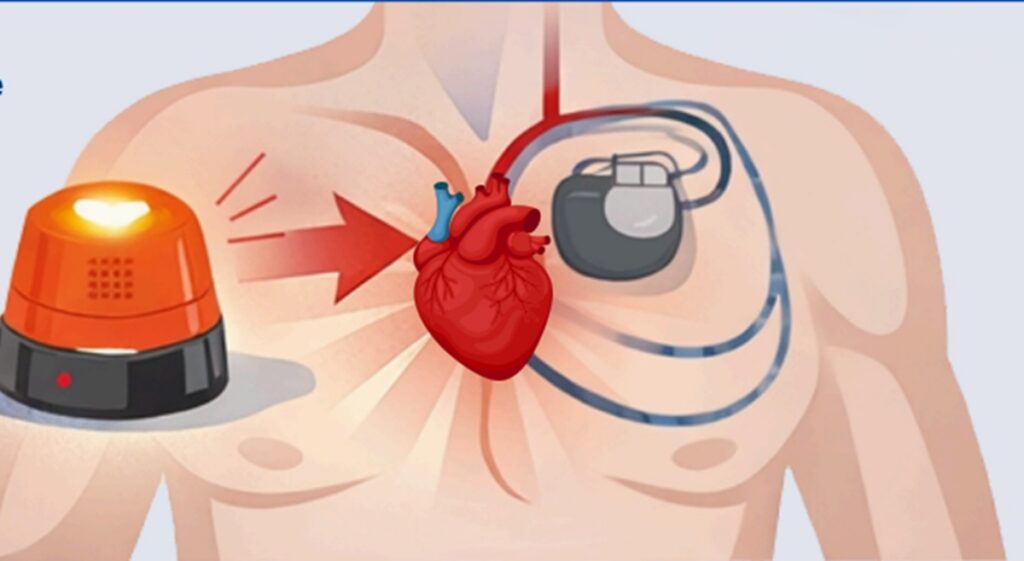
Illustration of how the magnetic base of the V-16 beacon could interfere with pacemakers when held too close to your chest.
Credit : Screenshot – fundaciondelcorazon.com
The Spanish roads have undergone many rule changes, but none has sparked such controversy as the V-16 emergency signal, which replaced the warning triangles in January. This device is marketed as an alternative that’s safer and smarter. It keeps drivers safe in the event of a breakdown.
Yet just weeks into its mandatory use, the V-16 is facing fresh scrutiny – this time from doctors and patients concerned about its impact on people with pacemakers and implantable defibrillators.
Some drivers claim that while authorities say the risk of a collision is minimal, the issue was something that should have been addressed well before the compulsory beacon.
The V-16 beacon raises medical concerns
The issue is not the V-16, but rather how they are designed. Most V-16 beacons attach to a vehicle’s roof using powerful magnets. This allows drivers to quickly place them without having to step onto the road.
Magnets are a great safety feature for most people. For those with pacemakers or implantable cardioverter-defibrillators (ICDs), however, magnets can be an issue. Experts have warned for years that magnetic fields that are too strong can interfere with heart-rhythm devices.
Doctors from Spain have confirmed that the beacon could cause interference if it is placed close to the chest area, where the implants are typically located. This risk is acknowledged by some manufacturers, who warn their users to keep away from magnetic radiation and pacemakers.
In response, the General Directorate of Traffic (DGT) has attempted to calm fears, pointing out – somewhat dryly – that the beacon is “for the roof of the vehicle, not the driver’s chest”.
What cardiologists have to say about the true risk
It is important to note that the word “you” means “you”. Spanish Society of Cardiology (SEC) The Department of Health has now published guidance aimed both at healthcare professionals and patients.
According to SEC, a V-16 beacon must be placed very close to an implant for it to disrupt the device. They say that in practical terms, the risk of a serious problem is not higher than for everyday items such as mobiles, wireless headphones, or smartwatches.
Cardiologists still urge caution. They are clear: Keep the beacon away, do not rest it against your body and use the opposite arm to handle it. The device must be held only for as little time as possible.
Doctors say that as a general rule, the beacon should be used safely if it is kept at least a hand-width away from the pacemaker.
Drivers with pacemakers have several options for alternative driving methods
There’s a simpler solution, according to some specialists. Manuel Martínez-Sellés, head of Acute Cardiac Care at Madrid’s Gregorio Marañón Hospital, recommends that drivers with pacemakers or ICDs choose V-16 models that attach using suction cups rather than magnets.
He suggests that common sense should be used in real life situations. He advises that if another person is in the vehicle, they should be the ones to handle the beacon and not the person who has the implant.
The doctors’ message is caution rather than alarmism. When used properly, the V-16 is unlikely cause any harm. For drivers with a medical condition who are already managing the issue, this controversy brings to light an uncomfortable truth: Safety innovations do not always work the same for everyone.
As Spain continues to modernise its road safety rules, many hope future regulations will take these quieter concerns into account – before drivers are left weighing compliance against their own health.