Costa News Spain Breaking News | English News in Spain.

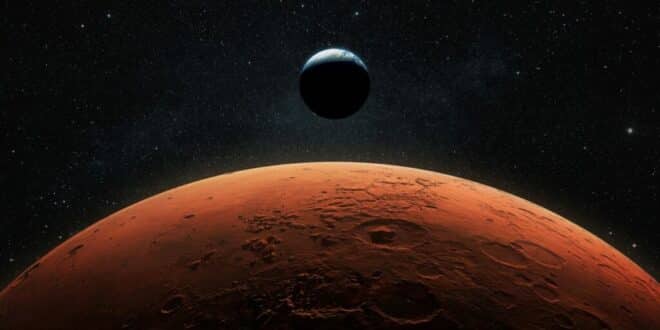
NASA might have just taken us a step closer to answering one of humanity’s oldest questions – are we alone in the universe?
The US space agency’s latest analysis has revealed the most convincing evidence to date of possible life on Mars. The findings are based on a rock specimen drilled by Perseverance in Sapphire Canyon Scientists call it groundbreaking.
This study was published in Nature, shows that the rock – known as Cheyava Falls – contains potential biological signatures, or traces that could have been formed by ancient life. NASA officials believe that this is the strongest evidence yet to suggest that Mars was once home to living organisms.
We’re the closest we’ve been to discovering life on Mars
Mars has always held a fascination for humans. Out of all the planets in our solar system, it’s the one that most resembles Earth — rocky, dusty and, long ago, possibly rich in water. Scientists believe it could also tell us how life began, thrived, and ultimately disappeared.
Perseverance is there to prove it. The rover, which landed in Jezero Crater in 2021, has been exploring it, looking for signs of ancient life in ancient lake and river formations.
It looks like the mission has paid off. Researchers say the organic compounds discovered in the Cheyava Falls sample show structures that might have formed through biological processes – something that has never been seen so clearly before on Mars.
Sean Duffy said, “This is as close as we have ever come to finding life on Mars.” The identification of a bio-signature on Mars is a groundbreaking discovery that will change the way we view Mars.
NASA, however, is careful to avoid premature claims. The team behind this discovery has said that, while the evidence “highly suggests,” more data are needed before any biological origin can be confirmed.
Young rocks, big surprises
This discovery may be the most exciting part. You can find out more about this by clicking here. It was discovered. Perseverance found that the Cheyava Falls rock is amongst one of Perseverance’s youngest sedimentary rocks.
Until now, scientists assumed that any traces of life on Mars would be found deep within ancient rock layers – remnants from the planet’s earliest, wetter period. This idea has been completely changed by the discovery of bio-signatures within much younger rocks.
This suggests that Mars could have been habitable later than thought. If that’s true, it could rewrite what we know about the planet’s evolution – and possibly about the conditions required for life itself.
It’s surprising,” said a NASA researcher who was involved in the mission. “We expected to find potential signs of life in older formations, but this tells us Mars could have been more dynamic – and more alive – than we thought.”
Why it is more important than ever
For NASA, this isn’t just about a single discovery – it’s about what comes next. Perseverance will continue its mission to collect more soil and rocks samples which will ultimately be brought back on Earth for analysis. Once the samples arrive, scientists can determine if they are the product of chemical or biological processes.
In either case, the implications will be huge. If life ever existed on Mars, it would suggest that life might not be unique to Earth – that it could develop wherever the right conditions exist. Even if these signs are only geological in nature, they will help scientists to understand the transformation of Mars from a wet world to the barren desert that it is today.
This discovery confirms that Mars is still at the center of our cosmic curiosity. This is the only planet on which humans have sent back data directly from the surface of the planet, including drilling into it. Each sample, photo and analysis is another piece of the puzzle.
NASA scientists have their feet firmly planted on the ground. There’s no talk of green aliens or cities buried under Martian dust — just the quiet, methodical excitement of a breakthrough decades in the making.
There’s no way to deny the importance. If the findings are confirmed, it could change the way we view our place in the Universe.
Until then, Perseverance keeps moving, drilling, and digging through the red soil – still searching for the one answer we’ve been asking for generations.