Costa News Spain Breaking News | English News in Spain.

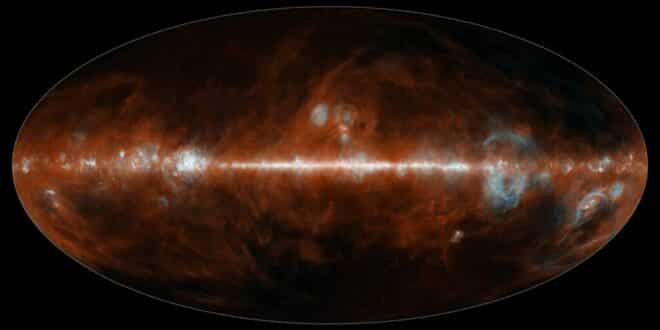
NASA releases the first infrared sky map from its SPHEREx Mission.
Credit: NASA/JPL/Caltech
Space reminds us of how small we truly are.
NASA released the first images of Earth from space a few weeks back. SPHEREx, A new space telescope has begun mapping the sky in infrared. The pictures look beautiful at first: glowing clouds and distant structures. They also show colours that our eyes wouldn’t normally see. The story behind the stunning visuals is much more complex.
SPHEREx, launched in 2025, will spend two years scanning our Milky Way galaxy and collecting data. Scientists are hoping that this mission will provide answers to some of today’s most pressing questions: how the Universe expanded following the Big Bang; how galaxies form; and where water and organic molecules supporting life came from.
It’s more than just pretty pictures. It’s about understanding how everything started – including us.
SPHERE scans the sky with its entire spectrum
Contrary to famous telescopes which zoom in on small patches of space SPHEREx It is more of a surveyor.
The satellite is in a low orbit around the Earth. It circles it roughly 14 and half times per day. As it moves between poles, it captures thousands of images of a narrow stripe of sky. The Earth’s rotation around the Sun causes the strip to move slightly each day. SPHEREx covers the sky in about six months. After six months, SPHEREx starts over.
This slow and steady approach allows astronomers to build a complete, layered map of the cosmos – not just what’s bright and obvious, but also faint structures hidden behind dust and distance.
SPHEREx is unique in the way it perceives light. It can observe 102 infrared wavelengths that are far beyond the capabilities of the human eye. Infrared can reveal cold dust clouds, distant galaxy and chemical signatures in particles that drift between stars.
It’s clever that even the cooling system is designed in a way to keep the telescope cool. SPHEREx doesn’t use any bulky cooling system, but instead uses specially-designed reflective shields which block heat from the Sun or Earth. There is no need for liquid cooling or heavy machinery. Simple, efficient engineering quietly doing the job.
This is not a replacement for the James Webb Space Telescope. Webb offers close-ups on individual targets that will blow you away. SPHEREx focuses on the bigger picture – the cosmic map that connects everything together.
Why scientists are searching for water and the origins galaxies
SPHEREx has a scientific focus that is surprising down to earth: water and chemical building blocks.
Scientists already know that the clouds of dust and ice between stars are rich in molecules such as carbon and nitrogen. These materials become part of the atmospheres of planets and potentially living organisms. Uncertainty remains about the extent of these compounds and their movement through space.
SPHEREX can help us understand how the components of life are passed on to young solar systems by measuring their distribution in vast areas of space.
The mission looks further back into history. According to modern cosmology, the Universe went through a period of incredibly rapid expansion shortly after the Big Bang – a phase known as cosmic inflation. Tiny quantum fluctuations during that time grew to become stars, galaxies or massive clusters.
The evidence is still not conclusive, but we can see the early ripples of background radiation that were left from the creation of the Universe. Many theories exist about the inflation process.
SPHEREx allows researchers to test their theories by mapping the Universe’s large-scale structure in three dimensions. By analysing how galaxies are distributed and how matter clusters together, scientists can narrow down which models make sense — and which don’t.
This is the type of research that doesn’t make headlines over night, but gradually reshapes how we perceive reality.
Enjoy the moment, but be prepared for a big discovery later
The newly released pictures are mostly a first glance. The images have been altered to appear falsely colored so that infrared lights invisible to the human eye are visible. This makes them look otherworldly and dramatic.
NASA hasn’t yet published detailed scientific conclusions from the data – and that’s completely normal. Sorting out this much information requires time, computing power, and careful verification.
Astronomers will turn these images into detailed maps in the coming months. They’ll show how galaxies are distributed across space, the evolution of matter over billions years, and the way the early Universe shaped the world we know today.
There’s an air of humility about it. A small satellite orbiting Earth is now capturing light that was emitted by distant galaxies billions or even millions of years ago. Scientists are trying, from these faint signals to piece together existence itself.
SPHEREx was not designed to produce viral space photos, or dramatic close-ups. Its strengths are patience, scale and consistency. It is building a map of reference that future missions can rely on.
This is the first release. This is only the beginning. It’s only the beginning.