Costa News Spain Breaking News | English News in Spain.

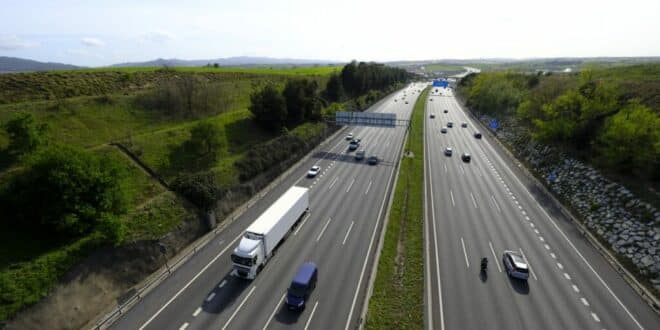
To improve road safety, some Spanish motorways now operate with lower speeds limits in 2026
Credit : csp, Shutterstock
Most drivers in Spain are used to 120km/h. You enter an autobahn, merge into traffic and then settle down to what you feel is “normal” speed. This has been the case for so many years that people hardly check signs any more.
By 2026 this habit has started to catch people by surprise. Not because Spain has suddenly changed the law nationwide – it hasn’t – but because more and more motorway sections are now being signed at 100km/h instead of 120km/h. It’s easy to miss unless you pay close attention.
After weeks of confusion and clarifications from DGT over the V16 warning device, the speed limit is now the next quiet change to be made on Spanish highways. It isn’t dramatic and it’s certainly not announced loudly, but that’s why some drivers have been caught by surprise.
Why some motorways have stopped adhering to 120km/h?
Let’s begin with the basics. Spain’s speed limit for motorways and dual-carriageways remains 120km/h. No reduction has been made across the board. What has changed is how the limit is applied along specific road segments.
DGT reduces speed limits to 100km/h for sections it deems high-risk. These areas are often those with poor visibility, steep hills, heavy traffic, aging road surfaces, or complex intersections. Reducing speed is a more effective and quick way to improve safety than waiting for years for expensive infrastructure improvements.
What was once an extremely rare measure, will be more commonplace in 2026. It’s not just Spanish logic either. According to international road safety studies and recommendations by the United Nations for safer road infrastructures, lowering speed limits is one of the best ways to reduce fatalities and serious accidents. On certain motorways, speeds of 100km/h are considered safe.
Depending on the characteristics and layout of the road, a section of motorway that allows 120km/h may suddenly reduce to 100km/h.
It’s not just a sign change, but a shift in the mindset of drivers who are used to driving on autopilot.
Spain is already imposing 100km/h speed limits on drivers
This isn’t a hypothetical situation. There are several routes that show the real-life operation of the system.
In Galicia, parts of the AG-55 between A Coruña and Carballo now operate permanently at 100km/h. These sections have poorer visibility and steeper gradients where the accident risk is greater. To ensure the rule improves safety and isn’t ignored, certain stretches are monitored using average speed cameras.
Up to six sections of the AP-8 are being adapted at the lower limit. There are several points that have a long history of accidents. The goal is to improve traffic flow without redesigning an entire motorway.
In Catalonia the situation is slightly different. On some parts of AP-7 the speed limit has not been fixed. Smart systems are used to adjust the speed limit in real time based on factors such as traffic density, road conditions, and even the weather. During periods of high traffic or in less-favourable conditions, 100km/h is the usual limit.
What all of these examples have in common is that the change isn’t universal – it’s targeted. But the number is increasing.
What does this mean for the everyday driver in 2026?
The rule is not the biggest risk. It’s not even noticing that it exists.
These reduced speed limits are often only applicable to short distances of road. One moment a driver may be legally travelling at 120km/h, and then need to slow down to 100km/h just a few kilometers later. When you rely solely on signs and not your habits, problems can arise.
The installation of more average speed cameras in these zones means that a brief slowdown near a radar will not be helpful. The speed of the vehicle is not measured at one point, but across the entire area.
It is important to note that the word “you” means “you”. DGT The company has stated that they prefer these targeted cuts to sweeping national changes, which would require changing signs across the entire country. It’s efficient from a management perspective. It requires more attention from the driver’s perspective.
It also comes at a time when motorists are already adjusting to several new rules this year – from the compulsory V16 beacon to revised overtaking rules and emergency lane behaviour. The rulebook can seem to be shifting under your feet.
This has a psychological component as well. Motorway driving is often associated with high-speed, steady progress. It can seem like a long journey if you drop to 100km/h, but in reality this only adds minutes to the majority of journeys. Safety experts argue that these minutes are worth it if the accident rate drops.
Navigation apps have begun to update to some extent, but not all of them. The roadside signs are the final authority, especially in areas where speed limits can change quickly.
It’s simple. Don’t assume that 120km/h is the standard everywhere. Continue to scan the gantries and watch out for temporary restrictions. Treat unfamiliar routes more cautiously than you did before.
In the coming year, it is likely that more sections will adopt the lower limits. There won’t necessarily be big announcements or headlines when that happens – just a new number on a sign above your lane.
If you don’t, you will be fined.