Costa News Spain Breaking News | English News in Spain.

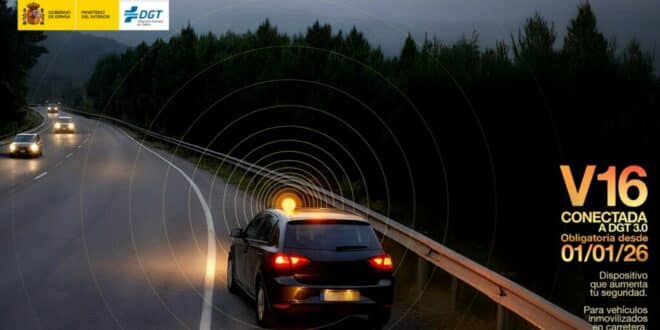
A vehicle using the V16 connected beacon, which will be mandatory in Spain as of 1 January 2026.
Credit: Dgt.es
Next year, Spanish road will be very different. The familiar image of a driver nervously walking along the hard shoulder to place warning triangles is about to disappear, replaced by the DGT’s new connected V16 beacon – a small flashing light designed to sit on the roof and instantly alert other drivers and traffic authorities when a vehicle has broken down.
This is one of the most significant changes in road safety that Spain has made in recent decades. It affects nearly every vehicle registered throughout the country. But surprisingly, a very specific category of motorists will be exempt – and that’s exactly where confusion has already begun.
The V16 beacon is now mandatory for all V16 users.
Millions of drivers will have to use the V16 light from January 1, 2026. The DGT states that the rule is applicable to approximately 25 million Spanish registered cars.
- Busses
• adaptable mixed-use vehicles
• goods transport vehicles
• non-special vehicle combinations
Most of the vehicles that travel through Spain’s cities, towns and highways every day are cars, vans, and lorries.
The idea behind the change is simple: keep people inside their vehicle during a breakdown and avoid the dangerous walk along the road to place triangles – something that has contributed to too many fatal accidents over the years.
No one expected the big surprise that happened
This is the part that has everyone surprised: Foreign-registered vehicles do not have to carry a beacon.
Anyone driving into Spain with plates from France, the UK, Germany, Morocco – or any other country – can continue to use the traditional warning triangles without any issue. They won’t be fined.
Why? Spain is unable to impose technical regulations on vehicles registered in other countries. This is crystal clear in international circulation agreements. Spain may have made the V16 connected mandatory in order to set an example, but it can’t force other vehicles to adopt the system.
The V16 rule does not apply to Spanish plates.
Renting a car from abroad is not allowed.
Tourists are not allowed to enter the country
It is not expats that drive in a foreign car.
There is a catch though: Not all V16 beams are valid
Even those who The following are some of the most effective ways to improve your business. A small detail is causing confusion.
DGT warns that many V16 beacons sold online today are not authorized, even though they may look the same as official ones. Dozens of models have appeared on online marketplaces, often at bargain prices – but not all of them meet Spain’s technical requirements.
DGT is clear in its message: if the item is not listed on their approved list, it does not qualify.
And from 2026, using a non-approved beacon will be treated as if you’re carrying no beacon at all – an offence punishable with a €80 fine.
Motorists are urged to do a thorough check on the vehicle before purchasing. DGT website Make sure that the model has been homologated.
Why Spain stands alone – for now
The V16 is a huge change for Spanish drivers. Nothing changes for foreign motorists. This mismatch is due to international traffic rules, which only apply to vehicles registered within the country that issued them.
Spain may be pioneering the use of connected beacons, but unless the EU – or individual countries – follow its lead, drivers entering from abroad will continue placing triangles the old-fashioned way.
So yes, from 2026, you may be on the motorway using a high-tech connected beacon… while the car behind you puts out a traditional triangle. This mixed picture will likely continue until other countries adopt the same system.