Costa News Spain Breaking News | English News in Spain.

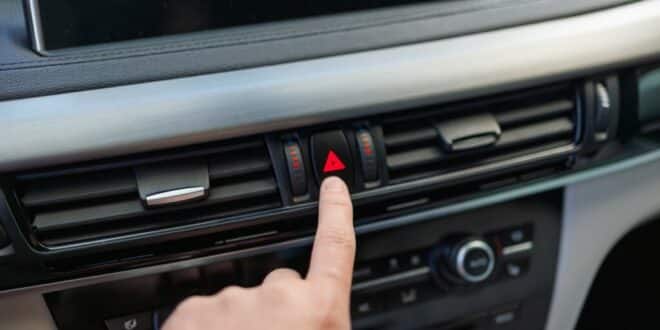
The Spanish DGT reminds motorists that the hazard light is only used for real emergencies and not illegal stops.
Credit : Andriiii, Shutterstock
On the streets all over Spain, this happens daily. A driver pulls up outside a shop, stops in a bus lane or double parks for ‘just a minute’, switches on the hazard lights and assumes that’s enough to avoid getting into trouble. According to Spain’s Directorate General of Traffic’s (DGT), this is not the case.
The traffic authority is reminding motorists that hazard lights, often called warning lights or ‘four way flashers’, do not give drivers permission to stop wherever they like. If your vehicle is parked or stopped somewhere it shouldn’t be, turning on the hazard lights won’t make it legal and, in some situations, you could still face a €200 fine.
This reminder is being issued as many drivers continue misusing the lights. They often believe that they are temporary passes for quick stops, collection or delivery. DGT states that this is one of the biggest misunderstandings in Spanish roads.
The hazard lights on your car don’t make illegal stops legal
Many drivers have become accustomed to turning on their hazard lights almost automatically. Before the engine has been switched off, someone jumps out of the car to pick up takeaway food, deliver a package or pick up passengers.
It’s not the law that doesn’t work this way.
According to Article 109 in Spain’s General Traffic Regulations (Road Traffic Regulations), hazard signals are meant to alert other road users to a situation that may be dangerous, and not to excuse unauthorized stops.
This includes incidents such as mechanical breakdowns, road traffic accidents or other incidents that force a vehicle into an unexpected stop in a location where it may create a danger.
A voluntary stop, however, is something completely different. When you decide to stop in an area that is prohibited, such as on double-yellow lines, in bus lanes, or double-parking, simply because you plan to stay there for a brief time, the act of activating hazard lights will not change the nature.
The flashing lights alert other drivers to the presence of your vehicle, but do not allow you to leave it.
DGT also highlights another common error.
Some drivers use their hazard light when they pull over to the side. When performing this manoeuvre, the correct signal is not the hazard light but the appropriate indicator. Even then, using an indicator doesn’t make it legal to stop anywhere where stopping is forbidden.
The mistake that could leave you with a €200 penalty
The idea that driving inside the vehicle somehow alters the rules is one of the most common myths.
It doesn’t. Unlawful stops are illegal regardless of whether you’re waiting to see someone, taking a call or driving away in a few minutes. It is a more serious offence if you block part of the carriageway, or make it difficult for other traffic to pass.
According to the DGT, that can result in a €200 fine.
In some cases, drivers are required to use hazard lighting.
In the event that your vehicle stops or breaks down in a situation where it could cause danger to other road users, you may be fined for failing to correctly warn approaching traffic.
The fines can begin at €80. The goal of the system is straightforward. It is important that drivers behind you are aware of the unexpected.
By using hazard signals for daily parking, or for convenience, you can weaken the message and cause confusion to other motorists.
The DGT has another habit that drivers should avoid
It’s not just parking that causes hazard lights to be used incorrectly. They are also switched on by many drivers when they see slow traffic or a queue ahead.
You can also find out more about the following: DGT Says that it’s not recommended as a way to warn other road-users.
When traffic starts to slow down, drivers should brake more gradually. Brake lights Showing vehicles that the speed limit is reduced clearly.
Hazard lights are only activated when the vehicle has stopped completely and there is an actual risk of being hit behind by approaching vehicles.
Despite the fact that many drivers have noticed different driving styles on Spanish roads, the rules set by the traffic authorities remain the same.
What are the hazard lights actually for?
The hazard lights are among the most basic safety features that every vehicle has. The purpose of these lights is to signal that something strange has occurred.
The car may have broken down. Maybe there was an accident. Maybe the driver was forced to stop, because it would have been unsafe to continue.
In these situations, the flashing light helps other drivers to understand that they might need to change lanes or slow down. The wrong message is sent when you use them to avoid finding a parking spot.
The safest and simplest approach for motorists is also the most straightforward. Use your hazard light if you are stopping due to an emergency or unexpected problem.
The flashing lights will not protect you from getting a ticket for parking or traffic if you are stopping to pick up someone, make a quick delivery, or pop into a store.
The DGT reminds drivers that hazard warning lights are not an excuse to disregard parking regulations.