Costa News Spain Breaking News | English News in Spain.

Spain’s DGT is planning to implement new overtaking laws in 2026. These rules could change the way drivers pass vehicles both on motorways as well as conventional roads.
Credit : Julian Maldonado, Shutterstock
The Spanish traffic authority, the DGT (Dirección General de Tráfico), is preparing two significant changes to overtaking rules that are expected to be approved during 2026 through a Royal Decree. No exact date for implementation has been set, but the reforms are expected to have a direct impact on how drivers overtake when it is bad weather or when they pass stationary vehicles or bicycles.
The proposed measure aims to improve road safety and prevent blockages in extreme weather, especially snow and ice. They are likely to spark debate among motorists who have already adjusted to recent rule modifications such as the removal 20 km/h of overtaking and the new lane restrictions.
What is expected to happen, who is affected and how should drivers in Spain prepare?
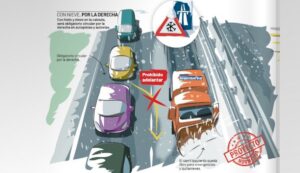
Snow and ice on motorways and dual carriageways can lead to a ban on overtaking.
The first change is about Overtaking During severe winter weather
The DGT announced its intention to amend article 31 of Spain’s General Traffic Regulations, to introduce new rules for driving on motorways or dual carriageways if snow or ice seriously affects the circulation.
Drivers will not be allowed to overtake in the left lane when certain weather conditions are present. In the event of a weather emergency, drivers will not be allowed to overtake in the left lane.
It is not a punitive act, but a practical one. In heavy snowfalls, vehicles can become stuck in multiple lanes due to overtaking maneuvers. This makes it impossible for snowplows and emergency services to access the road. Authorities aim to keep the left lane open so that maintenance vehicles can work efficiently.
This would not be an all-encompassing ban, but only a measure implemented during specific snow and ice events.
Credit: DGT
No more speed limit when passing stopped cyclists or cars
The second reform concerns overtaking stationary vehicles, cyclists and pedestrians on conventional roads.
At present, the law mandates that drivers maintain a safe distance and exercise caution. The upcoming changes will introduce a numerical requirement.
Overtaking is:
- Broken down vehicle
- A vehicle stopped in the road
- Cyclists
Drivers are required to:
- Reduce your speed at least by 20 km/h under the maximum road limit
- Maintain a minimum distance of 1.5 metres
Drivers would not be allowed to overtake a cyclist on a traditional road that has a limit of 90 km/h or an stopped vehicle at a speed higher than 70km/h.
To complete the maneuver, drivers can cross to the other lane when necessary.
This is a formalisation of what was until now largely guidance, and turns it into a enforceable obligation.
Why the DGT believes these changes are needed
Both measures, according to the DGT are intended to reduce risks in situations of predictable danger.
During winter storms, snow removal operations have been complicated by blocked lanes. In addition, it has been found that overtaking cyclists and stationary vehicles at high rates of speed is a factor in many serious road accidents.
The reforms are designed to ensure that vulnerable road users such as cyclists receive the same treatment as other situations involving high risk, like passing an stranded car.
The DGT views the changes as preventative rather than punitive.
What will happen in 2026?
The Ministry of the Interior, in coordination and cooperation with the DGT, is currently preparing the Royal Decree that will introduce the reforms.
The approval date has been pushed back to 2026. Once published, the Boletín Oficial del Estado The regulations will then become legally binding.
Immediately upon implementation, drivers will have to adapt their driving behaviour.
How these rules could change the way you drive
The reduction of overtaking speeds, in particular will have practical effects. The drivers of rural roads will be required to reduce their speed before passing, especially on roads with cyclists.
In some regions, the winter overtaking restriction could temporarily affect motorway traffic.
These changes are part of a wider trend by the DGT to tighten up the overtaking regulations, especially since the 20 km/h former overtaking margin will be removed in 2022.
What this means to drivers in Spain
If approved as announced, Spain’s 2026 reforms will introduce clearer – and stricter – overtaking obligations.
Expectations for drivers
- No overtaking on left lanes in severe snowfall
- Passing cyclists or stopped vehicles at a reduced speed of 20 km/h is mandatory
- Minimum 1.5-metre lateral distance enforcement
The measures are designed to improve Road SafetyThese are sure to generate discussion amongst regular road users.
As the Royal Decree nears its final stages of approval the DGT will be providing updates to motorists.