Costa News Spain Breaking News | English News in Spain.

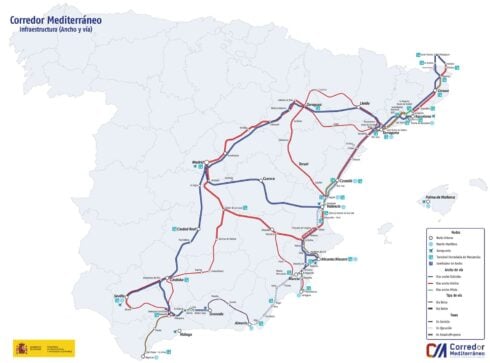
THE finished version of Spain’s €5 billion ‘Mediterranean Corridor’ rail network has finally been announced — but not to universal fanfare.
While some regions celebrate their newfound connection, there are some glaring errors that have already raised outrage.
Transport minister Oscar Puente, speaking in Valencia during the annual ‘Quiero Corredor’ event (responsible for creating a cringy video extolling the virtues of the train line), confirmed works are already underway across every region included in the new train map – while those left out languish.
He said the government had sped up construction in the past two years, ploughing in €2.6 billion since 2023 and forecasting a further €1.3 billion by the end of 2025.
In total, €5.4 billion has been splashed on the corridor since 2018 – much of it backed by EU funding – directed at linking Spain’s Mediterranean ports and cities with the rest of Europe.
READ MORE Spain accounts for 20% of the growth in GDP across the eurozone, while traditional powerhouses are stagnant
The winners
Murcia is one of the most likely beneficiaries of this much-hyped initiative. A large part of recent expenditures has been allocated to a new high speed line that connects it with Almeria.
A 200km stretch of track, backed by €3.6 billion in funding, is currently under construction, with work advancing between Murcia and Lorca and along the Vera to Almeria section.
One of the most significant milestones of the corridor will come in 2026, when Murcia’s El Carmen station opens as a through-station following a €600 million rebuild.
The change will remove a long-standing transport bottleneck and allow continuous high-speed services to run between Alicante and Valencia in the north and Lorca and Almeria in the south, forming – in some ways – a true Mediterranean train corridor.
READ MORE Spain’s housing crisis will continue for years because ‘house building is just not profitable’
The section of coast between Alicante and Valencia, Castellon and Tarragona has been upgraded and is nearing completion.
The new route will improve connections between the Valencian port, the Barcelona region and the French border.
These improvements, according to officials, will strengthen the larger Mediterranean arc. Eastern Spain is set to be the first region in the world to have a fully functional segment of the corridor as a result of the new planning.
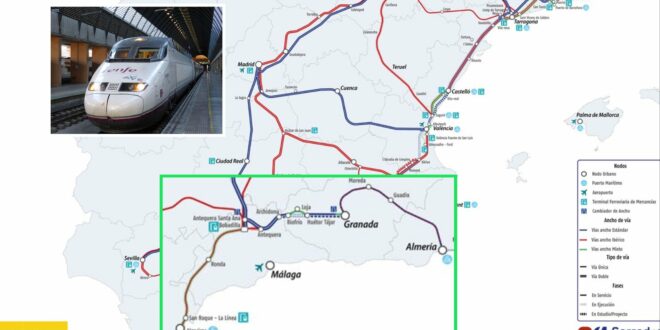
The government’s map also shows some notable gaps, which have left Andalucia and its coast regions puzzled.
READ MORE This is where house prices are actually FALLING in Spain – including two towns in rising expat hotspot
Omissions
For all the intricacy of the proposed map criss-crossing Spain with new high-speed train lines, Malaga does not feature at all, despite being a critical node and one of Spain’s busiest high-speed stations – not to mention the main transport hub for the Costa del Sol.
The Mediterranean Corridor does not cover the entire Andalucian coastline, which stretches 400km between Almeria and Algeciras. This is one of Spain’s most popular coastal regions.
READ MORE Why does the US send an unknown number B-52 heavy-bombers to Spain
It is also possible to skip major tourist and population centres like Marbella, Estepona Fuengirola Nerja as well as the entire Costa del Sol.
Motril and the nearby coastal towns are not planned to be connected with the Costa Tropical in Granada.
Even La Linea and Campo de Gibraltar – despite being situated next to Algeciras – one of Europe’s largest ports – will be left without a dedicated Mediterranean Corridor.

Other winners
On the other hand – and to little surprise for long-suffering Andalucians – Madrid and central regions of Spain will be richly served by a train network originally planned to benefit the Mediterranean regions.
In the current design, the long-distance cargo route that starts in Algeciras near the end of the corridor turns inland towards Madrid rather than following the coastline.
Trains departing from Algeciras or Almeria will be diverted into central Spain, before returning to the Mediterranean coast hundreds of kilometers further north.
It is necessary to pass through the city of Madrid for goods that are moving between Andalucia (including Valencia) and Catalonia, even if it is the most direct route.
READ MORE Spain has agreed to raise the maximum speed of trains between Madrid and Barcelona to 350km/h. This will reduce travel time to under two hours.
Spain’s Mediterranean region has strongly criticized this Madrid-centric layout, arguing that it no longer resembles what was originally promised.
Business groups in Andalucia Valencia and Catalonia accuse successive governments of designing the route around the traditional radial pattern, where the major infrastructure feeds directly into Madrid instead of connecting peripheral regions.
The campaigners claim that this approach is counterproductive to the goal of establishing a modern, fast coastal link between Algeciras and the ports of Malaga, Almeria Cartagena Valencia Barcelona.
Also, they warn that shipping freight through central Spain increases distance and fuel costs as well as time when compared to a route along the coast.

El Corredor Madrileño
Supporters say a coastal route could increase the amount of freight handled in Mediterranean ports from 10 to 15 percent and reduce traffic on the A7/AP7 highways.
Environmental groups have also questioned the decision to prioritize inland stretches. They point that sections of the interior will require extensive tunnelling – including through parts of Sierra Nevada – while a coastal route could make better use of existing corridors.
The debate is a product of many years of political history. Many critics have highlighted earlier decisions which weakened or delayed coastal option.
Critics claim the Aznar Government slowed the progress of Catalunya in early 2000s, to avoid strengthening the economic ties between Catalunya & Valencia due to fears that separatists could unite the two regions.
READ MORE Spain pledges additional €800 million in support for Ukraine as concern grows over Trump’s peace plan

They also mention the 2004–2005 Van Miert Report, which prioritised radial lines from Madrid after lobbying from Spain’s transport ministry, pushing the coastal corridor down the list.
Both the PP government and the PSOE are accused of maintaining a centralised approach despite the fact that the EU declared the Mediterranean Corridor a prior route in 2011.
Business leaders note that the pattern is still present today. They point out that the government has increased the pace of work on extensions linking Madrid to the south coast, while there’s no timetable nor funding plan for the latter.
The lack of progress between Algeciras & Almeria is becoming a hot topic, since one of Europe’s biggest ports still relies on a slow mountain route rather than a coastal link.
On social media, users have mocked the inland-heavy layout, describing the project as the ‘Corredor Madrileño’.
Campaigners warn that the corridor will never function as a true Mediterranean route unless the missing Algeciras–Malaga–Almeria section coastal stretch is finally built.
Only an appeal to Brussels, they claim, could force them to finish the southern section.
Travel News by The Olive Press.