Costa News Spain Breaking News | English News in Spain.

Rachel Gore
DOZENS of horses facing a one-way trip to the slaughterhouse are being thrown a lifeline – thanks to one expat’s last-minute offer to home them in her sanctuary.
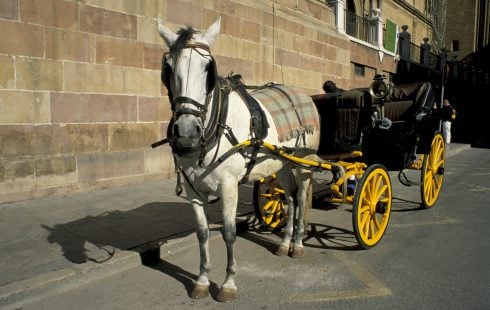
Malaga has banned the use of horse-drawn wagons, which means that more than 60 working horses are now in danger.
Expat Signe Frossle, who runs a rural rescue centre ‘A Better Life 4 Horses’ in Antequera, has stepped in to offer shelter to as many of these beasts of burden as possible.
The sanctuary owner told Olive Press many former licensees are scrambling for their horses to be offloaded to nearby towns, like Sevilla or Ronda, which still allow carriage tourism.
She fears these animals will ‘be sent further to other places and do exactly the same work they were doing all day long in the sun with the horse carriage’.
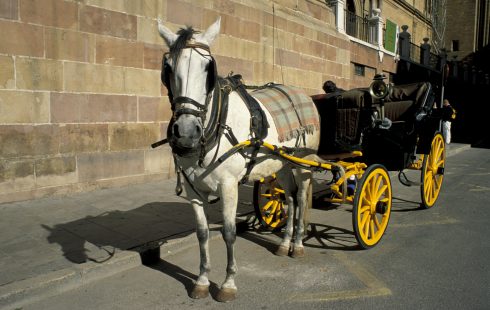
“‘If they do not sell the horses before a certain time, some of them will go to slaughter”, Frossle said.
“The slaughterhouses pay between €500 and €600 per horse, which is just more money for the license holders’.
Being sold to the slaughterhouse is the worst option, according to Frossle, as “it’s like saying, ‘your hard labour was worth nothing'” to the horses.
With time running out, Frossle is racing to save the animals from a grim and uncertain future ‘walking in the sun with tourists or being victims of the slaughterhouse.’
Frossle’s safe-have is located in Antequera just 40 minutes away from Malaga. It offers a contrast to the chaos of the city.
At her refuge, the horses ‘are treated like superstars’. Spread over 14 hectares, the sanctuary is already home to 34 rescued horses – and Frossle is prepared to take in up to 15 more.
The horses live in pairs, each with their own allocated paddock, and are free to roam the site’s ‘two enormous fields’, and ‘olive grove’. Shelters are available to protect from rain or sun, even in the open spaces.
Veterinarians are on site at all times to check the horses and evaluate them.
The professionals will determine if an animal is ready for adoption, or requires longer-term care because of injuries, trauma or illness.
The ‘traumatised’ or particularly unwell horses remain at the refuge where they receive lifelong care.
Frossle is working to find new homes for horses that have been recuperated in the refuge.
The Danishwoman insists the animals are never for sale. They are instead passed on to adoptive parents who are thoroughly screened.
These horses cannot be ridden, so they are only adopted for companionship. Riding schools are avoided even for horses that can be ridden and used for jumping.
As of yet, horses from the sanctuary have been permanently adopted in Denmark and Germany.
Frossle wants desperately to offer these services for the animals that are affected by Malaga’s ban on horse-drawn tourists carriages. It wishes the suspension of the carriages included a requirement to “sell the horses in a safe way”.
After moving from Denmark to Spain, she began her journey of horse rescue.
She said: ‘I saw a horse that was ill treated and I bought it myself. In a few months, I bought five horses in this manner. I thought ‘this is bigger than me.
As she took in more and animals, and when the number reached 17, she began to search for volunteers.
She registered the center in Spain and Denmark to gain money from both countries.
The next step for Frossle and ‘A Better Life 4 Horses’ would be to secure the right ‘destiny’ for the horses from Malaga’s tourist carriages.
To support her, you can donate on ‘A Better Life 4 Horses’ website
For a blind horse, Frossle has put bells in the paddock so ‘she can hear where in the paddock she is depending on the wind’.
Volunteers ‘work daily’ with the animals and for many this is transformative. One rescued horse, too weak to stand on arrival, was initially moved with a tractor – but within days, she was strong enough to walk unassisted.
The animals ‘can go under the roof’ whenever they want; the land at Frossle’s sanctuary is the horses’ space.
Each horse is ‘fed every day with hay, given ad libitum’ along with vitamin supplements. Some horses receive cooked meals that are specially prepared, depending on their requirements.
‘Some are happy to just get their hay and vitamins’, she explains, while others require ‘cooked food’ as well.
The Olive Press is a great source for Andalucia News.