Costa News Spain Breaking News | English News in Spain.

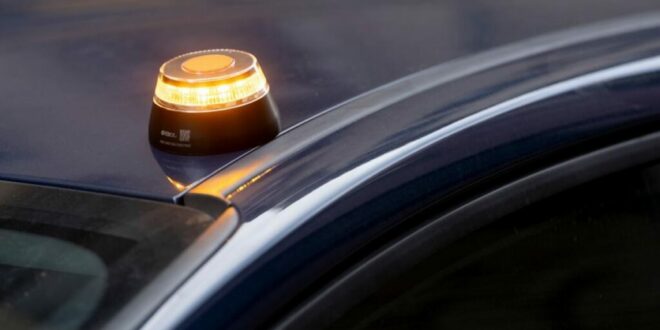
Spain’s V16 beacon installed on a car during roadside tests.
Credit : X – Ministerio del Interior
@interiorgob
Spain’s plan was to replace old roadside warning triangulars with new V16 emergency beacons. Instead, it has turned into one of the most talked-about changes in road safety – and one that has left many drivers confused, frustrated and uneasy.
Spain will be one of the few countries in the European Union that will ban triangles completely from January 1, 2026. The purpose is simple: to enable motorists to alert other road-users of a breakdown while remaining in their vehicles, thus reducing the risks of accidents.
The rollout was anything but smooth.
The drivers aren’t convinced that it’s safer
Most people are concerned about whether the beacon will be seen on time.
Drivers have posted videos on social media showing how the flashing light can be difficult to see, especially in tight turns, on hills or when there is poor lighting. Some people have claimed that their hazard light is brighter and more visible than the V16 beacon, which raises doubts as to whether this device really boosts safety.
Also, reliability has been questioned. Unlike triangles, the beacon needs batteries or internal charging to function – and many motorists worry about discovering too late that a rarely used device no longer works when they need it most.
Next, there is the data issue. V16 connected beacons transmit the location of a vehicle as soon as they are activated, as they link directly to DGT 3.0 traffic platform. Traffic authorities claim the system only helps to improve emergency response times and detect incidents more quickly. However, some drivers are still unsure about who has access to this information and where it goes. This has led to online speculation and a lack of public trust.
DGT re-emphasises that it will not rush to fine drivers
Amid mounting criticism, Spain’s Dirección General de Tráfico (DGT) has decided to ease the tension surrounding the launch.
Traffic authorities have confirmed that enforcement of the beacons will be gradual. Officers will use a “flexible approach” and place a priority on information rather than punishment for the first six months.
That means drivers won’t immediately face the standard €80 fine if they are caught without the beacon. Instead of penalizing drivers immediately, the focus is on providing guidance and helping them to understand the new regulations.
DGT Director Pere Navarro made the announcement at the VIII Meeting of Cities for Road Safety and Sustainable Mobility. He acknowledged that drivers needed time to adjust to such a significant change.
Navarro defended reforms, pointing out the V16 move was announced over five years ago. He said the new system is a step in making Spain a leader for European standards of road safety.
Consumer group warns of possible ‘fraud’
Another issue has emerged as confusion grows.
Consumer watchdog Leans into the chaos FACUA – Consumers in Action DGT is accused by a group of allowing “massive frauds” to occur on the V16 market. The organisation says that some beacons being sold as officially approved are not actually authorised for use from January 2026, despite claims on packaging and advertisements — sometimes even using the DGT logo.
FACUA’s general secretary, Rubén Sánchez, has criticised the traffic authority for what he describes as “passivity”, arguing that it should act to stop misleading sales rather than simply pointing consumers to its website for information.
DGT’s response was to stress that it has never supported non-connected device sales, but that in 2021 a Supreme Court decision allowed manufacturers the option of continuing to sell these devices for temporary use up until the deadline 2026.
To ensure their safety, drivers are urged to conduct a check on the official DGT websiteThe updated list of beacon models is published. Over 200 devices have been approved to meet future legal requirements.
Vox asks for suspension of V16 Rule in Parliamentary Challenge
The controversy now extends beyond Spain’s roads to the political arena. The controversy has now moved beyond the roads and into Spain’s political arena. Vox parliamentary group has formally asked Congress to suspend the mandatory introduction of the V16 beaconIn their view, the rule does not have a clear technical basis and is an unnecessary financial burden for families who already struggle with rising costs of living.
Party spokesperson Pepa Millán presented a non-binding motion (PNL) , describing the V16 requirement as “an imposition by the Government” that would apply only to vehicles registered in Spain, while the rest of Europe sticks with traditional safety triangles. Vox says that the timing of this move could not be worse.
Vox also raised concerns about the effectiveness of the beacon from a safety perspective. Millán argued that the effectiveness of the device has not been convincingly proven through independent research, real-world testing, or expert reports.
In its motion, Vox is calling for the beacon mandate to be suspended until independent and conclusive technical and forensic studies demonstrate that the device works reliably under real driving conditions, including low visibility, extreme weather and heavy traffic — the very environments where breakdown accidents are most likely to occur.
The party has also demanded that drivers should continue to be allowed to use the traditional warning triangles, stating that road safety rules should not push motorists towards staying inside their vehicles during emergencies — something they say is explicitly discouraged by existing road-safety risk prevention protocols.
As of now, there is one certainty: the V16 will soon be on the road, while triangles have been phased out. Drivers still have many questions. With enforcement starting softly but regulations firmly in place, the months ahead will likely see continued debate – and plenty of motorists double-checking whether the beacon they’ve bought is actually the right one.