Costa News Spain Breaking News | English News in Spain.

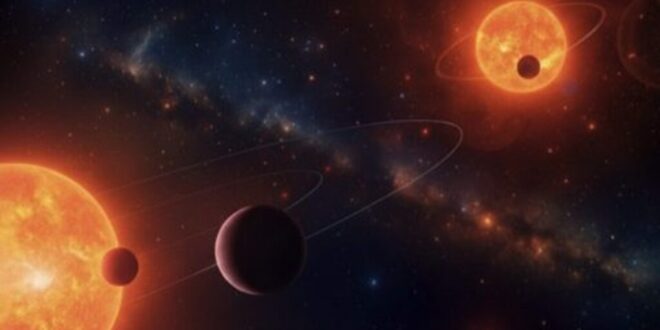
Toi-2267 as a visual representation. Credit: Mario Sucerquia / Univ. Grenoble Alpes.
Astronomy might never be the exact same. A team of astrophysicists in Andalucía has identified something that, until recently, many thought simply could not exist: three Earth-sized planets orbiting not one, but two stars at the same time.
The findings, published in the Journal Astronomy & AstrophysicsIt is being described as an important breakthrough in our understanding of the formation of worlds.
For decades, binary star systems – where two suns orbit each other – were viewed as too chaotic for planets to develop. It was thought that the gravitational tug of war between two stars would disrupt stable orbits, which are necessary for planets. The short answer is that if there were a solarsystem, it was likely to have a lot of planets. Two SunsIt was not supposed to have planets similar to ours.
Nature has rewritten all the rules.
A Solar system that shouldn’t exist – but does
The system in question has been named TOI-2267It is located approximately 190 light years away. At its centre are two small, cool stars – roughly classified as M-type dwarfs – orbiting extremely close together. The distance between these two stars is eight times less than the distance between Earth and the Sun.
Three planets of similar size to Earth orbit these two suns. They follow short, tight orbits, which means their “years”, are much shorter.
Francisco J. Pozuelos, one of the study’s co-leads at the Institute of Astrophysics of Andalucía (IAA-CSIC), describes TOI-2267 as “the most compact and cold binary system known to host Earth-sized planets.” The planets passed directly in front both stars. This was a rare opportunity for scientists to confirm that they orbited the two stars.
TOI-2267 stands out for its uniqueness in the universe.
The discovery also challenges the notions of many planetary scientists. If planets can form in the gravitational chaos of a binary system this tight, then the range of environments where planets – and possibly life – could exist is suddenly much wider than expected.
Andalusian Science
Part of what’s making this discovery resonate is that it’s not just scientifically impressive – it’s also a home-grown achievement for Andalucía.
The IAA CSIC developed a number of technologies, including a tool called SHERLOCK. Search through data in NASA’s TESS satellite SHERLOCK, which monitors thousands stars for signs that planets are orbiting them, was crucial in spotting the two planets ahead of any other team. The early detection allowed the researchers to confirm the system more than one year earlier.
From there, the team carried out follow-up observations using the Sierra Nevada Observatory and telescopes belonging to the SPECULOOS and TRAPPIST networks – international projects coordinated in part by the University of Liège.
Sebastián Zúñiga-Fernández, another co-author working with the team, notes that TOI-2267 now serves as “a natural testing ground for pushing the limits of planetary formation models.” The system enables researchers to ask questions previously unanswered.
In the coming years, scientists plan to use more advanced tools – including the James Webb Space Telescope – to examine the planets’ atmospheres, densities and compositions. If any of these planets is found to have liquid water and other conditions conducive to life, the conversation will shift from “possible universes” to possible worlds.
New possibilities open up when a door opens
The emotional impact of this discovery is in what it implies: that the universe might be more adaptable and innovative than we thought.
Astronomers have assumed for years that planets with life need calm, stable solar systems. TOI-2267 questions this. Even in extreme environments, it shows that planets can survive and form even if we think they are too extreme.
This discovery is not proof that life exists anywhere else. It does, however, expand the map as to where life is located. You can also find out more about the following: be.
Expanding the map in astronomy is essential.