Costa News Spain Breaking News | English News in Spain.

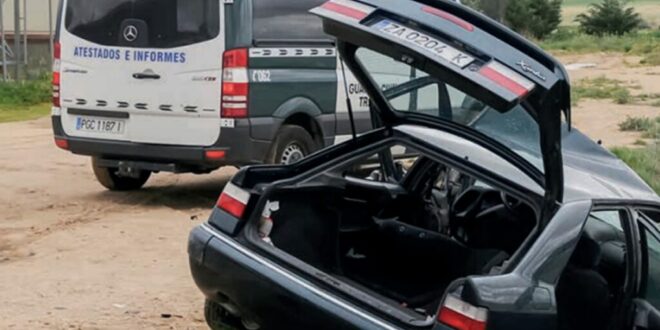
A rural Spanish road is closed down after a driver loses his control.
Credit: Revista.dgt.es
Spain’s Traffic Authority has released its latest traffic statistics, as we have mentioned in previous articles. latest magazine – and one of the most striking sections focuses on a type of crash that often happens when there’s no one else around.
No collision. No other vehicle involved. Just a driver, a road… and a sudden loss of control.
According to DGT’s latest data In 2025 there will be 482 deaths. in these incidents alone – more than all collisions combined. Many drivers don’t understand the reasons for these accidents, despite their frequency.
Accidents where the drivers are all alone
These are known as run-off-road crashes – when a vehicle leaves the road unexpectedly.
The fact that they are usually involving only one car is alarming. Around nine out of every ten crashes occur with no other drivers present.
That’s why experts often describe them as ‘solitary accidents’.
Many times, the driver does not even attempt to correct his situation. No braking, no steering adjustment – nothing.
What causes someone to lose their control?
What and when do these crashes most commonly occur?
DGT’s most recent figures paint a picture that is clear.
Most of these crashes happen on conventional roads – the kind many people use every day – rather than on motorways. Most of the accidents occur on curves, then straight roads.
They’re also more common during the day, but the risk increases significantly at night, especially between 2am and 5am – when fatigue tends to peak and visibility drops.
The statistics show that men make up the majority of the drivers involved in accidents, while middle-aged motorists are the most common.
Drivers lose control of their vehicles without warning
There isn’t just one explanation – but some factors come up again and again.
Around three of every four fatal accidents of this kind are caused by distraction and excessive speed. Add alcohol into the mix, and the risk increases even more – with around four in ten drivers involved testing positive.
Researchers are still working to understand another possibility.
Many experts think that sudden blackouts caused by health problems or extreme exhaustion may be the reason why so many drivers don’t react to situations before driving off. They may not even be aware of what is happening until it is too late.
Why the outcomes are often so severe
The problem is not just leaving the road.
The next step is what makes these accidents so deadly.
Without barriers, a vehicle can hit a slope, a ditch, or a fixed obstacle – or even roll over. When this happens, the severity and number of injuries increase dramatically.
Experts believe that the road environment has a major role to play. Uneven roads, curves poorly signposted, changes in elevation and a lack lighting make it more difficult to recover control when something goes wrong.
And something as simple as wearing a seatbelt can make a life-saving difference – especially in rollover scenarios.
Straight roads vs curves: two different risks
It is interesting to note that the cause of the accident often depends on the road type.
These crashes on straight sections are often caused by distraction or driving while asleep. The road feels easy, attention drops — and that’s when control is lost.
Speed becomes the key to success on curves. You have very little space to recover if you are too fast and misjudge the curve.
What Spanish drivers should learn from this
It’s important to know that most crashes do not begin with a dramatic event.
They begin with a moment – a lapse in attention, a bit of fatigue, a slight misjudgement.
The situation can escalate quickly once the vehicle has left the road.
It’s important to stay alert when driving, regardless of whether you’re traveling long distances or only using secondary roads. You should take breaks as needed, slow down around curves and avoid distractions.
Because as the DGT’s latest figures show, some of the most dangerous accidents aren’t caused by others – they happen when drivers lose control completely, and don’t get the chance to recover.