Costa News Spain Breaking News | English News in Spain.

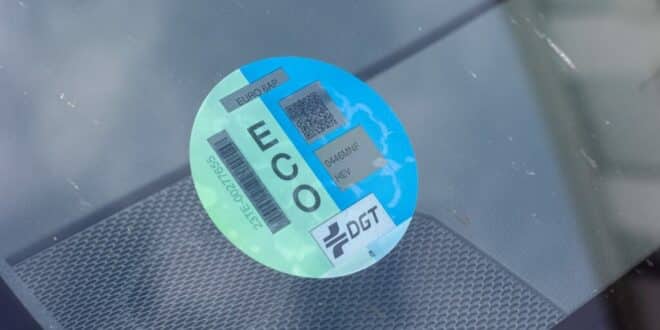
DGT V-25 Environmental Badge determines which cars are allowed to enter Spain’s Low-Emission Zones.
Credit : Azulblue, Shutterstock
It’s small, round and easy to ignore – but in many Spanish cities, that coloured sticker on your windscreen can decide whether you drive straight in or get turned away. The V-25 environment badge, issued by Spain’s traffic authority.DGTThe Low Emission Zones are now at the heart of how they operate throughout the country.
In Spain, the Climate Change Law requires cities with over 50,000 residents to introduce a climate change plan. Low Emission Zones (ZBE) restricts the most polluting cars. While some municipalities are still dragging their feet, others have been enforcing restrictions for years – and they base those decisions on the V-25 classification.
You’re not the only one who is unsure of what an sticker means.
What is the V-25 sticker?
V-25 is just the official DGT environment label. The V-25 is displayed in the lower right corner of the windscreen. It categorizes vehicles according to their emissions, fuel types and European standards.
There are four main labels.
Zero Emissions (blue).
In this category, you will find fully electric cars as well as plug-in-hybrids with a minimum range of 40km and range-extended electric cars.
ECO (blue & Green)
It includes plug-in and non-plug hybrids as well as vehicles powered by autogas or LPG.
C (green).
Diesel cars and petrol cars manufactured after September 2015 are eligible, provided they meet the Euro emission standards.
B (yellow).
This group typically includes petrol and diesel vehicles older than 2001, or those manufactured after 2006.
If your vehicle doesn’t qualify for any of these, it’s considered “sin etiqueta” – no label – and that’s where restrictions start to bite.
Why the small sticker has become more important now than ever
In cities with Low Emission Zones, cars without badges are frequently banned from central areas. Even B-category cars can be restricted during periods of high pollution.
The system’s idea is simple: promote cleaner vehicles, and phase out those that are most polluting from urban areas. The enforcement of the policy is increasing, whether you agree or disagree with it.
For drivers – especially expats who may not be familiar with Spain’s system – checking your environmental classification is essential before heading into city centres.
Is it possible to upgrade your vehicle and get an ECO sticker on it?
Yes, in certain cases. The legal system recognises one option. DGT Converting a petrol car to run on LPG is called converting.
The conversion can only be done in a certified workshop with kits approved. In most cases, the spare tire space is used to install the LPG tank and other components, such as sensors and injectors, are installed. The process usually takes between one and two days.
The vehicle must then pass an ITV test to be able to legally modify it. If the car qualifies, it can receive the ECO Label, which means fewer restrictions for Low Emission Zones.
For some drivers, it’s a way to extend their access to the city centre and reduce operating costs.
The sticker that will change the way you travel around Spain
What was once a simple classification scheme has become the gatekeeper of urban driving.
As more cities activate or tighten their Low Emission Zones, the V-25 badge isn’t just a piece of coloured plastic – it can determine where you’re allowed to drive, park and circulate freely.
You might want to check your windscreen just before you make your next trip to a Spanish city center. This small sticker may be more important than you realize.