Costa News Spain Breaking News | English News in Spain.

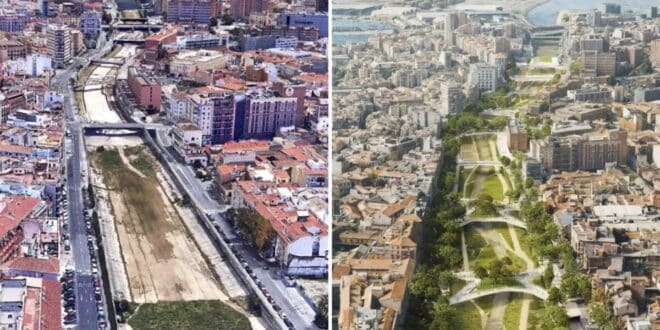
Before and after pictures of the Guadalmedina in Malaga.
Credit: Ayuntamiento de Málaga.
The city of Malaga has begun a major urban transformation to reconnect the city that was divided for many years by the Guadalmedina river. The council has expanded its ambitious integration projectThe proposal is to build two underground tunnels linking the Port of Malaga and the northern district of Ciudad Jardin.
Estimated at €300 million, this immense project hopes to remove heavy traffic from the the streets of the city, and reclaim the riverbanks for public use.
Malaga’s logistics revolution
The decision to extend tunnels comes after the Malaga Port Authority has been pleading for years to improve infrastructure. This is especially important to heavy goods vehicles that need to enter and exit the Port. The port needs a dedicated lane for lorries to avoid having to compete with cars, cyclists, and tourist buses for space on the road. The city can solve a logistical bottleneck by moving the freight vehicles underground while also reducing the noise in the city center.
But the project’s scale is enormous and it comes with many technical challenges. The integration of heavy freight requires larger tunnel sections, as well as a sophisticated ventilation system that runs across the tunnel. Demolishing and rebuilding old tunnel sections between Aurora and Esperanza to meet modern safety standards is also part of the project.
Green corridors, “bridge-plazas”, and more
The project, which is not just about infrastructure, is also a huge environmental undertaking. The project aims to create an integrated green corridor that covers over 76,000 square meters.
Features to be included:
- X-Shaped Bridge-Plazas: Five innovative diagonal bridges will connect neighbourhoods like La Goleta and Santo Domingo, creating 12,300 m² of new public space for playgrounds and leisure.
- Linear River Park: The park is 1,400 metres long and features native vegetation, lawns and “acequias”, or water channels.
- Pedestrian Boulevards By burying the current roads at Avenida de la Rosaleda and Avenida de Fátima, the surface will be transformed into lush, walkable boulevards.
Timeline
Malaga Council recently extended its planning contract with the firm Esteyco. The final blueprint will be ready by May 2026. Although the project is complicated, it will mark Malaga’s largest step in transforming Guadalmedina’s concrete barrier into a city’s “green center.”
Malaga has become a model of modern Mediterranean urbanism by prioritizing pedestrians and logistics.