Costa News Spain Breaking News | English News in Spain.

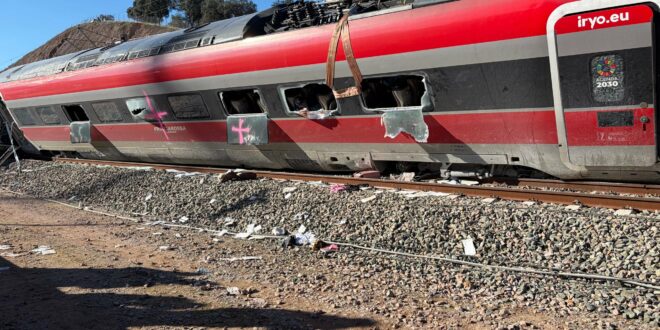
Residents and expats are being warned across Spain that the country’s once proud rail network is suffering from a serious decline of safety, services and basic passenger treatment.
A senior railway engineer has made a stark assessment following two recent train accidents and months of widespread disruption.
Antonio Martin Carrillo was a former ADIF executive as well as a representative for the European Railway Association. El Mundo Regular travellers have been able to see the degradation for some time.
READ MORE BREAKING: A train crash near Barcelona has injured at least 20 people, including the driver.
He says that passengers are routinely left stranded or delayed, or trapped inside trains without any information or assistance.
“In the last few months, we were treated like cattle at the stations. We were locked in without seats, and given no consideration,” wrote he.
Carrillo said that travelers have endured long delays, missed connections, and even been trapped inside stopped train in remote areas.
READ MORE WATCH: Sniffer dogs comb inside the wrecks from the Cordoba train disaster – as three more bodies are recovered
He describes trains that are halted on open country, with the doors closed, without air or light, and no explanation as to what went wrong or how long they will wait.
“Are there any rescue trains left to help the people?” He asks.
The engineer claims that authorities frequently blame engineering or technical faults and rarely offer solutions focused on passenger’s needs.
He has also criticised the lack of accountability and empathy he perceives in those who run the rail network.
READ MORE Cordoba train disaster: Search for missing woman Miriam Alberico, 27, ends in tragedy – family-of-four and journalist-photographer couple also among the casualties
Carrillo questions the political appointments at Renfe, Spain’s state-owned railway operator. He also asks why Koldo Garcia Izaguirre holds a role as a consultant in one of their companies.
‘Koldo’ is a former adviser to ex-Transport Minister Jose Luis Abalos and a key figure in a major corruption investigation involving alleged kickbacks, influence-peddling and irregular public contracts during the COVID-19 pandemic.
He has been accused of using his connections in politics to gain positions and benefits for those who are associated with state-linked firms, including those connected to the railway sector.
Commentary comes amid national shock after two serious rail incidents including the deadly accident in Adamuz and Cordoba earlier this Week, as well as the derailment of Barcelona.
READ MORE Spain train disaster death count rises to 40 after body found in damaged carriage
A high-speed Iryo derailment in Adamuz is suspected to be due to a failure of a section of track that was welded near newly upgraded points.
The rear carriages of the train then obstructed the adjacent track.
Only 20 seconds after the collision, a train from Alvia travelling in opposite directions collided at high speed.
Pablo Barrio and other members of the Alvia family, as well as the driver of the Alvia, were among the 40 victims.
Carrillo is convinced that neither driver could’ve prevented the accident.
He wrote, “The price of a weld is the lives that were lost.”
READ MORE Call for immediate blood donation by residents of Malaga Province after Cordoba Train Disaster
He compares it to the Angrois crash of 2013 in Santiago de Compostela (Galicia), which resulted in the deaths of 79 people, and revealed serious flaws in Spain’s rail safety system.
Initially, the accident was blamed on both human error as well as inadequate safety measures.
Carrillo is worried that Spain will once again be faced with a series of technical and organizational failures.
He claims that the official investigation of the Commission for the Investigation of Railway Accidents (CIR) will ultimately determine the cause.
But he insists at this stage, it is not possible to rule out any possibility.
READ MORE: Three days of national mourning declared in Spain as Pedro Sanchez promises ‘transparent’ probe into train disaster with at least 39 deaths
The warnings are likely to be a shock for many foreigners.
Expats in Spain use the rail network for long distance travel, airport connections, and regional commuting.
In recent months, Andalucia and Catalonia have experienced repeated delays, cancellations, and infrastructure problems.
Overcrowded platforms, timetable changes made at the last minute and late trains have been reported by passengers.
Carrillo says that the contrast between Spain’s first high speed AVE line, which ran from Madrid to Seville in 1992 and its current version is painful.
READ MORE Spain’s rail safety under scrutiny after Cordoba crash – as passengers report worrying vibrations on high-speed trains ‘for over a year’
He wrote: “Those of us that built the first AVE in enthusiasm and with pride can’t believe the level degradation we now see.”
According to him, it is not only a technical decline but also a moral one.
He believes rail users should be provided with transparency, adequate assistance and a service that puts the human life ahead of commercial or political interests.
Carrillo says he does not know what has happened to Spain’s train system.
“I’m not sure what to say,” concludes the man.
Many passengers are asking the same question.
Click here to read the latest Spain News at The Olive Press.