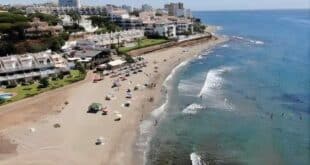
Costa News Spain Breaking News | English News in Spain.

By Norbert Suchanek
Two US military aircraft collided by accident in the sky over Andalucia on 17 January 1966 at the height the Cold War.
One of these bombers, the B-52, was carrying four nukes.
Three of the bombs fell to the ground as flaming debris from the sky fell near the village Palomares northwest of Almeria.
The impact caused two hydrogen bombs’ triggers to detonate. The nuclear material in the warheads was not ignited, but plutonium & uranium were spread into the soil & air.
The third bomb that exploded in the sea near Almeria was not recovered until 80 days after it sank.
This was one of worst nuclear accidents of the Cold War period.
READ MORE The Night Manager’s Spanish locations revealed
Jose Herrera Plaza from Andalucia was just a small child when the accident occurred. But the accident left a lasting mark on him.
Herrera Plaza is a film maker who has been studying the history and disaster of Palomares in Mexico since 1986. She has authored several books, as well as directed a documentary.
Norbert Suchanek interviews Herrera Plaza, 60 years after two planes crashed in Palomares.
What were you doing in January 1966 when the hydrogen bombs began to fall from the sky
I had just started school in Almería, about 90 kilometres from Palomares. I was unaware that the hydrogen bombs were being launched over my head, like most of Andalucia.
When and for what reason did you start researching the Palomares incident and make it your main research focus?
On 13 January 1986, I met with residents from Palomares. Three days before the 20th Anniversary of the accident and the expiration date for their health claims, I attended a meeting with residents in Palomares. I wanted to create a documentary on this little-known, almost unbelievable story. However, at that time all documentary film sources were classified. After 21 years of collecting all the documents I could find, I finally completed “Operation Broken Arrow – The Palomares Nuclear Accident”.
What does ‘Operation Broken Arrow’ mean?
‘Broken Arrow’ is a US military code word. This code word refers to an accident involving nuclear weapons. Examples include an unintentional or accidental nuclear explosion or the theft or loss of nuclear bombs.
How did local authorities respond? Did they know about the threat of plutonium?
Initial, the local authorities followed the protocol of an aviation accident. It was only several days after the incident that they realized nuclear weapons had been used and a vast area of land had been contaminated.
READ MORE MICHAEL COY explains how the lives of two Spanish princesses 500 years apart didn’t go to plan – thanks to their choice of husbands
How and when did Madrid’s government react?
Spanish authorities became aware of the crash almost instantly, thanks to an alert sent by a Spanish Navy helicopter through emergency channels. Later that day, the US ambassador revealed that the plane had four hydrogen bombs. Both governments were silent, but three days later the media broke the story.
How did the media manage to report so quickly on this during the Franco dictatorship
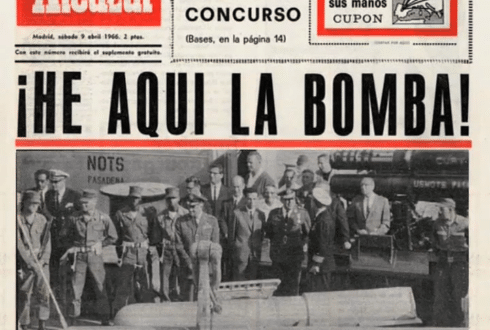
Andre del Amo (Spanish-American journalist) from United Press International arrived at Palomares just two days after an accident. He revealed that accidents involving nuclear weapons were being measured with Geiger counters. His report appeared the next day in major international media outlets. The dictatorship responded in the usual manner: confiscating newspapers at newsstands, and in airports in Madrid or Barcelona when international flights arrived.
Anyway, residents of Palomares and the rest of Spain learned the truth because, to circumvent strict censorship, it was common practice to listen to Spanish-language shortwave broadcasts from Radio Paris, the BBC, and especially Radio España Independiente ‘La Pirenaica,’ the Communist Party of Spain’s station broadcasting from Bucharest, Romania.
What are the direct effects of the broken hydrogen bombs? Was there any risk of a nuclear explosion?
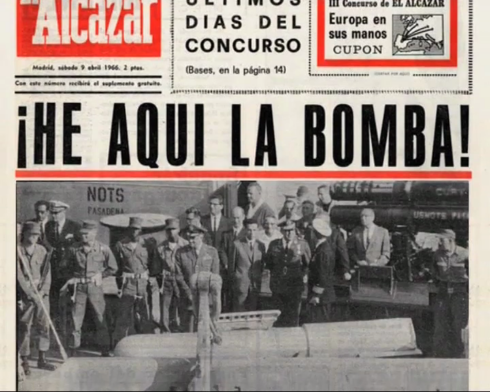
The Mk-28 FI had 68x the explosive power as the atomic bomb used to destroy Hiroshima. The hydrogen bombs in Palomares exploded when the conventional explosive in their triggers detonated. The result was that an area of approximately 635 hectares had been contaminated with fissile matter: around 10 kilogrammes plutonium-239, and -241, as well as slightly more than 10 kg of uranium-238 and -238.
Although the risk of an accident nuclear detonation is very low, there was still a possibility. These hydrogen bombs were among the most technologically advanced in the US arsenal at the time, and their safety systems were generally effective – except for the conventional explosive, which was sensitive to shock and vibration. After this accident in Thule and a second similar incident two year later in Greenland, US military decided to replace the conventional explosive with one that was shock and fire resistant.
Has the local community been warned of the dangers of eating potentially contaminated foods, like tomatoes?
Palomares residents were continually – and perversely – misinformed, both during the Franco dictatorship and later under democracy, for nearly fifty years.
The Duchess Medina Sidonia was one of the most prominent members of the Spanish Nobility. She informed the locals of their situation and rights. She was imprisoned by the Franco dictatorship for her actions.
Do you have any data or estimations on the number of people who became sick or died from plutonium contamination or uranium?
No, since a rigorous study of epidemiology has never even been allowed. Independent researchers who have tried to conduct such studies have faced constant obstacles. The official narrative of both governments insists that plutonium never causes any tumour disease.
Palomares, a zone of environmental sacrifice with serious health risks to its residents. It is not the only case: invisible minorities around the globe continue to suffer from invisible consequences.
Did the ‘nuclear accident’ affect the region’s emerging tourism industry?
Tourists visited other parts in Spain but not Almeria. Almeria province was poor, isolated and had poor transport links. The dictatorship, however, feared that tabloid coverage in the British and Italian press, as well as in British newspapers, could have a negative impact on tourism in other parts of Spain.
The most sensational headlines were from an Australian newspaper owned by Rupert Murdoch when he was a teenager. The newspaper claimed that there had been a nuclear explosion, thousands of people fled, and the entire Spanish Mediterranean coastline was contaminated. The Spanish Minister of Information, along with the U.S. Ambassador in Palomares, took part in a highly publicized swim on the beach.
The US military performed a massive cleanup and search operation. What was the reaction of the locals?
The search for the missing bomb was the main goal of the massive military operation. The sea and land searches lasted 80 days.
Second priority was the recovery of classified components and the black box from the B-52. These included radios and documents related to combat. Third, more than 125 tonnes of wreckage was collected from the tanker and bomber. It was then dumped into the Mediterranean near Palomares. Finaly, there was only a symbol decontamination, which was mainly done to appeal to the public.
Some local residents may have suffered from a post-traumatic anxiety disorder. Then, a collective paranoia developed, which was exacerbated by the contradictory claims of both governments. The population entered the atomic era, trying to grasp a new term in their vocabulary.
READ MORE ON THIS DAY: Dali, Buñuel – and Dani Carvajal? This weekend in January, three Spanish geniuses had ties to each other
Was it possible for the military to remove all of the plutonium in the area?
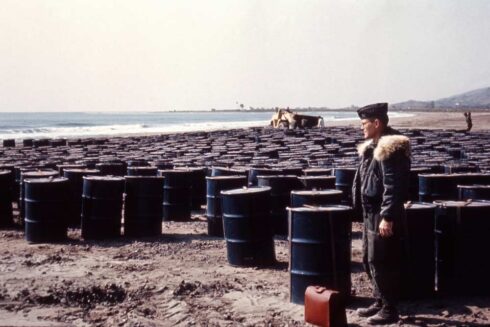
They removed only what they wanted. After many years of unequal negotiations, the Franco dictatorship and the hegemonic powers reached an agreement to decontaminate and return the plutonium back to its original country. In reality, only 650 cu m of soil and 350 cu m of crops contaminated with plutonium were removed.
This amounted to less than one percent of the plutonium – less than 100 grams – which was shipped to the US in 4,810 barrels. Most of the radioactive material was not removed. The rest of the contaminated land was then ploughed in order to bury plutonium approximately 30 centimetres into agricultural fields. Fourty years after the war, two secret pits with 4,000 cubic meters radioactive waste were discovered.
What happened to the contaminated materials in the United States
Two barrels went to Los Alamos National Laboratory, for experiments on plants. The remaining 4,808 were sent to the Savannah River Site, a US Atomic Energy Commission facility in Aiken (South Carolina), and buried 6 meters below ground. This gesture was widely reported.
Meanwhile, 99% of the plutonium and uranium remaining in Palomares was concealed from public view – especially from the residents and farmers working those radioactive lands.
The US Air Force, along with the Spanish government, assured the Spanish that the area was completely decontaminated and did not pose any danger. In parallel, the US Atomic Energy Commission (AEC) and Spain’s Junta de Energia Nuclear used the situation to run a secret human research program. They wanted to know how people would react to the inhaled plutonium aerosols. This programme, codenamed ‘Project Indalo,’ was carried out without the informed consent of the local population.
What is the present situation in Palomares, Spain? Do you still have radioactive and contaminated sites?
Despite assurances made by Spain and the United States in 1966, plowing contaminated soil produced radioactive aerosols. Residents of Palomares have been exposed to radionuclides for forty years. In 2006, the first radiation-protection measures were introduced, which restricted access to 40 hectares of agricultural land, as well as transit and use.
Now, in 2026 – 60 years later – the area still awaits full decontamination by the central government in Madrid. The area has never been given priority despite the fact that over 210 residents had internal lung contamination symptoms. Unknown is the true number of people affected. The political elites in Madrid are located 525 km away.
Why did the B-52 fly over southern Spain carrying atomic bombs?
As of January 18, 1961, the Operation Chrome Dome sent four to six strategic air bombers over Spain on a daily basis, both on their way out and on their return. During the Cuban Missile Crisis 42 bombers equipped for massive destruction flew every day. The B-52s took off from the US East Coast and crossed Spanish airspace before approaching southern Italy. They then returned via Spain. Each B-52 carried four nuclear bombs.
Over the spanish territory, 17,000 aircraft refueled 26 000 times in five years. Other European countries did not allow such dangerous maneuvers. Nearly 35,000 hydrogen bombs flew over Spanish territory. Probability was stretched to the limit, resulting in accidents like those at Palomares, and then at Thule (Greenland).
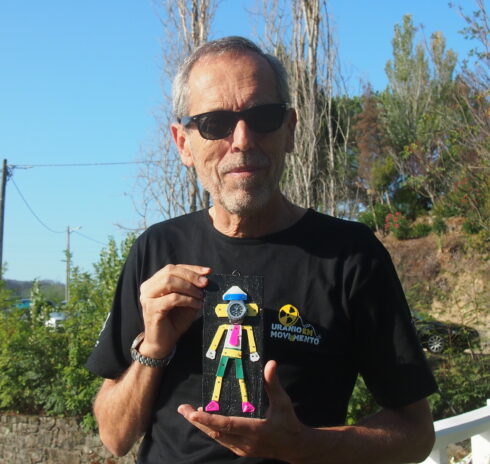
What are your plans to commemorate the 60th anniversary Palomares Disaster?
I am planning a photo exhibition and a panel discussion at the Villaespesa Library in Almeria titled “Palomares – 60 Years of Government Failure.” My new book, “The Year of the Bombs – Stories from Palomares” will be launched at the end of the month. The book brings together the testimonies of 27 Spaniards, as well as Americans, who were unwittingly involved in this accident. The book is written as a documentary narrative, similar to Chernobyl Voices Svetlana Alexanderevich to whom it pays homage.
Palomares is not to be forgotten. Palomares’ story is not yet over. It’s still being written.
Thank you.
The Olive Press has more La Cultura News. Click here to read it.