Costa News Spain Breaking News | English News in Spain.


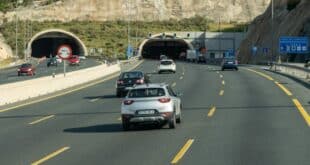
Black lines like these are common on Spanish roads—crack repairs that can be surprisingly slippery, especially when wet.
Credit : Girlgirl, Shutterstock
Have you ever been on an autoroute in Spain, perhaps on a road trip during the summer or on your daily commute, when strange black lines began to squirm across the road. Perhaps they snake or form tiny webs. On first glance, they might look like road graffiti or a spillage from a dodgy truck. But no—these lines are there for a reason, and they’re actually a big clue about what’s happening under your wheels.
We’re all busy, and we barely notice anything except the traffic lights or the satnav. However, the next time these lines appear, you should give them another look. These black lines are actually the result of an extremely practical and cost-saving solution to a costly problem: Spain’s road are literally crumbling.
Why are there so many black lines on Spanish roads?
Spain is no different from other countries in that it struggles to maintain the thousands of miles of tarmac. According to the Spanish Roads Association, more than half the country’s main roads are in serious need of repair—about 55,000 kilometres, if you’re counting. Roadworks are expensive (think of billions of Euros), so local councils, as well as the DGT in Spain (Direction General of Traffic), have to be creative.
Enter the black marks. These aren’t just random marks—they’re actually crack sealant, a special goo that gets heated up and poured into cracks and splits in the road. The crack sealant works like a bandage on a grazed leg. It’s to prevent rainwater from getting into the cracks and making things worse, particularly in winter. This will buy the council some time to afford a proper resurface. Let’s face it, this might take a long time.
These lines can be seen in odd shapes or crisscrossing along the road like a spider web. They may also stretch for many metres. If you are at a stop, the material can look a little shiny. It’s almost like plasticine on the road. You can poke it and feel that it is softer than regular asphalt, but I wouldn’t suggest stopping on the motorway for a quick test!
Experts warn against driving on them
They’re not harmful, then, are they? Not exactly. Although they may appear innocent, crack repairs pose a hidden danger, especially when you are on two wheels. The grip is the problem. The crack sealant doesn’t have the same grip as a normal road surface. This is especially true if you are riding a motorcycle or if the weather is damp. Spanish authorities actually advise you to avoid driving over these lines.
Here’s why: when it rains, or even if there’s a bit of condensation in the morning, the sealant becomes slippery—think of painted zebra crossings when they’re wet, but sometimes even slicker. You can get into a serious skid if your tyres strike one at the wrong angle, or even at the wrong speed. Even cars can lose grip, particularly if they hit the brakes, or make a sharp right turn on top of the crack.
It’s not only the rain. Councils in some places use the least expensive sealant which can make things worse. Although it may save you a few Euros, it does not always provide the best traction, even when the weather is dry. It’s best to avoid a patchwork pattern of black lines, especially if they are at a corner or roundabout.
What should you do if you see black lines?
Don’t panic—you don’t need to swerve all over the place or treat every road like a minefield. It’s important to be more attentive, particularly if you are riding a motorcycle, a scooter or driving in bad conditions.
Here are a couple of simple tips.
- Be on the lookout for those lines – especially if you’ve had recent rain.
- If you’re on a motorbike, avoid riding over them at an angle or while turning—cross straight over, if you have to.
- You should slow down a little if there are many black lines on the road ahead. Also, leave more room to brake.
- In a car? While using the sealant don’t accelerate or brake hard, especially in the rain.
- Be cautious in areas where the council may have made cheap repairs.
Keep alert, and have fun!
There are no perfect roads in Spain. The combination of the sun, the storms and the tight budgets make for some innovative solutions. Those black lines aren’t going anywhere soon, but knowing what they are—and giving them a bit of respect—can keep you a lot safer on your next journey, whether you’re off on a beach weekend or just heading to the supermarket.
The next time you notice those wiggly, black marks on the road, you’ll realize that it’s not just a piece of road art. They’re Spain’s way of keeping its roads together—one crack at a time.