Costa News Spain Breaking News | English News in Spain.

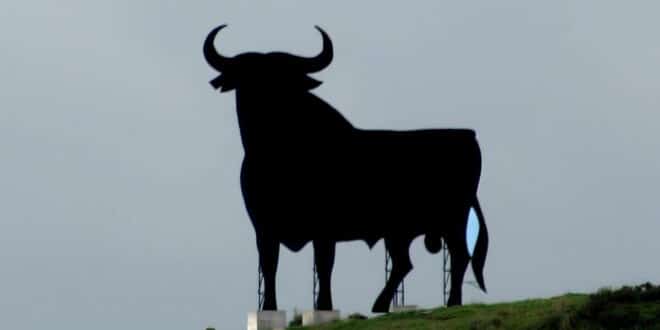
The only Osborne Bull on the Costa del Sol is perched atop Torreblanca Hill, visible at various points along its coastline. It has become a part of our collective memory, as well as a symbol for the community.
For decades, the striking silhouette of a black car, set against a sky-blue background, was a common sight on Spanish highways and regional roads. It became regarded as essentially ‘Spanish’.
The true symbol of Spain
Osborne Bull, despite its commercial origins, has evolved over the years to become an important cultural and artistic symbol. Designed by Manuel Prieto in 1957 to promote Veterano brandy. The early versions were made from wood and prominently displayed product name. As time passed, the legal restrictions led to changes in placement and structure of advertisements, as well as the removal or modification of any commercial messages. But, by now, it had become a national symbol and part of the personality of Spain – a milestone for so many who travelled the slow, pre-motorway roads in a Seat 600 to their coastal destination.
From advertising billboards, to cultural landmark
Its survival was dependent on the transformation. The metal figures were 14 meters tall and moved away from the roadside to blend in with the landscape. In 1998, after years of controversy, Spain’s Supreme Court decided that the bull was no longer an advertisement hoarding, but a decorative feature of the environment. This allowed for its permanent conservation. Since then, there are 92 bulls scattered throughout Spain. 24 of them are in Andalusia and only one is in Fuengirola.
Osborne Bull’s iconic silhouette has made it a symbol of international culture. It has been featured in prestigious publications such as The New York Times Magazine, inspired artists including Salvador Dalí, appeared in films, and been reinterpreted in countless artistic formats. This has all made it a symbolic image that is tied to landscape, identity, and popular cultures.