Costa News Spain Breaking News | English News in Spain.

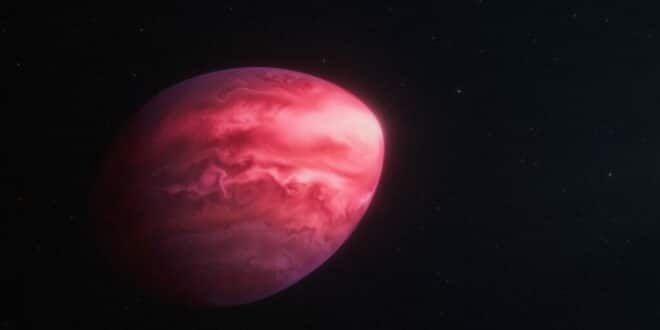
Artist’s rendering of the strange “lemon shaped” exoplanet which is confusing scientists.
Credit: Nasa
Space is full of strange phenomena, but sometimes something happens that truly leaves scientists baffled. This is what happened when a newly-studied exoplanet was discovered that looked, behaved and even possessed a life. The smells Chemically, it is unlike anything astronomers have ever seen.
The planet, also called PSR J2322-2650bThe planet is more than 2,010 light years away and has earned the reputation of being one strange world ever discovered. The planet is unlike any other in the planetary sciences. Its crushed lemon-like form, its scorching temperatures, and its bizarre atmosphere are all examples.
The biggest mystery of them all? Nobody knows how it was formed.
The wrong planet
PSR J2322-2650b’s orbit is one of the things that make it stand out. Instead of circling a normal star like our Sun, the planet is locked into a tight orbit around a pulsar – the ultra-dense, rapidly spinning remains of a dead star.
Pulsars can be violent. Planets that orbit them are rare because they emit powerful radiation and have strong gravitational fields. Most scientists believe that any planets nearby would have been destroyed many years ago.
This one, however, is still around and whips its host in only 7.8 hours. This means that a “year” lasts less time on this planet than an average working day.
Gravitational forces are so intense that astronomers claim the planet is elongated and oblong. Instead of being round, the planet looks like a squshed lemon floating in space.
No sense in an atmosphere
Researchers studied the planet with data from the James Webb Space Telescope. The atmosphere of this exoplanet was unlike any other.
Instead of water vapour or carbon dioxide – both common in gas giants – the atmosphere appears to be dominated by molecular carbon.
It may not seem that dramatic to you, but astronomers find it a bit puzzling. Carbon bonds normally with oxygen or some other elements. Carbon floating in a molecular state suggests that everything else is gone.
Michael Zhang is an astronomer who works at the University of Chicago. He admits that the scientists are unable to give a definitive answer. To end up with an atmosphere like this, the planet would need to lose oxygen, nitrogen and other common elements, while leaving carbon behind – a process no known model can account for.
It is an environment that “shouldn’t” exist.
Extreme heat and strange wind patterns are a common feature of the world.
The conditions on PSR J2322-2650b is as hostile as it is bizarre. The planet orbits so close to its pulsar that temperatures are estimated to reach at least 650°C, even in the coolest regions.
The wind here blows the opposite direction to the rotation of the planet, which is a bit odd.
Zhang suggested that the planet’s colour would be deep red, and its clouds would consist of graphite. It’s easy to understand why he described it half-jokingly as “looking like an evil lemon”.
The puzzle that scientists have not yet solved
All these characteristics, when taken together, raise an uncomfortable question: How did this planet even form?
According to the current theories, planets gradually form from dust and gas discs around young stars. Pulsars are created by catastrophic stellar explosions which should destroy anything in their vicinity.
PSR J2322-2650b doesn’t fit either story. It may have been once a much bigger planet which has been stripped down with time or it may have originated elsewhere and moved inward. These ideas are still speculative.
This planet is not a game of rules.
This discovery suggests that as our telescopes grow more powerful and sharpen our view of the cosmos, we’ve only just begun to scratch the surface. PSR J2322-2650b may be an outlier – or it may be the first hint that planet formation is far more creative than scientists ever imagined.
It doesn’t matter how you look at it, this bizarre, lemon-shaped object has earned its spot as one of most mysterious objects discovered beyond our solar systems.