Costa News Spain Breaking News | English News in Spain.

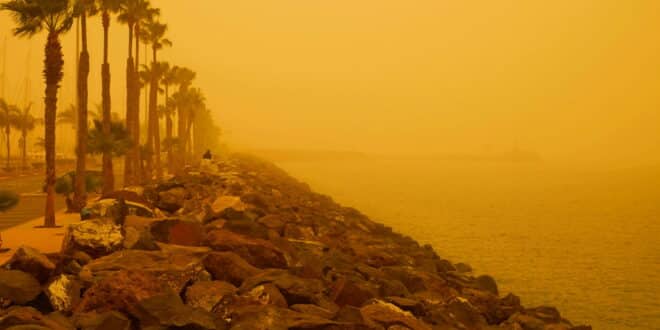
Saharan dust contains fine mineral particles. Photo credit: daguimagery/Shutterstock
As Saharan Dust spreads over the peninsula in the south and west of Spain, people will see hazier skies. On the Canary Islands, calima is already more visible. Dust is moving from North Africa into the peninsula as Spain experiences another period of high temperatures.
Dust is expected to move north and east over the weekend and Friday, affecting the southern and western parts of Spain. Arrival will alter the appearance of skies, replacing the deep, blue sky seen in recent days, with a milky, hazier appearance. Dust may settle on vehicles and outdoor surfaces. Rainfall in affected areas can produce muddy rain.
Southern and Western Spain is the first to feel the impact
The dust is moving into the peninsula from North Africa, with western and southern Andalucía particularly exposed as the plume advances. Residents in Cádiz and Huelva, as well as areas around Sevilla and Córdoba, can expect increasingly hazy conditions as suspended dust becomes more widespread. However, the concentration won’t be the same across the entire region as it depends on the direction of the air mass.
As the dust settles, the blue of the sky will become increasingly milky or washed out. The dust can settle on outdoor surfaces, cars and windows. Rain can form while the particles in the atmosphere are still suspended. This will result in muddy rain that leaves brown or reddish deposits. The dust is expected to continue spreading beyond Andalucía as the weather pattern develops, with Extremadura and other western parts of Spain also affected.
Canarias already under calima warning
Canary Islands is facing an impact that is more established and distinct from airborne dust. The Government of Canarias has declared a pre-alert Calima will be in force from Thursday afternoon on Gran Canaria. Authorities report high concentrations of African Dust, especially in Fuerteventura Lanzarote La Graciosa.
Authorities have warned that further developments on the continent could increase dust concentrations in the air and further reduce visibility. Calima is predicted to continue being a major part of Canarias weather over the next few days. Fuerteventura has been affected the most, but it is expected that dust will spread to other islands. It is forecast that the dusty and warm conditions will continue through the weekend. The temperatures are expected to also rise in various parts of the island.
Who is at risk?
Saharan dust can Increase in concentrations of airborne particlePM10 can cause irritation to the respiratory system. Those with respiratory or cardiovascular diseases, such as asthma, should pay special attention when concentrations rise. Canarias Government has explicitly warned that calima could exacerbate chronic and respiratory diseases.
Reduced outdoor activity is the easiest way to reduce exposure when air quality is bad. This is important, especially during physical exercise when the respiratory rate increases. More airborne particles are drawn into the lungs. People who are sensitive should check the local air quality before exercising outdoors or spending long periods of time outside.
Closed windows during the most severe periods will also help reduce the amount outdoor dust that enters the home. Anyone taking prescribed medication for respiratory conditions should continue to follow their usual treatment plan. Consult a doctor if you experience significant chest pain, breathing problems, or any other serious symptoms.
Heat can make conditions worse
Dust is arriving along with Extreme heat is back againParticularly in southern Spain. AEMET has issued orange warnings for parts of Córdoba, Jaén and Sevilla, where temperatures are expected to reach between 40C and 42C on Friday. Cádiz, Granada and Huelva are also under yellow heat warnings. Residents in the affected areas are advised to avoid excessive exertion and stay hydrated during the hotter part of the day.
Temperatures are expected to increase in Canarias over the weekend. Some areas, particularly those located in the south and inland, could reach 35C. Calima will continue to be a problem in the eastern islands until the start of next week. As the weather pattern changes, dust will gradually spread to areas beyond those initially affected. As the calima episode continues, Canarias authorities are already monitoring increased dust concentrations and decreased visibility.