Costa News Spain Breaking News | English News in Spain.

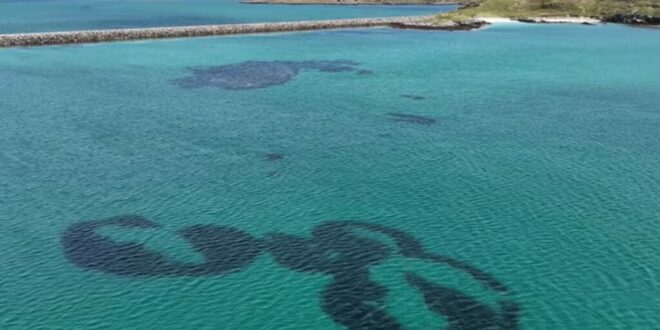
The Outer Hebrides of Scotland has strange seagrass “fairy-circles” that have been spotted.
Credit: Screenshot from YouTube NatureScot
Something unusual has been quietly forming beneath the waters of Scotland’s Outer Hebrides – and now, for the first time, it’s been captured on camera.
Locals and marine experts are both intrigued by the perfectly shaped circles that appear in aerial footage. These formations appear to be seagrass but the exact reason why they have a ring pattern is unknown.
They almost look deliberate. Almost designed. Yet they are completely natural.
What is the problem? They might not last.
A fragile ecosystem already under pressure
To understand why these so-called ‘fairy circles’ matter, you have to look at the bigger picture.
Scotland’s coast was once covered in seagrass. It stabilized the seabed, absorbed waves energy, protected marine life, and quietly stored away carbon. For generations, it was a part of the coastline.
There was a turning-point.
In the 1930s, a devastating outbreak of wasting disease – caused by the pathogen Labyrinthula macrocystis – wiped out large areas of seagrass. The pressures that followed were a decade-long combination of pollution, dredging and overfishing, as well as the wider impact of climate change.
The meadows have never recovered to their former glory.
When something new is discovered in the waters, scientists Pay attention
Why are these circles causing a stir?
The Outer Hebrides formations that have been recently filmed appear to be seagrass rings growing in circular shapes along the seabed. Locals have talked about the unusual patterns of seabed before, but it’s the first time that they’ve been documented from above.
Although no one knows exactly how or why the circles form, experts believe they are related to seagrass growth. The formation of similar natural “fairy rings” has been observed in many ecosystems throughout the world. These circles are often related to environmental conditions or competition for nutrients.
The timing of the event is important.
Seagrass has been declining in Scotland for a long time. Seeing organised growth patterns like this raises cautious hope – could this be a sign of resilience? Or are these formations merely temporary features within an ecosystem which remains vulnerable?
Researchers don’t jump to conclusions.
The pattern is more than just pretty
The circles are striking, and it’s easy to get caught up in that. Under the surface of seagrass, it is a serious environmental defender.
Reduces coastal erosion. It is a nursery ground for marine species. In addition, the carbon stored in its roots and surrounding soil helps slow climate changes.
It’s for this reason that organisations like NatureScot Now, seagrass beds in Scotland are classified as a Scottish Priority Marine Feature. This gives them extra protection. In certain areas, fishing techniques like dredging are restricted to avoid further damage. Improvements in water quality have also helped certain locations – including Loch Ryan, the Firth of Forth and parts of the Solway Firth – show signs of recovery.
Recovery is fragile. This is the main concern.
They may be beautiful or even symbolic. The circles appear as Scotland’s seagrass habitats slowly and cautiously try to rebuild themselves after decades of destruction.
It remains to be determined whether they are a temporary phenomenon or a minor ecological comeback.
For now, they serve as a reminder of just how delicate these underwater landscapes are – and how easily they can vanish.
Sometimes, the most interesting discoveries don’t involve something new. Some of the most interesting discoveries involve something old that is trying to survive.