Costa News Spain Breaking News | English News in Spain.

IF you drive along the Andalucian coast road east of Almería, you enter a desolate wilderness.
The bustling port gives way, alarmingly rapidly, to a flat expanse of moorland where nothing seems to live, except a few shivering seagulls: gone are the cheerful chiringuitos of the Costa del Sol, and the placenames tell you all you need to know – “Bitter Water”, “The Beach of the Dead”.
Carboneras, a tiny town in the north of Spain, feels secluded and lonely.
You feel like you are in a Spaghetti Western as you wander around the streets (in fact, these iconic films were filmed in this area in the 1960s).
READ MORE:
How would we describe a 21-floor seafront hotel built by a developer?
Is it a philanthropic act that injects life and employment into a dying area?
Or is it a cynical attempt to cheat the environmental laws?
We recommend that our readers look up Hotel Algarrobico in Wikipedia.
There can’t be many articles on that ‘non-judgmental’ site which start with the words, “this hotel is a ruined building in Spain”.
When the work began, in 2003, the construction boom had already begun.
The story of our National Park begins in 1980, long before the designation.
The developers knew the Spanish government would classify this area and that it was almost impossible for them to build anything new on virgin beaches under Spanish planning laws.

The concrete-pourer was the king of the Marbella era, before the scandals that have engulfed the city.
The developers did what they wanted. After all, they were making Andalucía prosperous, weren’t they?
A company named “Azata Del Sol” was granted permission to build the Algarrobico. They then set out to build it.
This will all depend on how you view it. You may see it as a clever sleight of hand, a clever way to dodge the bureaucratic deadweight, or even if you think of this as an amazing act of environmental theft.
It is undeniable that the Algarrobico was built on land that was protected in 2003.
Azata del Sol argued that its 1980s permits were valid – and didn’t Carboneras need jobs for its citizens?
Protesters from both the local and international level got involved.
You can get an injunction against someone who is building a tall tower right next to your bungalow.
In their endearingly direct way, the Spanish call this a ‘paralysing’ order.
For years, the Algarrobico has been ‘paralysed’.
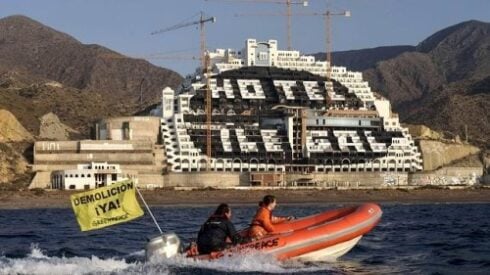
The courts cannot agree on what to do. Greenpeace, among others, brought a lawsuit against the judges who gave the project green light.
The Junta de Andalucía (broadly equivalent to a British County Council) is taking steps to demolish the empty hulk of the hotel with no guests.
Algarrobico has remained standing for 11 years.
Carboneras residents were disappointed if they expected that the 400-room Hotel would transform their economic situation.

In Spain, this syndrome is repeated often: the locals are convinced that a new project will bring them prosperity, when in fact, skilled workers from abroad are brought in, leaving behind only low-paid menial work.
Greenpeace continues to fight.
Environmental activists have called Algarrobico, “one of Spain’s five thousand miles of coastline’s biggest scandals”.
They claim to have won in court more than 40 times – and in truth, the complex has never functioned as a hotel in the 20years since it was ‘completed’.
Greenpeace asks a pertinent question: Why is it still standing today?
Now, in April 2025, it is again in the headlines. Estimates suggest that its demolition would generate 400 local jobs. The mayor of Carboneras, Salvador Hernández, has commissioned a viability study.
Azata del Sol has stated that it will fight against any attempt to demolish the hotel. This includes going to the Supreme Court.
The hollow shell of Hotel Algarrobico and the illogicality that Big Tourism exhibits will likely remain with us in the future.