Costa News Spain Breaking News | English News in Spain.

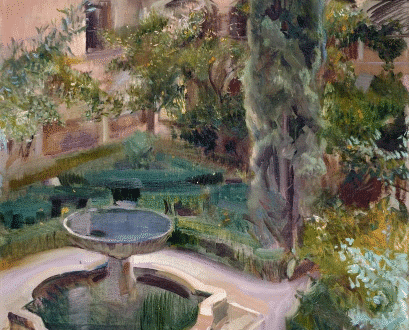
Alhambra is Granada’s majestic palace/fortress. It has achieved a cultural coup by acquiring a canvas depicting the Patio de Lindaraja that had been in Sorolla’s family’s possession for a hundred years.
Andalucía’s most-visited monument, the Alhambra receives three quarters of a million tourists each month during the summer.
Joaquín Soralla (1863-1923) is one of Spain’s greatest painters. He developed an obsession (some say a passion) for the Alhambra’s magnificent architecture during the Edwardian Period.
He painted 47 canvasses on-site in the first years of 20th century.
The Alhambra’s Board of Trustees has expressed its delight and pride in having purchased this painting, which Sorolla refused to part with, and which he regarded as ‘the best of all those he painted in the Alhambra’. The asking price was €730,000.

Up until now, the painting had belonged to the brilliant Valencian Impressionist’s family. However, negotiations to buy it culminated at the end April.
The oil on canvas dates back to 1909, when Sorolla made his first visit to Granada and began to paint.
View of the courtyard at the same viewing point, showing the fountain and the surrounding vegetation in the foreground, and the northern façade in the background. These are the Rooms of Charles V the Emperor.
Sorolla subsequently visited Granada twice in 1910, 1917 and signed five works that are dedicated to this courtyard.
The painting now owned by the Alhambra Trust was first exhibited in 1911 at the Art Institute of Chicago (United States) and the City Art Museum of St. Louis.
The exhibition has been a huge success in many countries around the globe, including Madrid, Paris, Ferrara (Italy), Valencia, Granada and Madrid.
The Alhambra Board of Trustees believed it was important to buy the painting to “continue and expand” their art collection which, until now, did not have any physical artwork by someone who is so closely connected to the monument and to the city, and who also “is undoubtedly an artist of international stature”.

The Patio de Lindaraja is named after the magnificent view that dominates the Palace of the Lions’ southern facade, the entire exterior of the Palace of the Lions which was, up until the 16th century open to the surrounding landscape.
The Emperor’s Rooms were built on top of what was once a low-lying, open garden. They had porticoed gallery on the ground level, which used columns from the Alhambra. This created a cloister like feeling, which is accentuated by its design and fountain in the centre.
The fountain was made of Sierra Elvira stones with Baroque designs on the base, parapet and pilaster. It housed a beautiful Nasrid cup decorated with gadroons and a epigraphic inscription from 1626 to March 1995 when it had to be dismantled and conserved at the Alhambra Museum.
Joaquín Sorolla y Bastida was a Spanish impressionist painter who excelled in the painting of portraits, landscapes, and monumental works of social and historical themes.
In Spain, he is known for his beach scenes.
READ MORE
Ses most famous works are distinguished by the dexterous portrayal of the landscape and people in the bright sunlight and water of Spain.
He was born in Valencia, the eldest child born to a tradesman, also named Joaquín Sorolla, and his wife, Concepción Bastida. Concha was born one year after his brother.
Both children became orphans in August 1865 when their parents, who may have died from cholera, passed away. Their maternal aunt, who was a locksmith, and their uncle took care of them.
His first art training began at age nine in his hometown.
In 1899, he traveled to Madrid and studied the master works in the Museo del Prado.
His own work is proudly displayed in the most important art museum of Spain.