Costa News Spain Breaking News | English News in Spain.

Unlock White House Watch for free
What Trump’s second term will mean for Washington, the business world and the rest of the world
Spain is the final major holdout of a Nato Plan to announce, early next month, that all alliance members will spend 5% on defence by the year 2032. The target set by US President Donald Trump.
Madrid is being pressed to meet its target, allowing Nato to declare that all members of the alliance will be meeting the pledge during a meeting with its defence ministers on June 5 in Brussels.
Trump said that Nato member countries must hit 5% or else they risk losing US protection. He is trying to “equalise’ the cost of protecting the alliance.
Diplomats struggle to win unanimous Nato backing before the leaders’ summit at The Hague, on the 24th of June. There are hopes that Trump will accept Trump’s promises to increase spending and to reaffirm US Security Guarantees to Europe.
The officials stated that Spain has not confirmed yet whether it will support the pledge of 5%. This could prevent a unanimity in the statement and undermine the alliance’s unity, complicating preparations for The Hague.
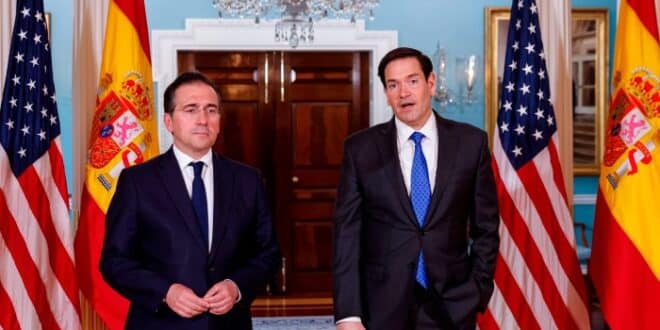
After meeting with Spain’s Foreign Minister in Washington, Marco Rubio stated that he “urged Spain to commit 5 per cent to defense”, as he has done for allies.
But the socialist-led Spanish Government refuses to face the issue in public.

Spanish foreign minister José Manuel Albares said: “There was an exchange [with Rubio] Both of us have expressed our opinions very clearly. I said that it would take a lot of effort to get to two percent, and the discussion should now focus on capabilities.
Spain has always been behind on its defence expenditure. Prime Minister Pedro Sánchez only said this month that Spain would meet Nato’s current 2 per cent spending target this year, as he unveiled a €10bn defence investment plan. He had said previously that Madrid would reach 2 per cent by 2029.
According to a plan drafted by Secretary-General Mark Rutte the allies have committed to spending 3.5 percent on core defence by 2032, and 1.5 percent on related expenditures such as cyber-security and defence-adjacent facilities.
Margarita Robles said that she told her Nato counterparts this week that it was not important to talk about percentages but rather develop capabilities and fulfill missions.
Madrid has claimed that its contributions to Nato and EU missions as well as UN missions are significant but not quantified.
Nato’s existing criteria state that no Nato ally spends 5 percent on defence. The 3.5 percent figure, however, was deemed more crucial by two officials. This is because almost all allies are already spending 1.5 percent on GDP in the areas covered by the 2nd portion of the target.
Matthew Whitaker, the US ambassador to Nato, said “5% is our number” earlier this month. “We want our allies investing in their defence as if they meant it,” said Whitaker.
Nato diplomats claim that, if Spain accepts this pledge, Nato will use its June defence ministers’ meeting to discuss the technical aspects of the scaling-up. This includes potential milestones for now and in 2032.
Bernardo Navazo of GeopoliticalInsights in Madrid said the Spanish government recognized that it needed to spend more than 2% but they had to buy some time to “work out an accompanying public dialogue, because our country comes from a tradition which is more pacifist-anti-militaristic”.
Navazo regarded the US target for a 5 percent increase as unrealistic. “It will be hard for countries such as Spain and Italy to get their people to support 5% in a situation where they do not perceive any imminent threat. Even if leaders claim that we are a part of the EU, and that the EU faces a threat from Russia.