Costa News Spain Breaking News | English News in Spain.

Ernesto Collado was our morning scent guide and perfumer. He shook a head as I held the geranium leaf to my nostril. “Don’t only smell it,” said Collado, as he crushed another leaf in his hands. “Flirt, then It will give you the essence of its essence.”
We had met Collado, founder of a natural scent brand called Bravanariz, in the garden of the yellow-stone farmhouse where we were staying that week. Mas Flor is one of a collection of 20 privately owned villas in the Baix Empordà region of north-east Spain, managed by a company called Viu Empordà. “It’s the Cotswolds of Spain,” says Viu’s 38-year-old founder, Pablo Rovira — a rural enclave to which residents of Barcelona can retreat at weekends and holidays.
The houses Rovira rents out are the country and seaside escapes of entrepreneurs, designers and architects from the city. Rovira says that each home is selected for its unique soul and connection with the region. From Barcelona himself, he grew up spending summers in the Baix Empordà village of Rupià, where the company is now based, no more than a 30-minute drive from any of the properties.


Pablo began the collection by acquiring two homes owned by friends of his family. Word spread, and soon other owners joined. The homes are mostly new and have never been rented out before. Rovira says, “I have to ask myself: Would I love to live in this place?”

Casa Brava is a six-bedroom modernist masterpiece with furniture by Noguchi, Audoux, and Audoux Minet. It has a lawn on the seafront and furniture from Noguchi. Viu Empordà doesn’t meddle with the interiors; it’s the owners’ art collections on the walls and their books on the shelves, but stocks bathrooms with natural products and offers round-the-clock service via a WhatsApp group: when our WiFi faltered it was fixed within the hour. Each home also has a swimming pool, as well as gardens and terraces that take advantage of the beautiful surroundings. The price is another draw: A villa such as Casa Brava rents for less than half of what an equivalent property on Ibiza or Mallorca would cost.


But what really sets Viu Empordà apart is that it draws on its network of local connections to organise unique experiences — or “good plans” as Rovira calls them — from pottery classes to vermouth tastings to e-bike tours. I’d never heard of a scent walk, let alone been on one, which was why we’d joined the charismatic Collado, resplendent in a teal corduroy suit, matching jumper and felt hat, in the garden at Mas Flor that morning.
In contrast to other senses, the limbic brain system is directly linked to smell. This part of the body is responsible for memory and emotional processing. Collado explains that it is a powerful connection to the environment. He introduced us to the flora of the garden as if we were old friends. It was a pine tree (cypresses are planted at doorways to symbolize hospitality), rosemary, sage and sage-like plants (which were once propagated by Romans). There was the toxic Euphorbia plant that — Collado claimed — a newlywed from a little way north used to poison her husband, adding four drops of its milky sap to his omelette each day.


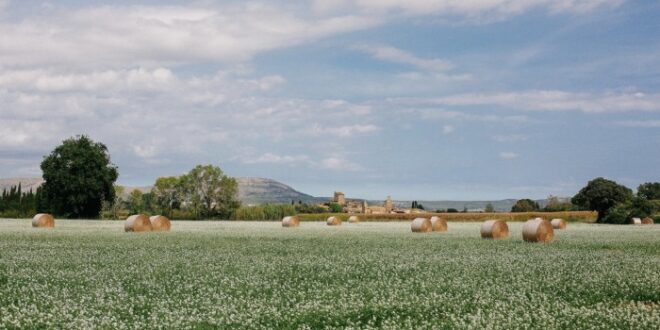
It was April, and the Baix Empordà was a poster paint scene, with fields of yellow mustard flowers, and poppies strewn along the green verges. Mas Flor, located just outside of La Pera village (a few km west of Rupia), has gardens backed by oak forests, including a swimming area adorned with wisteria in full bloom at the end a pergola spotted with roses. The first night my Merlin app picked up the rhythmic, smoke alarm-like chirps of a Scopus owl. A loud flock of birds, including a nightingale and a cuckoo, woke me at dawn the next morning.
The farmhouse, decorated in muted colours with antique furniture and clever touches like sidelights mounted on pulleys I wanted to replicate at home, had four bedrooms and a large azulejo-tiled, open-plan kitchen. We cooked with the basket of local produce we’d received, including globe-shaped artichokes that we steamed, then ate with garlic-infused butter. The house had to be sturdy enough to hold our children and the remote control car that my 8-year-old had sneaked into his luggage. He then wheelied across the terracotta tiled floor.


Calella de Palafrugell is one of the many unspoiled villages that dot this stretch of coast. Our captain Miki Puig was waiting for us to embark on a journey along the rugged coast. My nose was alerted by Collado’s lesson and I could smell fennel and pine. As Puig’s Menorquina fisherman boat approached the dock, families were sunbathing and building sandcastles along the white sand beach. After a dip in our swimming pool, I was glad that the water was choppy. I had had enough of cold-water swims. I was happy to take in the sights and colours: the rust red of the dramatic arzilion rocks, dotted with pine trees; the inky sea, and to hear Puig’s stories of shipwrecks and skirmishes that took place here — including the battle of Les Formigues, a pivotal naval clash during the Aragonese Crusade, which saw a Catalan-Sicilian fleet defeat a French-Genoese fleet.
The fingerprints of invading civilisations are everywhere in the Empordà. Rice fields surround Pals village, a living medieval museum, which is dominated with a castle keep from the 12th century. They are believed to have been planted in Pals by Arabs who came from Valencia. We watched as girls in hair bows carried elaborately braided branches of olive and palm into the Church of St Peter, a living museum of medieval architecture.


Es Caroxfa, in the tiny village of Púbol, is renowned for its rice dishes, and our long, late alfresco lunch in its 14th-century square was the kind of meal I fantasise about on grey November days in London. Between games of “Go Fish”, we shared a crisp broad bean salad and two rich arroces, one topped with a single chicken thigh and a ring of calçots, the other with a fillet of rockfish and two squid hoops that looked, my children thought, like a nose and eyes. Our three-course meal, with wine, cost the same as our Prêt à Manger lunch at Barcelona airport on the way home.
Few minutes walk away from the restaurant, there was a stunning sight. When Salvador Dalí’s Russian-born wife and muse, Gala, grew tired of the constant stream of guests and admirers calling by their beach house at Cadaqués, just to the north in neighbouring Alt Empordà, he bought her an 11th-century castle retreat in Púbol. Gala Dali spent her final 10 summers in Pubol, before her death in 1982. In a nod towards courtly love she had an invitation-only policy. Salvador needed to be granted written permission to visit the castle on cards that he designed. These are displayed in the castle.
As I looked at its large goldstone walls and crenellations, I was reminded of the medieval castle Gala loved. The 10ft sculptures of elephants with bird legs and a thicket plane trees were a surprise. Inside, the decor was equally zany with a taxidermy steed and plenty of trompe-l’oeil. We also saw through a glass-topped, ostrich footed coffee table to see into the room below. Mas Flor was a great place to get some design inspiration, but I won’t be stealing any of the ideas. Gala’s vintage Datsun parked outside or the ginger cat laying next to it would have been fine with me.
Gala’s Dalí-designed castle isn’t the only creative landmark in Púbol. Caterina Rom, a celebrated local ceramicist, has her showroom over the castle’s wall in an old stable from the 16th century. She fires the “wild” clay she digs up in the Catalonian mountains at 1,300C over 48 hours. The wood ash melts and covers the pieces, giving them the appearance of being glaze. The result is a pure, strangely moving, rough-hewn beauty that seemed like the opposite of Dalí’s contrivances.


On our last day, we left Baix Empordà for the half-hour drive to Girona, a city I’d only visited once when I’d booked a Ryanair flight there, mistaking it for a suburb of Barcelona. When we started our walking tours, I realised that I had greatly underestimated this city. Our guide Anna Massot, enlisted by Viu Empordà, showed us its Roman road, Gothic-Baroque cathedral, medieval Jewish quarter and Gustave Eiffel bridge. My children were most excited by a signpost next to a stone replica of a Romanesque lioness that she pointed out. It read “Don’t Kiss the Lion’s Butt,” referring to the statue’s precovid life when it used to be smooched for good luck by passing passersby.
El Celler de Can Roca’s menu seemed too sophisticated for my kids’ palates, plus it’s booked out a year in advanced. But the three Roca brothers own several other spots in and around Girona, including a chocolate shop selling cacao gin and chocolate video game controllers, and Viu Empordà had recommended their Restaurant Normal. It suited us perfectly: the house white, five euros a glass, was deliciously minerally; the ambience laid-back enough for us to continue our Go Fish tournament, and our meal — moussey croquetas; a custardy omelette topped with barely cooked shrimp; tender, textured beef Wellington — was so good I regretted suggesting we share.
As we left Mas Flor and my daughter pressed into my hand a sprig from her favourite plant rabaniza Blanca or Catalan isabi, I thought about how lucky Barcelonans must be to have such a variety of plants at their fingertips. Collado’s advice about smelling consciously is still in my nostrils. And I’m certain the blossom in my neighborhood is more pungent now than when I left.
Details
Kate Maxwell was a guest of Viu Empordà (viuemporda.com/en), which has homes to rent throughout the Baix Empordà, as well as providing chefs, guides You can also find out more about the following: arranging local experiences. Mas Flor sleeps eight and costs from €4,400 per week
Find out about our latest stories first — follow FT Weekend on Instagram and X. sign up Get the FT Weekend every Saturday newsletter