Costa News Spain Breaking News | English News in Spain.

Editor’s Digest: Unlock it for Free
This weekly newsletter features the favourite stories of Roula Khalaf Editor at The Financial Times.
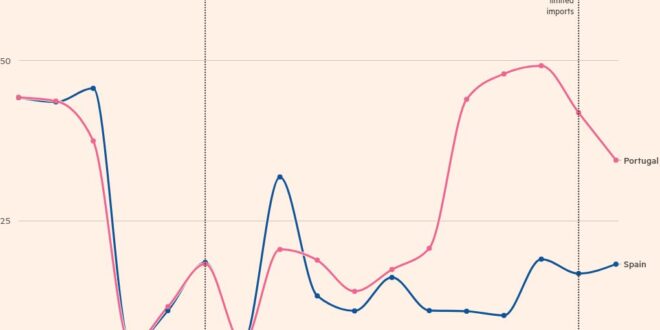
Portugal has seen a dramatic rise in its electricity prices since it decided to temporarily reduce its imports of power from Spain. Last week, the grid collapse that caused a blackout on the Iberian Peninsula was due to a failure by Spain.
The wholesale electricity price in Portugal was nearly five times greater than that in Spain this week, as Lisbon stopped imports from Spain. The two countries usually pay about the same amount for electricity.
Power outages in Spain began on April 28, and Portugal imported one-fifth its electricity. This has caused tensions between both countries.
In the aftermath of the still unexplained power outage, Maria da Graça Carvalho, Portugal’s energy minister, said her country was suspending electricity imports from Spain “as a precaution”.
After the blackout five days earlier, Portugal’s electricity rates began to soar far above Spain’s on Saturday. The gap reached a peak on Tuesday, when Spain’s average wholesale price was €10.24 per megawatt hour but Portugal’s leapt to €47.92/MWh.
Prices set under longer-term agreements will not immediately be increased for most consumers or businesses.

REN, Portugal’s grid operator, said to the Financial Times that it was made to “ensure the safety of the Portuguese National Electric System” to “close importation from Spain”.
Imports were suspended Wednesday. On Thursday, when REN re-started limited inflows to Spain, the gap between prices narrowed. Spain’s average electricity price that day was €16.76/MWh versus €41.86/MWh in Portugal, according to OMIE, the Iberian market operator. OMIE’s “day-ahead” prices for the Friday indicated that the gap would continue to narrow.
REN has announced that it will limit its daily import capacity at 1,000 megawatts until May 12. This is less than a quarter of the maximum daily imports Portugal had in recent years.
Grid operator said that even though the “trade” of electricity was halted, the cross-border connections remained open in order to allow for the technical balance of the Iberian System “if necessary”.
Carvalho, the energy minister, told the FT that “a comprehensive and phased-in plan is being developed to normalise the trade in energy between the two nations with the dual goal of ensuring market stability and operational security.”
The Spanish and Portuguese electrical systems have been interconnected since the 1980s. Lisbon has recently benefited from the rapid expansion of solar power plants in Spain, giving it access to cheap and abundant power.
“In Portugal we have been delayed in solar power generation compared to Spain,” said João Peças Lopes, a professor of electrical engineering at Porto university. “The electricity produced by Spain is cheaper that what’s produced by Portugal, so why don’t we profit from it?”
In Spain, it is not uncommon for the spot electricity price to drop to zero in afternoons due to the abundance of solar energy produced.
Armindo Monteiro is the head of CIP – Portugal’s largest business lobby. He said that his country does not “live in electric isolation” and neither should it. Monteiro argued that Portugal’s access to cheap Spanish electricity boosted Portugal’s economic competitiveness. Monteiro said that it was important to consider the security requirements for the current dependency level.
REN reports that Portugal imported 35% of its power from Spain a few moments before the blackout. Lopes pointed out that Portugal used some of this electricity to pump uphill water at hydroelectric plants called “water batteries” which act as a storage.
Portugal was able, after the blackout to restore its power by itself. Spain relied on France and Morocco via interconnections between these two countries to get their system back online.