Costa News Spain Breaking News | English News in Spain.

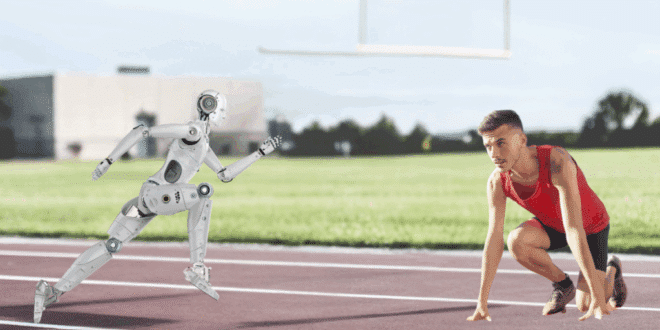
The future of robots? One slow and unsteady step. Credit: Canva
The Beijing marathon was not just a race—it was a line between science fiction and reality. The line was filled with humanoid robotics and people. No, it’s not a Black Mirror. In Beijing 2025, man vs. machine is a literal race. Humans and robots were standing shoulder-to-shoulder as the announcers counteddown. It was kind of.
The World’s First Cyborg Race
Beijing will host its first humanoid robot and human-like marathon on 19 April 2025. Beijing E-Town Half Marathon was run by over 12,000 people. They shared the race this year with 21 other runners. Humanoid robots The machines are not metal mascots or delivery bots. They are bipedal walking machines. And yes, they were required to complete a 21.1km course within the time limit. The fastest human was an hour.
How did the robots do? The best-performing robot was a tall, thin machine called “Tiangong Ultra,” The journey took approximately 2 hours and forty minutes. Beijing Innovation Center of Human Robotics has developed robots that use algorithms and long legs to mimic human stride patterns.
Robots meet Reality
“Tiangong ultra” made headlines but most other robots struggled. Some fell before the crossed the start line— one bot in particular face planted and lay motionless for a few minutes before rebooting. Other participants drifted from the course, bumped up against barriers, or froze when the terrain changed. The race staff replaced drained batteries more than once. How did the audience perceive this chaos? The show was equal parts a technological marvel and slapstick comedy. But this event revealed more.
The Progress of Steps
This was no publicity stunt. It was a real-world experiment with robotics. Race environments were introduced that labs couldn’t simulate, such as uneven ground, crowd noise, changing lighting, and unpredictable weather. They were not tested on code, but on adaptation. The marathon is a symbol of a shift in technology, not only for sports. We are now beginning to use robots in daily life. From construction to caregiving, robots will appear more frequently in our everyday lives (just like the movie I, Robot).
Beijing didn’t show that they can run. The important thing is that they tried. Robots will soon take over our jobs, streets and lives. Beijing’s Half Marathon showed us that the robots are coming. They stopped for battery packs at times and lied on the ground. In that clumsy, very human way– it’s making progress.