Costa News Spain Breaking News | English News in Spain.

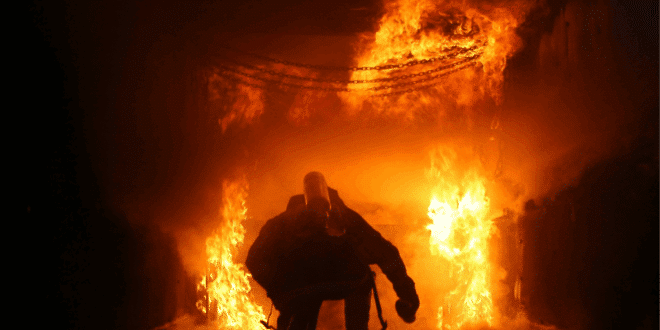
Robots walk into the fire to save humans when they can’t. Credit: Canva
In a country routinely at war, Ukraine’s latest firefighting weapon is not a ladder or a water hose—it’s a robot. TAF AirCore35-C was developed by Italian engineers. EmiControls, was deployed this year—not in peacetime cities but as a frontline in an industrial war zone. It’s not working the way you might think. This robot doesn’t put out fires. It clears escape routes, navigates chemical fumes and does dangerous, risky tasks that no one else is capable of. In Ukraine, it is not an opulent convenience. It’s a necessity.
Why this robot matters
Robots are usually associated with high tech economies or innovation in peacetime. In Ukraine, there are different stakes, and TAF AirCore works in zones that would normally be targeted by firefighting teams. The industrial sites that are targeted by drones or rocket strikes will not get a second shot.
This robot is capable of being controlled remotely by up to 300 metres. It uses its thermal camera onboard and its turbine in order to cool explosive materials, disperse high pressure mist and suppress fire spread. It also includes a feature that is built into the fork that removes debris and opens access routes— a vital role in urban rescues. In such hazardous conditions, each second counts and every metre closer a burning fuel tank or collapsed building increases the risk to humans. Robots can narrow that gap, thereby increasing safety.
Beyond fire: Robots for conflict-era rescue
Let’s be honest. Ukraine does not use robots to modernize, but rather for survival. AirCore 35 C represents more than just technological progress: it’s a paradigm shift in how nations are able to manage disasters when under pressure. In many countries, firefighting robotics are still used as a niche in chemical plants or tunnels. In Ukraine, however, firefighting robots are being integrated into a wider civil defence strategy. This is a testbed for other countries to take note of, especially those that are vulnerable to climate disasters or conflict.
What happens if drone strikes are combined with wildfires? Was there an earthquake in a conflict zone? Ukraine has the unfortunate situation of having to answer these questions in real time, but technology such as this helps it cope.
What it means for people on the Ground
The robot is not just a novelty for the Ukrainian frontline responders, it’s a way to breathe. One Ukrainian firefighter interviewed by the “International Fire & Safety Journal” stated that robots have “given us a new level of reach” in environments that were once told to wait, hold back, or risk injury.
This is why it’s important to phrase this correctly: Robots don’t replace bravery. They reduce unnecessary sacrifice.” The Ukrainian people have responded positively to an efficient robot that protects and is neutral. It may not have a gun but it still saves lives.
The shift to a broader technology
Automation is usually discussed in terms of cost reduction, jobs, and factories. Here’s another side of evolution: robotics is a force multiplier that can increase human resilience. What we’re seeing in Ukraine now is part of an even larger wave. Firefighters from Italy are working alongside robots such as Colossus or Trypper. Drones are used in Japan to recover from earthquakes, and interest is growing across Europe for rescue robots as we face threats that are not linear, clean or predictable. Ukraine has been forced to be ahead of its time in many ways.
The beginning of something bigger
The most significant advances happen in the midst of war, on factories under siege and in communities struggling to function. This deployment of robots in Ukraine signals human resilience becoming hybrid— part flesh, part code, and part machine. That’s not a dystopian design, but a design with aims, demonstrating how powerful and essential it can be.