Costa News Spain Breaking News | English News in Spain.

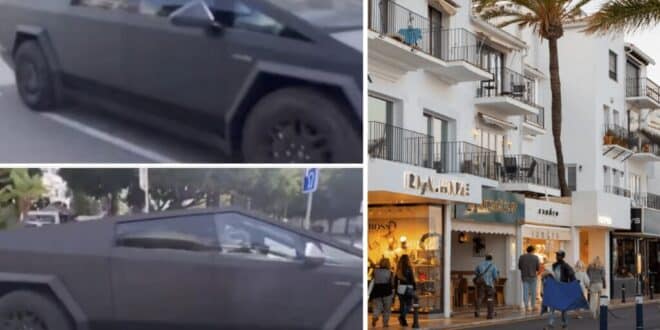
A viral video has sparked widespread curiosity along the Costa del Sol after a Tesla Cybertruck was filmed cruising through the glamorous streets of Puerto Banús. Even though it’s not uncommon to see exotic vehicles on the streets of Marbella, pedestrians were still left in awe.
This car had been spotted just a day prior in Algeciras after arriving from Tarifa. This has led to a burning question: how can a car banned by the European Union legally navigate Spanish roads.
Tesla Cybertruck was launched in a year and has divided opinions due to its retro-futuristic design, solid construction, and angular shape. Measuring 5.68 metres long and 2.20 metres wide (2.41 metres with mirrors) and 1.79 metres tall, the all-electric pickup weighs over three tonnes and can reach 3.5 tonnes when fully loaded, classifying it as a ‘heavy-road vehicle’ or ‘truck’ in many jurisdictions. The exoskeleton is made from stainless steel panels of 1.4 mm thickness with sharp edges. This sets it apart the common rounded shapes in Europe. Also, it is said to also be bulletproof.
Why is it illegal in Europe? The Cybertruck design violates EU safety regulations. These mandate protruding parts of vehicles have a minimum radius of 3.2 mm to reduce injury in collisions. This is especially true for pedestrians. The angular body and rigid shape of the Cybertruck are more likely to kill pedestrians in a collision than vehicles that have more flexible plastic numbers and rounded edges.
Tesla’s Vice-President of Engineering Lars Moravy has said that it is “impossible”, given the stainless steel, to adapt the manufacturing process in order to meet EU standards. According to Tesla CEO Elon Mohs, this is why the Cybertruck has not been approved for sale in Europe.
Could Tesla Cybertruck be in Puerto Banús illegally?
In spite of the ban, one Cybertruck is legally registered in Europe. Owners of the vehicle in the Czech Republic were able to homologate it by modifying the vehicle, including changing red rear indicators (as per European requirements) and adding red fog lights. Rubber protectors on the sharp edges were also installed as a safety measure. This exception has been criticized by road safety advocates including the European Transport Safety Council, the International Federation of Pedestrians and others who believe that allowing Cybertrucks on European roads was a mistake.
The Cybertruck spotted in Puerto Banús, bearing California license plates, has fuelled speculation about its legal status. There are several possibilities: it could either be a privately-imported vehicle that is undergoing temporary certification, like the Czech case, of a vehicle registered outside the EU temporarily driven in Spain. A third theory is that it could be a promotional vehicle or test car, but no official confirmation has yet been given.
The audaciously styled vehicle fits right in in Puerto Banús and would probably have raised fewer eyebrows there than in most other places. Its circulation has ignited debate about its compliance with EU regulations, and the possible risks that it poses. Many are wondering, as the video circulates online, how an American icon made its way to European roads and whether others will follow.