Costa News Spain Breaking News | English News in Spain.

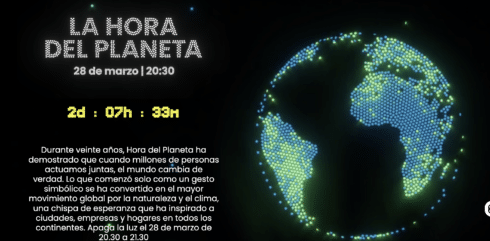
It was a campaign to raise awareness about climate change that started in Sydney. This sparked an international social movement for the symbolic turning off of city lights for an hour.
What started as a simple gesture has now become one of the biggest movements in support of climate change and nature.
Olive Press explores the reasons for celebration as WWF Earth Hour takes place on Saturday, March 28.
READ MORE A photo of a young Iberian Lynx in Spain’s Ciudad Real playing with a mice wins top prize in prestigious wildlife competition
Spain is particularly susceptible to the climate crisis, which affects all of Earth. In the Iberian Peninsula, droughts are a constant. From recent floods that killed many to forest fires that destroyed thousands of trees, they have become an everyday occurrence.
There have been some notable environmental achievements in the past two decades.
Paris Agreement, where 195 nations committed to limiting global temperatures rise. It was followed by the 2030 Agenda and European Green Deal.
In light of the fact that fossil fuels are primarily responsible for the climate crisis in Europe, the reduction of coal usage by 70% in Europe since 2010 as well the growth in wind and sun power was also positive.
Technological innovation – including electric mobility and smart buildings – accompanied by a 50% reduction in emissions in some European sectors since 2005, shows that accelerating decarbonization is possible.
In addition, air pollution has been reduced in more than 100 nations.
READ MORE WWF fines unlicensed hunter for killing a female protected lynx in central Spain and leaving her four cubs orphaned
As for nature restoration, it is estimated that the ozone will recover fully between 2040-2060. In addition, ecological restoration has gained momentum in global policies, with a focus on restoring degraded wetlands, forests, rivers and oceans.
At least 30% of our planet must be protected now.
Antarctica is important in maintaining the temperature of our planet. It also retains its status as an area dedicated to peace and science.
The Iberian Lynx is a species that has been able to recover from being endangered. Its numbers have increased from 100 in 20 years to 2,400.
The recovery of large fisheries, such as the bluefin tuna thanks to improved management and the battle against illegal fishing is another example of success.
There will be plenty to celebrate on March 28. Earth Hour After all.
The Olive Press offers a variety of environmental news.