Costa News Spain Breaking News | English News in Spain.

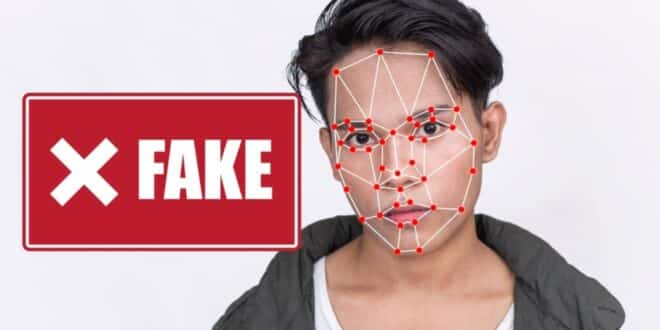
Detecting a deepfake. Credit: MDV Edwards. Shutterstock
Dutch forensic experts recently revealed a new method for detecting deepfake video by tracking subtle changes to facial colour that are caused by the heartbeat of a person.
Zeno Geradts, of the Netherlands Forensic Institute NFI will be giving a presentation at the European Academy of Forensic Science (EAFS) Dublin conference from 26 May to 30 May 2025.
The technique, dubbed ‘blood flow detection’, identifies the expansion and contraction of tiny facial veins that pulse in sync with a person’s heartbeat – something AI can’t (currently) convincingly replicate.
The heartbeat of the human face is a constant.
Geradts, a digital forensic expert at NFI and professor of Forensic Data Science at the University of Amsterdam, explained that the method involves using high-resolution video to detect tiny shifts in skin colour around the eyes, jaw, and forehead – areas where blood vessels lie close to the skin.
“Artificial Intelligence can do a great deal, but it cannot produce a convincing pulse,” said he De Telegraaf.
The subtle differences are evident with the improved image compression technologies and are not present in deepfakes. This makes them an important marker for verifying video authenticity.
Deepfake detector has been in development for over a decade
Geradts first came up with the idea in 2012, when he read an MIT report on how facial veins can be used to measure heart rate. The video quality was poor at the time and it could not be used in real situations.
Geradts, in a cited press release, said that the large video files were compressed, which resulted in the loss of color differences for each heartbeat. NL Times.
The method is now viable thanks to technological advances. Paula Pronk began the research. Sanne De Wit, a TU Eindhoven computer graduate who studies forensic science, expanded it. De Wit trained her model by comparing 79 points on the face of people who were wearing heart monitors and smartwatches.
The results revealed a consistent correlation between data on heartbeats and changes in facial colour. Importantly, this method worked across all skin tones and even low-light conditions.
Spain’s crackdown against deepfakes highlights increasing demand
As deepfakes become more sophisticated, countries in Europe are taking steps to combat them. Spain has been reported to be cracking down against deepfakes. New legislative and regulatory measures are being taken in order to combat deepfakes, which can have harmful effects on both individuals and society.
These efforts were made in response growing concerns over the use of AI-generated videos in political disinformation, deepfake pirography, and financial scams. The demand for deepfake identification is on the rise. Forensic tools, such as NFI’s blood-flow technique, could become vital not only to investigators, but regulators, media outlets and tech platforms.
This new method is still being validated and not admissible in courtrooms yet. The method is being used to assist in forensic investigation.
Sometimes I worry that everything soon will be seen to be fake. “What is real then?” Geradts said.
The Netherlands Forensic Institute does not rely on one single method. The toolkit also includes:
- Electric Network Frequency: This matches video flicker patterns with the electrical grid and dates footage.
- Photo Response Non Uniformity (PRNU), identifies the unique sensor pattern on a camera.
- Traditional analysis includes detecting irregular blinking or speech patterns.
Geradts explains that “we need to combine different methods.” The more signals we detect, the better able we are to assess a video’s authenticity.
Real-time deepfake detector training
Geradts also runs hands-on deepfake discovery workshops at the Dublin Conference. Attendees have to decide whether videos are real or fake, and they are taught how to create their own deepfakes in order to understand what investigators go through.
He said, “I could do a new workshop each month.” The developments are moving so quickly. I’ve never seen a fake where the heartbeat of the face is visible.
This breakthrough is a vital step to keeping up with the rapidly evolving AI technologies.
What do YOU think? Should heartbeat detection tools be included in social media video verification? Do you feel that everything has already gone too far?
All the latest news from Netherlands.