Costa News Spain Breaking News | English News in Spain.

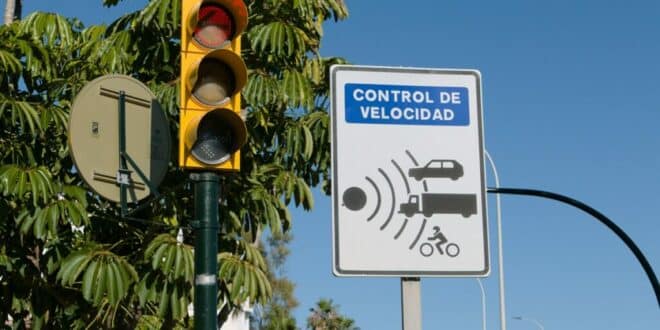
On Spanish roads, it is almost impossible to see the Velolaser Speed Checks
Credit : No-Mad, Shutterstock
There’s a new kind of speed trap on Spanish roads – and it’s catching drivers before they even realise they’ve done anything wrong. The speed traps are small, portable, and nearly impossible to see. Velolaser radar The Spanish traffic authority is using one of its most effective tools.
You may have driven through Spain believing you would see a speed camera and slow down in time. These devices don’t look like traditional radars, they don’t stand out – and by the time you realise one might be there, it’s usually already too late.
It can be a shock to many drivers who are used to cameras clearly marked in countries such as the UK and France.
Why is it so difficult to detect this radar on Spanish roads?
The Velolaser roadside camera isn’t like your average one.
It’s small – really small – and that’s exactly what makes it so effective. It can be placed anywhere: behind a barrier, attached to an advertising sign, positioned low in grass, or near a vehicle that is not marked.
You’re no longer looking for that big grey box. You’re searching for something that’s probably not visible.
That’s what I mean.
Traffic authorities want motorists to adhere to speed limits all the time, not just when a radar appears. The devices are small and discreet, so they eliminate the habit of drivers to brake at the last second.
Velolaser is a laser-based device that measures speed accurately and at a distance. It can capture vehicle details and take multiple readings within seconds. In real terms, that means there’s very little room for mistakes – or second chances.
When and where you are most likely to see it
These radars are often used on long, straight stretches of road – the kind where it’s easy to drift slightly over the limit without thinking.
What makes them difficult is the frequency with which they move.
The officers can quickly set them up and move them because they are battery-powered and lightweight. The officers can move them quickly from one quiet stretch of road outside a small town to another.
Several reports indicate that they are positioned in the same place for about an hour. It is therefore difficult to track their movements using apps and shared alerts among drivers.
They also tend to appear during busy periods – morning commutes or early evening – when roads are more crowded and the risk of speeding increases.
You can’t just assume that the location of your friends will be the same every day.
It’s not just about fines – but it can feel like it
The official aim is road traffic safety.
The speed of vehicles is still a major factor in accidents. DGT The government has invested more in the technology that monitors it. The Velolaser is part of that wider strategy – along with drones and helicopters that can track traffic from above.
From the driver’s perspective, it’s not always that way.
Many people, particularly those who are unfamiliar with this type of enforcement, may feel that it is a trap. You drive as usual, maybe a few kilometres over the limit without realising – and later, a fine arrives.
This is often the first time people learn about these devices.
What expats living in Spain need to know
It’s important to know the small, but significant differences if you drive or live in Spain.
In some countries speed cameras are prominently displayed or shared via navigation apps. In Spain, that’s not always the case – especially with mobile devices like the Velolaser.
You cannot rely on them being spotted. Apps can’t warn you all the time.
This is especially relevant for expats driving between cities such as Alicante or Valencia, Malaga, or Madrid where there are often long stretches of road. These are the exact types of roads that radars are used on.
Takeaway for Drivers
It’s not possible to avoid them.
No reliable warning system.
The only real way to stay clear of fines is the obvious one – stick to the speed limit, even when the road feels empty.
Because right now, on Spanish roads, there’s a good chance the thing watching your speed… is the one you never saw.