Costa News Spain Breaking News | English News in Spain.


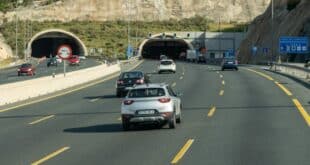
Spain’s overtaking regulations have changed for 2026. They now include stricter safety and speed requirements.
Credit : K-FK, Shutterstock
You’ve probably noticed if you drive in Spain that the rules of the road are about to change. From mandatory V16 beacons to new obligations on motorways, the Dirección General de Tráfico (DGT) has been busy tightening and clarifying regulations. One change in particular is surprising drivers: the new way to overtake.
It’s no longer a question of “common-sense” or “extra care”. Everything is in black and white. Since January 1, 2026 there are clear speed limits for overtaking broken down vehicles on the hard shoulders or cyclists passing. There is also a fixed safety distance. This guide is well worth reading if you still drive the same way as you did last season.
Overtaking 2026: Slower, wider, and no longer an option
The Spanish traffic laws were surprising vague until now when it came down to overtaking vehicles parked on the side of the road or cyclists riding near the road. The Spanish traffic rules were vague when it came to overtaking stationary vehicles on the shoulder or cyclists riding close to the road. The speed reduction rule was not precise, and the enforcement varied.
It has changed.
DGT mandates that drivers reduce their speed to at least 20 km/h less than the speed limit on the road, when overtaking vehicles stopped on the shoulder of the road, particularly if they are signaling an incident. The same rule is applicable when passing one or more cyclists.
This means in practical terms:
– On a road limited to 90 km/h, you must drop to at least 70 km/h
– On a motorway limited to 120 km/h, you must slow to at least 100 km/h
It is not just about slowing down.
A minimum lateral separation of 1.5 metres is also required by drivers. This applies now not only to cyclists but also stationary vehicles parked on the shoulder. This is no longer just a recommendation. It’s an obligation.
Yes, you can cross a solid line – but only in specific cases
What the new rules allow is more surprising than what they restrict.
Drivers can now partially occupy the opposing lane to ensure that safety distance of 1.5 metres, even when there is a white continuous line. Crossing a solid line has been a strict no-go for years. In 2026 safety will take precedence over the paint on the roads.
This is not a pass for free.
Only if there is enough visibility and other road users will not be put in danger, is it permissible to cross over into the opposing lane. You must wait if traffic conditions don’t allow it. The rule is intended to protect vulnerable road-users, not to justify risky maneuvers.
It’s simple: Slow down, move to the side if you feel it’s safe and don’t pass if not.
Why the DGT stepped in
These changes didn’t just happen. In recent years in Spain, there have been a number of serious and deadly accidents involving road workers, cyclists and drivers who are stopped on the side. Several of these incidents occurred at high speeds, with vehicles dangerously close.
This safety drive also includes the introduction of V16 emergency beacons that are now mandatory in all vehicles. These connected warnings lights make broken down vehicles more visible, and alert traffic officials instantly. The DGT is clear in its message: Visibility alone is not sufficient if drivers continue to pass at high speeds.
The DGT wants to eliminate ambiguity by establishing a speed reduction that is fixed and a safety distance that is clearly defined. The drivers no longer decide what “being cautious” means. Now the rule defines it.
Spanish traffic: Other important changes for 2026
Spain’s new road regulations include a comprehensive update of the overtaking rules.
The V16 warning beacon replaces the traditional triangles. Since 1 January, every vehicle must carry one, or risk an €80 fine. The beacon is a powerful light that flashes in 360 degrees for 30 minutes, and it transmits your vehicle’s position. The rule has now been fully implemented despite criticisms about its effectiveness and cost.
Insurance requirements for personal mobility cars (VMPs) have also caused confusion. The DGT clarified that while the DGT initially anticipated wider insurance obligations to apply as of early January, most VMPs will not be affected yet, since the national registration system has not yet been operational.
Even if they are not registered, VMPs capable of more than 14 km/h and weighing over 25 kg must be insured.
Another change that is important to motorway drivers during congested periods is the requirement for them to free up their central lane. Drivers are now legally required, since 1 January 2013, to release the central lane when traffic slows down or stops. The vehicles must move off the road to make room for emergency services, such as ambulances and police.
What does this mean for everyday drivers?
These changes are difficult for many drivers to accept. It can be difficult to slow down by 20 km/h on a road that is empty. Even after years of conditioning it still feels wrong to cross a solid lane. Not adapting to the new world will have real legal and physical consequences in 2026.
This year’s DGT message is consistent: road traffic safety comes first, before speed or convenience. Whether you are overtaking a cyclist on a rural road or passing a broken-down car on the shoulder, the expectation is the same – slow down, give space, and don’t rush the manoeuvre.
If you stay informed and follow the rules, it’s easy. If you don’t comply, fines, penalties points, and unpleasant lessons may be waiting for you in 2026. Overtaking in Spain has changed – and this time, the rules leave very little room for excuses.