Costa News Spain Breaking News | English News in Spain.

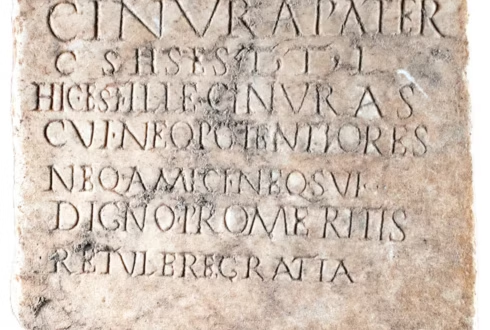
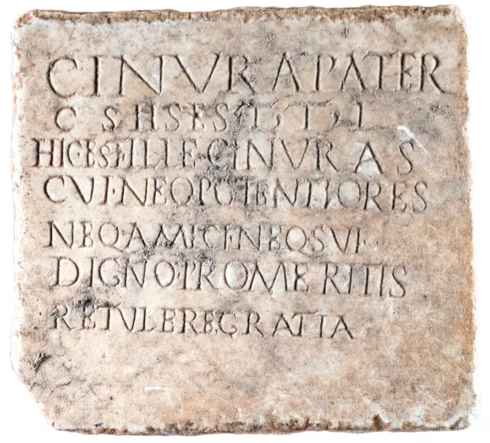
Cinuras was buried in a marble grave, sometime around Emperor Nero’s reign, in Gades. (Now Cadiz).
The gravestone was likely purchased with his hard-earned money and bore a bitter epitaph.
“Neither the powerful nor his friends or loved ones showed him any appreciation when he was still alive.”
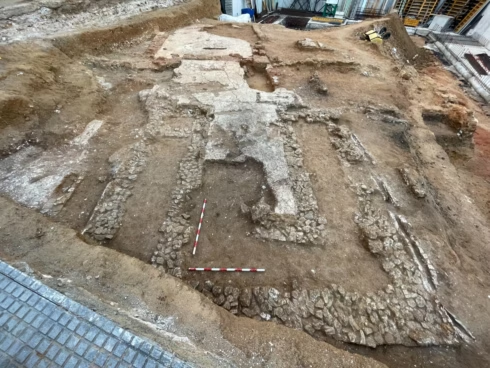
Nearly 2,000 year later, the words of his father were found not in a textbook or museum but in an old cabin in the north of Cadiz. It was early January 2022, and workers doing renovations accidentally uncovered Roman fragments – just the beginning of a much larger story.
Thanks to subsequent funding and the involvement of professional archaeologists, what was initially thought to be an isolated find has since revealed itself as a vast Roman necropolis: a sprawling ‘city of the dead’ that has remained hidden for centuries.
Cinuras, today, is one of the many voices that are rising up from the soil.
The excavation is being led by historians Jacobo Vazquez & Adrian Santos. Both have published four academic articles on the site and are currently working on a fifth. Yet, they both agree that Cinuras’s tale is the most compelling.
Vazquez says, “We have done extensive research on names.” “Cinuras almost always is a slave name. And yet here he is – buried in a marble tomb, next to magistrates. This means that he died as a free person.”
It is evident from his grave. Roman tradition forbade slaves from being buried so close to the elite of the city. It’s likely Cinuras was manumitted – freed after years of loyal service – and succeeded well enough to afford a proper tomb. The bitterness in his last words indicates that wealth and freedom did not bring him the peace he sought.
Santos says, “We give voice to a person who would otherwise have been utterly unheard.” “It is very beautiful. It’s hard to remember how his family and close friends treated him. What is left behind is a man who lived.
Cinuras’s story is not unique. Archaeologists discovered 269 inscriptions so far, some of which are rich in personal stories. One tomb belonged to a woman who lived to be 100 – an exceptional age in Roman times.
Others appear to cluster around an Egyptian goddess Isis temple or a funerary institution.
Vazquez explains, “We believe this site was sacred for Isis.” She was worshipped in many port cities, such as Gades. Many people probably came to this place to pray regularly and wanted to be buried close to a place that they loved.
Small terracotta votive statuettes – hand-held offerings likely left by worshippers – support this theory. The same goes for faint wall murals that depict birds and reeds as symbols of the Nile mythology and Isis.
Santos adds: “This wasn’t a luxury temple, but a local working chapel.” It served real, working people and many of them returned here after death.
READ MORE
The team has so far documented 55 burials, from simple pits dug into the sand to elaborate marble tombs from the 4th Century AD, when it appears that the necropolis was abandoned.
Remarkably, many of the tombstones were found stacked like playing cards, suggesting someone – long after Rome’s fall – had preserved them rather than destroy them.
Santos says “that kind of care is uncommon.” “Normally, these items would be destroyed or repurposed. Someone saw their value. We now have an incredible archive of life thanks to them.”
Work is still to be done. Vazquez, Santos and others believe that the site will fundamentally change how we view Cadiz in the Roman World. Gades, far from being a sleepy village, may have played a significant role in cultural exchanges and spiritual significance.
Vazquez says, “The investigation just began.” “We’re likely to make some shocking discoveries.”
Even now, even before the complete picture is known about Cinuras, it feels like a quiet victory.
A man who once lamented being forgotten is now, against all odds, remembered – his story a voice from the grave that still has something to say.
The Olive Press’ La Cultura News is available here.