Costa News Spain Breaking News | English News in Spain.

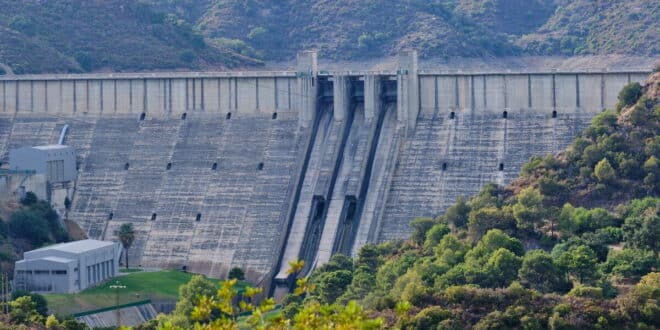
In a dramatic turn of events for a region long plagued by severe drought, the La Concepción reservoir, the primary water source for the Costa del Sol, has begun releasing masses of water after reaching 80 per cent of its capacity. The sight of water flowing down the River Verde may be a relief for many, but it also raises an important question for the residents and tourism industry. Is the surplus sufficient to ensure a 2026 without restrictions?
A surplus under control
Since Sunday, January 4, authorities have been forced to open the floodgates of the La Concepción dam as a safety measure. The reservoir, currently at 87% capacity, is going through a controlled release in order to lower its levels to 80 per cent to make room for incoming storms Expect heavy rains during the peak of wet weather.
According to the Ministry of Agriculture and Water of the Junta de Andalucia, the goal is to reduce the accumulated volume by 2.5 cubic hectometres (Hm³). In order to put this into perspective, the amount of water in question could provide a city of 37,000 residents with drinking water for a whole year.
Scarcity and its financial implications
The long-term prospects are still in question despite the current abundance. The Costa del Sol has a high population density and water consumption varies greatly between seasons.
While the 2.5 Hm³ being released would cover the entire region’s needs for two weeks during the winter, that same amount would barely last a single week during the high summer season when tourism peaks. To meet the region’s demand, it relies on “a mix” of resources including the Marbella Desalination Plant, local wells and the reservoir.
Record rains
Malaga province has experienced one of the most rapid increases in water reserves over the past few years. Before December 2025, the provincial reservoirs held 277 Hm³; as of January 5, that number has jumped to 337 Hm³. The increase of 61 Hm³ is big enough to supply Malaga city for a year and a half.
Local leaders have warned that infrastructure has not been optimised yet to capture the windfalls. Malaga’s mayor, Francisco de la Torre, has renewed calls for The construction of Cerro Blanco Dam to regulate Rio Grande which recently reached a record height of 2,98 metres. Without such infrastructures, much of the record rainfall would have ended up in the sea and not be stored for future dry periods.
The 2026 Question
Conde de Guadalhorce is also seeing massive gains as well, in the Guadalhorce systems reservoirs rising by 12 Hm³ In just a few short hours, optimism has grown.
This is the central question: Is atmospheric luck a long-term solution or just a temporary respite? If the region fails in its investment in storage and regulation, the “surpluses” of today could not be sufficient to avoid water restrictions by 2026.
Costa del Sol residents are watching the water level rises with a mixture hope and caution. They know that, in the Mediterranean climate, the flooding of today is often the best defence against the drought of tomorrow.