Costa News Spain Breaking News | English News in Spain.

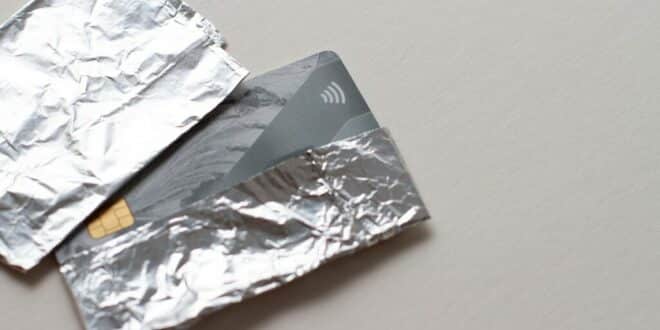
It is suggested that wrapping bank cards with foil will prevent contactless thefts from occurring in crowded spaces.
Credit : Epov Dmitry, Shutterstock
Wrapping your bank card in aluminium foil to stop contactless theft might sound odd, but it’s a trick more people are trying – and it’s based on real science. It is believed that the foil will block wireless signals for contactless payment. While the theory is sound, some experts claim that it’s not as simple as it seems.
With contactless payments now part of everyday life in Spain – from cafés to supermarkets – concerns about digital fraud have grown. With that came these quick, home-made fixes.
Where the idea comes from – and why it’s not as random as it sounds
The foil trick wasn’t a sudden appearance.
It’s based on a concept called a Faraday cage – something scientists have known about for over a century. Aluminium and other conductive materials can be used to block electromagnetic signals.
NFC cards (near-field communications) are used to operate contactless cards. The same technology is used to tap your phone or card to pay.
So the thinking is simple: if you wrap your card properly in foil, those signals can’t get through – meaning no one nearby could scan it.
The same principle is used to create RFID-blocking Wallets that are designed to prevent this type of wireless communications.
Yes, science is a fact.
Do you really feel safe when you go out?
It’s here that things start to get less clear.
The foil must completely cover the card for it to function properly. No gaps, no tears, no loose edges. Even a small hole can allow signals to pass through.
It’s not as easy as it sounds.
A card that is loosely wrapped or covered with a thin layer foil may not stop anything. It may reduce the signal but not stop it completely.
There’s also another point worth keeping in mind: this type of contactless theft – where someone scans your card in public without you noticing — isn’t as common as people think.
Banks set limits on contactless payments and are quick to detect unusual transactions. Customers are often refunded in many cases if anything suspicious occurs.
While foil can offer some protection under ideal conditions, you cannot rely on it to protect you completely.
This trick is spreading, but why?
You can protect yourself easily, inexpensively, and with a sense of accomplishment.
It’s because of this that it has become so popular. You don’t even need to buy any products. You don’t have to know the technology. Wrap your card and continue.
At a time when people are more aware of scams and fraud, simple ideas like this spread quickly – especially online.
In everyday life, this is not very practical.
It’s not very convenient to have to take your card out and put it back in foil each time you pay. The foil may tear, become worn out, or be a nuisance to handle.
That’s why many people who want that extra layer of protection end up using RFID-blocking wallets instead – they do the same job, but in a way that actually fits into daily life.
What puts your money and investments at risk?
Most banking fraud today is not committed by someone with a scanner standing right next to you.
This is more likely to happen if you receive phishing emails, visit fake websites or leak data.
There are greater risks in this area.
The foil trick may be useful in certain situations, but it won’t help you to protect yourself from what people will most likely encounter.
Simple habits still matter more – checking your transactions regularly, avoiding suspicious links, and being careful about where you enter your details.
Is it worth the effort?
If you wrap your card properly, yes – it can block signals. This part is true.
For most people it is not necessary.
There are safeguards in the banks, but there are also more practical methods to protect your card if you have any concerns.
These concerns are understandable for residents of Spain, a country where contactless payment is almost universal. But it helps to know where the real risks are – and where they’re not.
The foil trick doesn’t work. The foil trick isn’t as revolutionary as it’s often portrayed. It’s more work than it’s worth for most people.