Costa News Spain Breaking News | English News in Spain.


In February 2026, people in Spain enjoy terrace drinks as temperatures rise well above the seasonal averages.
Credit: Shutterstock/Carlovis
When you are looking for a way to improve your life, Copernicus Climate Change Service The global trend that pushed Europe towards one of its warmest winters ever confirmed by the data, but the reality on the ground is a tale of two continents. As northern Europe struggled with its coldest winter since 2010, Spain and the Balearic Islands experienced an anomalous “tropical” weather. Driven by a relentless heat surge that peaked in February, Spain didn’t just stay mild—it shattered six national daily heat records in a single week. While the rest of Europe shivered, Spain recorded temperatures 2.4°C above normal, proving that for the Mediterranean, “winter” has officially become a season of the past.
Spain’s temperatures in February rose significantly compared with last year
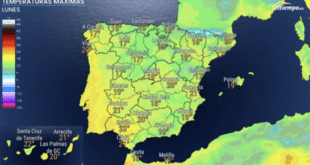
According to data from AEMET, February 2026 in mainland Spain recorded an average temperature of around 9.5°C, which is 2.4°C above the 1991–2020 average. It was one of the hottest Februarys ever recorded.
By comparison, February 2025 already stood above normal at 8.6°C, or +1.5°C above average. The year-on-year increase of roughly 0.9°C highlights how quickly temperatures are rising, even between consecutive winters. The pattern confirms the feelings of many on the ground, that winter 2026 not only continued the warming trend but accelerated it.
Baleares & Canarias experienced even more anomalies
Temperature changes were even more marked in Spain’s islands. In the Balearic Islands, including Palma, February 2026 averaged around 13.2°C, which is 2.9°C above normal. A year earlier, February 2025 averaged approximately 11.4°C, meaning a much smaller anomaly. Palma airport was one of several monitoring stations that recorded the warmest average temperatures for February since decades.
In the Canary Islands, temperatures rose from around 15.4°C in February 2025 to approximately 16.5°C in February 2026, with anomalies increasing from +0.5°C to +1.6°C above normal. While mainland Spain had a warm winter, the coastal and island areas experienced more extreme deviations. This reinforced the feeling of a mild winter.
Why Europe still calls winter unusually cold
Despite regional differences, Copernicus Climate Change Service classifies the 2025–2026 winter as one of the warmest in recent decades at a broader level.
The European picture is not uniform. The colder temperatures in January in central and eastern Europe helped to offset the warm weather in December and early February. The seasonal average in Europe is therefore more moderate even though temperatures were still above normal in many regions. This was especially true for the south and west. Spain’s experience is therefore more extreme than what the average continental climate suggests.
Compare Spain with other European countries
Spain’s February anomaly of +2.4°C above average stands out when compared with other major European countries.
In the UK, February 2026 temperatures were around +1.5°C above average, while Germany’s overall winter anomaly was closer to +0.3°C above normal. These figures show a clear pattern. Southern and western Europe saw a stronger warming while other parts of Europe had more mixed conditions. Spain was one of those countries where the signal for warming was most noticeable in February.
What does this mean for everyday life in Spain?
The impact of a warm February on people in Spain goes beyond the temperature records. The impact of a warmer winter is felt in many ways, from the energy demand and heating to agriculture patterns and tourism.
The shift is already evident in regions such as Andalusia and Valencia, and on the Balearic Islands. There, vegetation has grown earlier and conditions are more springlike. In the north, in areas like Galicia and Basque Country, there has been a less dramatic but still visible change compared to the previous year.
Spain warms up faster than Europe as a whole
Spain experiences these changes more frequently. In mainland Spain, Baleares, and Canarias in February 2026, temperatures were warmer than they had been in February 2025. This is consistent with the broader climate trends that Copernicus has identified.
This means that for expats or residents of Spain, even during winters that are described as “mild”, the local conditions may feel unusually hot.