Costa News Spain Breaking News | English News in Spain.


Spain’s used car market has never been more active. In 2026, second-hand vehicle transactions across the country are running at record levels, driven by a combination of rising new car prices, supply chain delays on new vehicles, and an expanding expat population that needs reliable personal transport in areas where public connections are limited or nonexistent.
On the Costa del Sol alone, the used car market serves over 100,000 registered foreign residents — plus tens of thousands of seasonal visitors, second-home owners and recent arrivals who are navigating the Spanish car buying process for the first time, often in a second or third language, and almost always without a clear understanding of the legal and mechanical risks that are specific to this market.
The result is entirely predictable. Every week, expat buyers across Marbella, Fuengirola, Estepona, Benalmádena, Torremolinos, Mijas and Málaga discover expensive problems with recently purchased vehicles that a proper pre-purchase inspection would have caught before a single euro changed hands.
This guide covers everything an expat buyer needs to know before entering the Spanish used car market in 2026.

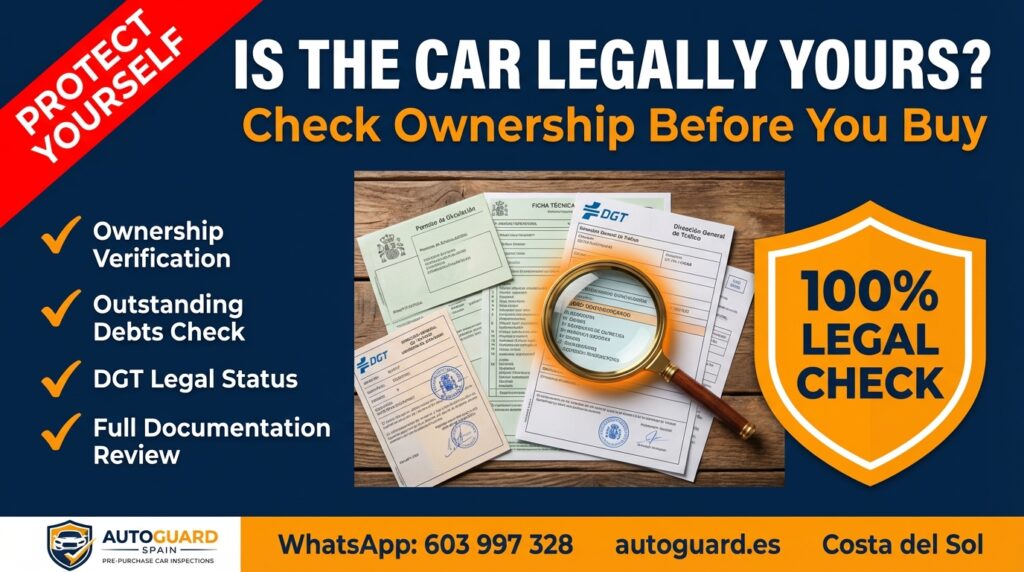
Why Spain’s Used Car Market Is DifferentBuyers arriving from the UK, Ireland, Germany, Scandinavia or the Netherlands bring with them assumptions about used car purchasing that are reasonable in their home markets but dangerously misleading in Spain.In the UK, HPI checks are standard practice. Finance and write-off databases are widely accessible to consumers. The used car trade is heavily regulated. Consumer protection legislation gives buyers meaningful recourse after a purchase if undisclosed faults emerge. Private sales carry implied terms under the Consumer Rights Act. The overall framework, while imperfect, gives buyers a reasonable degree of protection.Spain operates differently in almost every respect that matters to a used car buyer.Debts travel with the car. This is the single most important legal fact every expat buyer must understand before purchasing a used vehicle in Spain. Outstanding bank finance, court-ordered legal embargos, and accumulated traffic fines above a certain threshold are all attached to the vehicle registration — not to the seller as an individual. When ownership transfers, those obligations transfer with it. There is no equivalent of the UK’s clean title guarantee. The buyer bears the responsibility for verifying the vehicle’s legal status before purchase.Consumer protection is weaker in private sales. Purchases from registered dealers in Spain carry statutory warranty protections — typically one year on used vehicles under Spanish consumer law. Private sales, however, are largely caveat emptor. Once a private sale is completed in Spain, the buyer’s practical options for recourse over undisclosed faults are extremely limited, time-consuming and expensive to pursue through the Spanish legal system.
The language barrier creates real vulnerability. Contracts, vehicle documents, DGT records and ITV certificates are all in Spanish. A buyer who cannot read these documents fluently is entirely dependent on the seller’s translation and interpretation — a significant vulnerability in any transaction involving thousands of euros.Where Expats Are Buying Used Cars in Spain — and the Risks of EachOnline platforms — Wallapop, Coches.net, Milanuncios and AutoScout24 — dominate the Spanish used car market in 2026. These platforms offer genuine access to a huge inventory at competitive prices, but they also concentrate private sellers, many of whom have no professional obligation to disclose faults, and some of whom are actively motivated to conceal them.Wallapop in particular has seen significant growth in used car listings across the Costa del Sol. The platform’s informal, app-based format encourages fast transactions and discourages the kind of careful due diligence that a high-value purchase requires. Buyers who would never purchase a house without a survey routinely buy €15,000 cars on Wallapop based on six photographs and a WhatsApp conversation.Independent dealerships along the N-340 and across the Costa del Sol vary enormously in quality and transparency. Some operate to high professional standards. Others are essentially sophisticated private sellers operating from a forecourt. The presence of a business premises does not guarantee warranty coverage, accurate vehicle history disclosure, or compliance with Spanish consumer law requirements for used vehicle sales.Auction and trade vehicles entering the Costa del Sol market from Málaga province and beyond present specific risks. Ex-rental fleets from Málaga Airport, ex-lease vehicles from corporate fleets, and trade-in vehicles from main dealers all circulate through the wholesale and independent dealer market. These vehicles frequently carry high-cycle wear, deferred maintenance and minor undisclosed damage that is not reflected in their presented mileage or condition.

The Five Checks Every Expat Buyer Must Make1. DGT Legal and Financial CheckBefore viewing any vehicle seriously, confirm it carries no outstanding finance, legal embargos, or administrative blocks on transfer. Access to DGT records requires either a Spanish digital certificate — which most new arrivals do not possess — or a professional inspection service with direct DGT access.2. ITV History VerificationSpain’s mandatory roadworthiness test — the ITV — generates an official record of every inspection the recorded mileage at each test, and any failures or advisories noted. Gaps in the ITV history, or mileage figures that do not progress consistently between tests, are immediate red flags.
Paint Depth Test
A paint thickness gauge detects non-original paintwork — the clearest physical evidence of previous accident damage and body repairs. Panels that have been resprayed following an accident show significantly higher paint depth readings than original factory paintwork. This test is quick, non-invasive, and catches repairs that are visually undetectable.
Full Mechanical Inspection
A visual check and test drive by the buyer is insufficient. A professional mechanical inspection by an independent inspector covers engine condition, transmission behaviour, braking and suspension integrity, bodywork for accident damage and structural repairs, and a physical assessment for corrosion — particularly relevant in coastal areas where salt air accelerates deterioration significantly.
Professional OBD Diagnostic Scan
Modern vehicles store electronic fault codes that are invisible to visual inspection and undetectable on a test drive. A professional OBD scan reads every electronic control unit in the vehicle — engine, transmission, airbags, ABS, climate — and identifies stored faults, pending faults, and critically, evidence of recent fault code clearing by a seller attempting to conceal known issues.
The Remote Buyer — A Growing and Vulnerable Category
An increasing proportion of used car purchases on the Costa del Sol in 2026 are being made by buyers who have not yet relocated to Spain — people in the process of moving, purchasing a vehicle in advance of arrival, or buying remotely from the UK or elsewhere in Europe.
For these buyers, the standard risks of the Spanish used car market are compounded by the impossibility of attending a physical viewing. They are entirely dependent on photographs, video calls, and the seller’s description — all of which the seller controls entirely.
For remote buyers, an independent inspection service that can attend the vehicle, carry out a complete mechanical and legal check, and deliver a full written report with photographs before any purchase commitment is made is not a convenience. It is the only viable approach to a purchase of this size and risk profile.
A Local Service Worth Knowing About
AutoGuard Spain provides fully independent pre-purchase car inspections across the Costa del Sol, covering all five of the checks listed above in a single service starting from €149.
Operating from Sotogrande to Nerja and covering Marbella, Málaga, Estepona, Fuengirola, Benalmádena, Torremolinos, Mijas, San Pedro de Alcántara and surrounding areas, AutoGuard Spain inspects vehicles on-site at their location — dealership, private address, or any other location — and delivers a complete written report with photographs within 24 hours.
Reports are available in English, Spanish and German. For remote buyers, AutoGuard Spain coordinates directly with the seller, carries out the full inspection independently, and delivers the complete report digitally before any commitment is required.
Further information is available at autoguard.es or via WhatsApp on 603 997 328.
The Bottom Line
Spain’s used car market in 2026 offers genuine value for expat buyers who approach it correctly. The inventory is large, the prices are competitive, and the variety — particularly on the Costa del Sol — is genuinely extraordinary.
But the legal framework is different from northern Europe. The risks are real. And the consequences of skipping proper due diligence — a vehicle repossessed by a finance company, an undisclosed mechanical fault, a car with structural accident damage — are expensive, stressful, and in the case of legal embargos, potentially unrecoverable.
The five checks outlined in this guide take hours, not days. The cost of a professional inspection is a fraction of the cost of getting it wrong. And on the Costa del Sol in 2026, getting it right means buying with confidence rather than buying and hoping.
Article published by Costa Spain News. Independent pre-purchase car inspections for expat buyers across the Costa del Sol from autoguard.es
m