Costa News Spain Breaking News | English News in Spain.

My confusion when I started writing for The Olive Press, back in 2019.
The story was about how Spain’s Government passed a law that allowed Sephardic Jews, who were forced to leave their homeland centuries ago, to apply for citizenship. By the end of the deadline, 127,000 people applied.
Was there really a Jewish population in Spain? I thought about it.
Stamford Hill was a Jewish community in North London. Every day I would pass by it. My landlord is Jewish. I had Jewish students at university.
After nine months in Spain, I had not seen any Jewish culture.
Where are they?
This story is one of those moments that opens your eyes.
You start to see threads in the news that you hadn’t noticed before. For example, recent claims and debates about Christopher Columbus. Sephardic Jewish origins. Or how a dish as comfortingly “traditional” as cocido – eaten religiously every Sunday in winter at my Spanish in-laws – has a Jewish origin.
Then I wrote an extensive feature article about Thomas of Torquemada, a man who was ruthless in his efforts to torture, burn and expel Jews and Jewish converts out of Spain during the 15th century.
If you take a closer look, the vast Jewish history of Spain begins to come alive.
What are the most important Jewish sites in Spain?
What brings me to my interview with Asaf Peled, The CEO and founder is Shin Tours – one of the world’s leading private tour operators for Jewish heritage tours in Spain and across Europe, North Africa and Israel.
Asaf’s tale has a fascinating connection to Spain.
He told me that it was during his travels in Spain in his early twenties when he experienced an epiphany. On a Friday evening, he could hear faint singing drifting along the old streets in Toledo.
He then followed the sound and found himself outside of a small, quiet synagogue. Less than ten people had gathered to sing. “Lecha Dodi”. It is a Friday night hymn that welcomes the Sabbath.
“I broke down and felt this strong attachment to my own Judaism that I hadn’t been able to feel in years,” he said in an interview with the Olive Press.
It ignited a fire within me to reclaim and celebrate my Jewish heritage. Shin Tours was born from my desire to share these experiences with Jewish and mixed family travellers around the world.
Asaf is a great source of information on the best Jewish sights in Spain.
Below are his top 10 must-see Jewish quarters, museums and buildings in Spain – they’re the same landmarks and neighbourhoods he prioritises when designing a Jewish tour in Spain Shin Tours is the best way to explore the world.

Top 10 Jewish sites in Spain
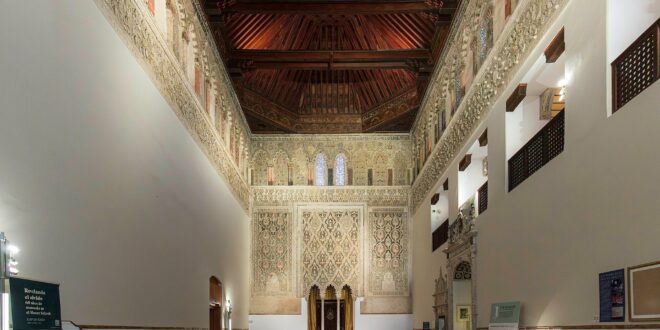
1) El Tránsito Synagogue & Sephardic Museum (Toledo)
Asaf told me “Toledo was the obvious starting place” for a Jewish Tour in Spain. The single best “gateway” site is the Museo Sefardí, which is housed inside the Sinagoga del Tránsito – also known as the Synagogue of Samuel ha-Leví.
The building itself is a 14th-century synagogue commissioned by Samuel ha-Leví (treasurer to King Pedro I) and famous for its dramatic prayer hall and ornate decoration. The museum’s exhibits tell a story of Jewish history in Spain. From the early Jewish presence to the “golden age” of medieval Spain and on through the Sephardic Diaspora.
2) Casa del Judío (Toledo)
Asaf likes to take people to a more intimate place after the major headline sites of Toledo. The Casa del Judío, tucked right in the heart of the old Judería (Jewish quarter), is exactly that.
Property is an old mansion with a potential for a new home. mikveh It has a basement that contains an ancient “ritual bathtub” from the 14th Century. The property has recent history too, as it was restored following the death of its last owner – a French Jewish businessman called Elie Nahmias, who was an Auschwitz survivor and later in life fell in love with Toledo.
3) Córdoba Synagogue
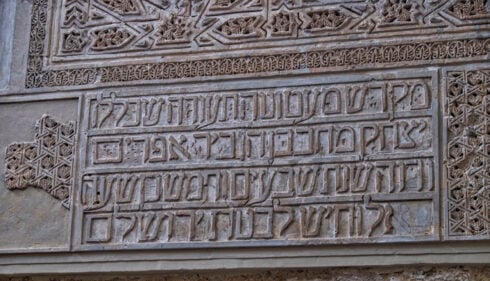
Asaf calls Córdoba “a city where Jewish Spain doesn’t feel like a footnote” as it’s still very visible in the Jewish quarter (Judería). At the heart of this neighbourhood is the Córdoba Synagogue. It’s the only medieval synagogue preserved in Córdoba and one of the best-preserved in Spain.
The scale and the detail are striking. Inscriptions inside the building place its construction between 1314 and 1315, and today you can still see the refined Mudéjar plasterwork, traces of Hebrew inscriptions, and the intimate layout that suggests a space designed for a close-knit community rather than grand spectacle.
4) Judería of Córdoba Walk
Asaf then recommends treating Córdoba as a walking chapter of the story – because there’s just “so much to see”.
The Judería is part of the city’s historic centre (a UNESCO World Heritage area), and its narrow lanes make history feel close. He recommends that travellers stop at two places of interest during the walk:
- The statue of Maimonides, Rabbi Moshe ben Maimon: The Córdoba-born rabbi, philosopher and court physician (born 1138) whose legacy still resonates far beyond Spain.
- The Casa de Sefarad: A small museum dedicated to Sephardic Culture that brings Jewish History to life through everyday objects and artifacts.
5) Girona El Call
El Call, the Jewish Quarter of Girona is one of Spain’s most beautiful neighbourhoods. The Jewish presence dates back to 890 CE in Girona, and the area flourished up until the expulsion of Jews and Moors in 1492.
Girona’s Call, as it is known today, remains one of Spain’s and Portugal’s best preserved Jewish quarters. The Museum of Jewish History, located at the heart of the old quarter, offers visitors an incredible collection of artefacts and exhibitions – from medieval manuscripts to architectural remnants.
6) Mikveh of Besalú
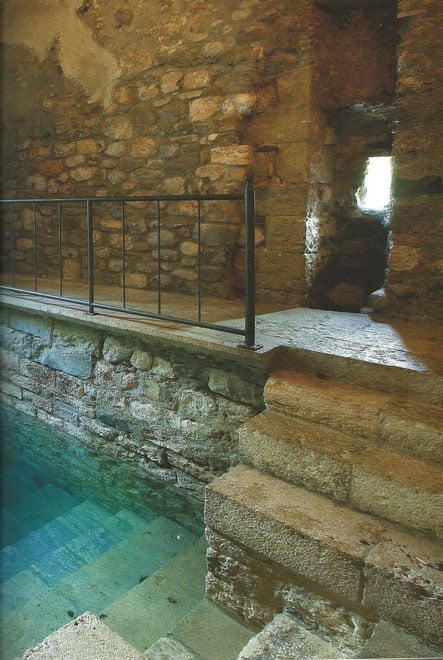
Just outside Girona, Asaf points travellers to Besalú for one of the most distinctive Jewish heritage stops in Spain: its medieval mikveh (ritual bath).
It’s an important, if not unique, link to Jewish daily life. Asaf says it’s “one out of only a few medieval mikva’ot” in Europe.
7) Barcelona El Call
Barcelona is a top destination on any trip to Spain, and many travellers on a Jewish tour understandably want time for Gaudí’s masterpieces too. You can combine the Barcelona headline experience with something much older, a stroll through El Call, Barcelona’s historic Jewish district.
Asaf recommends stopping at the Sinagoga Major You can also use MUHBA’s El Call Interpretation Space to help you understand the story of each quarter as you explore.
He builds in flavour too and tells me there’s a “discreet café” he brings every group to, where you can try Jewish delicacies and sweets inspired by recipes passed down through generations.
8) Realejo (Granada)
Granada, Spain is a “must do” stop for any Spain vacation because tourists want to see the Alhambra. It’s for this reason that a visit to Granada’s medieval Jewish quarter (Realejo) works so well.
Realejo, also called Realejo in Arab times. Garnata al-Yahud (Granada de los Jueces). Asaf enjoys Realejo more than other neighbourhoods, which are easier to “read”, as they have a preserved street plan. It still feels like an active community. It is a maze of streets that resembles an old community.
9) Sinagoga Beth Yaacov (Madrid)
Asaf loves to end (or begin) his stay in Madrid, which is often a logistical destination due to the international airport. Present tenseSinagoga Beth Yaacov
It’s not a particularly old or well-known building – it was only inaugurated in 2007, and visits must be pre-booked. The museum contains a carefully curated selection of photographs, materials and documents that show the modern rebuilding in Spain of Jewish life by descendents of those who had returned from nearly five centuries exile.
Seville’s Jewish Quarter (Barrio Santa Cruz).
Seville is hugely popular for its headline sights: the Cathedral, the Royal Alcázar and the Archivo de Indias (a UNESCO-listed trio). It’s even more interesting to visit the Cathedral, as it is the final resting place for Christopher Columbus. He is now thought to be of Jewish descent.
Barrio Santa Cruz is Seville’s oldest Jewish quarter and also its most popular tourist area. This fascinating maze is a collection of narrow streets and squares that you can use to create an easy walking route. As part of that walk, Asaf recommends adding at least one “memory marker” site, such as Church of Santa María la Blanca – a former synagogue site later converted into a church.
You want to book a Jewish Tour to Spain?
You may be interested in this tour if you want to learn more about the Jewish heritage of Spain.
Asaf wants to give Olive Press readers a chance to receive a custom-made itinerary by his team at Shin Tours. You just provide some details about your group and interests, and he’ll create a customised plan for you – at no cost.
This is a great way to get a tour itinerary that has been curated by an expert of the top sites in Spain.
Interested?
Contact Shin Tours via their website:
Travel News at The Olive Press. Click Here to Read More.