Costa News Spain Breaking News | English News in Spain.

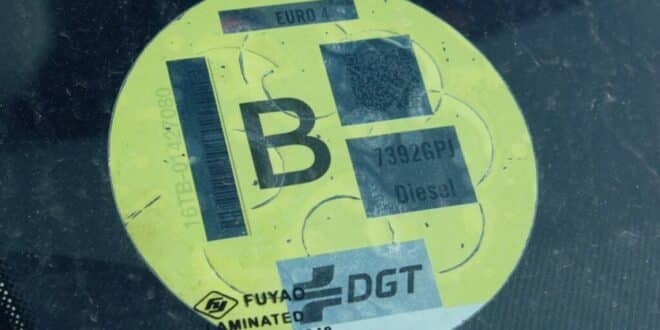
From 2026, cars with the DGT B environmental label will face new restrictions on access to low-emission areas in Spain.
Credit : Capturing images by Shutterstock
If you own a vehicle with an environmental sticker B, then 2026 is a significant date. This yellow label has been enough until recently to keep you on the right side for most low emission rules. It is not guaranteed anymore.
Across Spain, more than nine million vehicles carry the DGT’s B badge – around one in three cars on the road. Since the beginning of this year, many have faced new restrictions within Low Emission Zones.
Local councils have focused on cars without any environmental label for years. This approach has changed. By 2026, B-label vehicles will not be tolerated and, in some cities, there are already restrictions in place.
What is a B label car?
The B sticker is a common way to describe the vast majority of Spain’s older but still heavily-used vehicle fleet. The vast majority are petrol cars, registered between 2001 and 2006. Diesel vehicles, from 2006 to 2014. However, the exact cutoff depends more on the emissions approval than the year of registration.
There are exceptions. Some petrol cars dating back to the early 2000s qualify for a label C instead. In general, however, if the car is older than ten, it is likely to be a B sticker.
What often surprises drivers is that DGT labels are not based on CO₂ emissions. Instead, they concentrate on nitrogen oxides (NOx) and fine particle pollution that is closely connected to air quality. With transport responsible for around 29 per cent of Spain’s total CO₂ emissions, pressure on city authorities has continued to grow.
The Sustainable Mobility Law that is shaping the urban traffic policy does not ban B-label cars. The Sustainable Mobility Law gives local and regional governments the legal authority to tighten rules on access when public health or air quality are at risk.
Barcelona, Catalonia, and Madrid: restrictions have now begun
Although they may not be applied everywhere, the biggest changes started this year.
Catalonia took the strongest stance. According to its Air Quality Plan, 2027 cars with the B label will be banned from low-emission areas during periods of high pollution in the region. This restriction is already in place and can be activated at any time when air quality worsens.
It is only the beginning. The ban will be permanent in Catalan ZBE zones from January 2028 regardless of pollution levels.
Barcelona has a more gradual, but still clearly defined approach. From 2026 onwards, the B-label vehicle will only be restricted during episodes of nitrogen dioxide pollution. On normal days, there is no restriction on the movement of vehicles. This window will close in 2028 when the low-emission zones of the city will permanently prohibit access.
Madrid is currently more flexible. In 2026, cars with B-labels can continue to circulate in the ZBE general, which includes the entire municipality.
The key exceptions remain the areas of special protection, such as Madrid Central, where access has already been limited to specific cases – residents, authorised vehicles and certain parking arrangements.
Other cities in Spain have moved quicker. Bilbao is one of the major cities that took this step first, by banning B label vehicles from its low emission zone as early as 2025.
What drivers will need to be aware of in 2026
Drivers of B-label cars will have to adjust in 2026, rather than face an immediate shutdown. Restrictions are not applied uniformly depending on where you live, the pollution levels, and local regulations.
Pollution alerts are the primary trigger in Catalonia and Barcelona. Madrid is still a city where pressure is focused on specific districts and not the whole. Other local laws continue to change, sometimes without much notice.
Experts in the field of mobility agree that staying informed is essential. It is now mandatory to check local ZBE regulations, monitor pollution warnings and consider future vehicle access limits when making vehicle decisions.
The B sticker is still a valid pass for some time. But in 2026, it has clearly lost its status as a safe pass – and for millions of drivers, access to city centres has become far less predictable.