Costa News Spain Breaking News | English News in Spain.

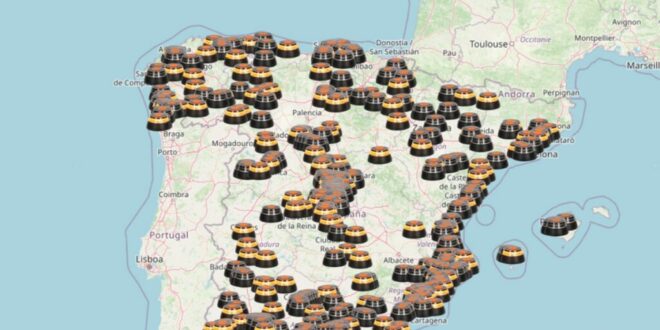
Locations of V16 beacons displayed live on a traffic chart raises safety concerns
Credit: Screenshot from mapabalizasv16.es
The switch in Spain to V16 emergency beacons was supposed to improve safety for drivers. Guardia Civil officials are warning motorists that this system may unintentionally turn them into easy targets for stranded tow trucks or organised crime.
Devices now compulsory in Spain as of January 1, 2026The triangles are meant to replace the old warning triangles. These devices allow drivers the ability to signal an accident or breakdown without stepping outside their vehicle. This is to reduce risk of being hit by other vehicles on fast moving roads. Behind the safety promise is an uncomfortable and growing downside, say traffic officers.
Location data is the core issue.
When a signal of safety becomes public knowledge
The V16 beacon automatically transmits the exact location of the vehicle to Spain’s traffic authority when it is activated. This information is displayed on official traffic mapsMixed in with roadworks and weather incidents, as well as emergency services activity.
Theoretically, this system allows roadside assistance teams and emergency services to reach drivers more quickly. Guardia Civil traffic officials warn that anyone with internet access can view this information.
There are already websites which separate beacon signals and other traffic data, displaying an interactive map of all vehicles in Spain that have broken down or been involved in accidents. It is now possible to find out where a driver has broken down, what road they’re on and even which direction they were traveling.
The level of detail that is provided by emergency services may be very valuable. Guardia Civil sources have pointed out that it can be just as useful for the wrong people.
Why pirate tow trucks watch closely
The problem of illegal or “pirate”, tow trucks on Spanish roads is a well-known one. They tend to appear when traffic is heavy or conditions are difficult – during summer getaway weekends, holiday periods or extreme weather events.
These operators monitor motorways and patrol them, arriving at the scene before official assistance. The drivers, often stressed and unaware, will accept the help, believing that it is genuine. Later, they find out that they were charged for services they never requested. Their insurance also does not cover the cost.
Guardia Civil officers claim that V16 beacons will make this practice easier and more common. Due to real-time beacon location information, illegal tow truck drivers no longer have to wait on radio chatter and rely solely on chance. They can drive straight to the stranded car, knowing where it is.
The officers warn that it is not the whole problem. Criminal groups that specialize in violent robbery or theft could also use the same data. In recent years, police have dismantled gangs – particularly from Eastern Europe – that targeted broken-down vehicles, stealing from drivers when they were most vulnerable.
A Guardia Civil spokesperson warned: “Now they’ll know exactly where victims are”, noting that a driver stuck on a roadside or possibly by himself is in an extremely vulnerable position.
No delay, no turning back
Spain’s traffic authorities made it clear, despite the growing anxiety, that the deadline will not be extended. The 2021 Royal Decree introduced the obligation to use V16 strobes, which gave drivers and companies four-years to adapt.
The Directorate-General for Traffic believes that delaying this measure will only delay an inevitable transition. Officials say that the technology is crucial to modernising road traffic safety and reducing deaths.
The V16 beacon is now the standard emergency alert system. Traditional triangles will still be tolerated until the V16 becomes the standard. Those triangles were originally phased out because drivers had to leave their vehicles to place them – A manoeuvre considered hazardous on high-speed highways. Critics say that this physical risk still exists, but that a new digital one has now been introduced..
The authorities have attempted to calm down motorists’ nerves. DGT has said that there won’t be an immediate wave of fines, and that officers will instead focus on educating drivers. Vehicles won’t be stopped just to see if they have a V16 beam, and only in the last resort will fines be issued.
The message to traffic officers is still clear. It may save lives but caution is also required. Drivers have been advised to accept only roadside assistance that is arranged by their insurer. They should also remain vigilant when approached by uninvited help.
Spain is moving into the V16 age, but what was originally sold as an upgrade for safety has quickly become a larger debate on privacy, security and the unintended consequences of the V16 system.