Costa News Spain Breaking News | English News in Spain.


Spain’s TruCAM II speed camera can detect vehicles speeding from a distance of over one kilometer.
Credit : Screnshot – Tiktok – ayto_launion
Spain’s traffic officials have some shocking news for you. If you thought that spotting a camera meant you had enough time to slow down, you may want to reconsider. The new generation of mobile speed radars has quietly been rolling out in Spain. They don’t have to be close to you to catch someone speeding.
Spain’s Dirección General de Tráfico (DGT) has been steadily strengthening its speed enforcement strategy, and its latest weapon is a laser-based radar capable of detecting drivers from more than one kilometre away. For drivers, particularly those who are not familiar with Spain’s evolving traffic control, this is a significant change in the way speed limits are enforced.
The new type of speed camera that drivers don’t expect
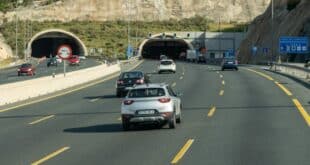
Spain operates over 3,400 speed enforcement systems across the nation. They include red-light and fixed-roadside cameras, as well average-speed devices, technology to detect drivers on their phones or not wearing seatbelts. But while fixed cameras are clearly signposted, mobile radars remain the most feared among drivers – largely because they are harder to spot and give no warning.
This latest addition is the TruCAM IIPortable laser speed radar, which represents a significant technological leap. The DGT announced the purchase of 15 devices of this next generation earlier in the year. Although their deployment is still discreet, local authorities are testing them in urban areas.
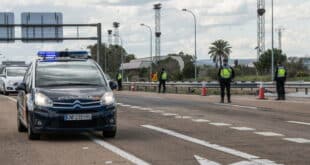
One of the first municipalities to publicly acknowledge their use is La Unión, a town in the Murcia region. In a video shared on social mediaThe local council announced its police force has begun testing the new radar in an effort to improve road safety. Officials stressed that the aim is not punishment for its own sake, but accident prevention – particularly during periods of heavy traffic.
It is not a coincidence. With holiday travel peaks approaching, towns like La Unión can see visitor numbers far exceed their usual population, increasing both traffic density and accident risk.
Why is the TruCAM II Radar so powerful?
TruCAM II appears simple at first glance. It is actually one of the most sophisticated portable speed detection devices currently available. It can be used to measure the speed of cars travelling towards or away from it using laser technology.
Its range is its most outstanding feature. TruCAM II has a range of 1,200 metres. This is much further than what drivers might expect. Even at shorter distances – around 150 metres – the system captures significantly sharper images than older models, making vehicle identification far easier.
It is designed to work long shifts. It runs for up eight hours on interchangeable batteries. This allows officers to change power units at any time without having to interrupt their work. It also features a larger, more responsive touchscreen that can be operated while wearing gloves – a practical detail that matters during long roadside deployments.
A key improvement in the radar is its connectivity. The radar can also be connected to other devices for remote monitoring. Automatic number plate recognition, direct database checks and automatic DGT database searches are also available as optional features.
It is important to note that this isn’t just another speeding camera. It’s a mobile enforcement device designed to work quietly, flexible and at distances that drivers may not expect.
What drivers should expect when the rollout begins
For residents in areas where these radars are being tested, there is some reassurance – at least initially. Most new speed enforcement systems are tested for a period of time before being introduced. Drivers who exceed the speed limit during this phase may only receive a warning rather than a fine.
These trials usually last around a week, and then penalties are enforced. Once that happens, speeding fines remain unchanged under Spanish law, starting at €100 for minor offences and rising to €600 for the most serious breaches, potentially accompanied by points being removed from a driver’s licence.
Local authorities say that the radars are not meant to generate revenue, but rather for safety. By increasing the likelihood of detection, the DGT hopes drivers will think twice before exceeding speed limits – especially in towns and built-up areas where the risk to pedestrians is higher.
The message for expats and tourists is clear: visual cues are no longer sufficient to detect speed cameras. As technology can now monitor traffic more than a mile away, observing posted speed limits is the best way to stay safe.
The TruCAM II may appear in many more towns and cities as Spain modernises its traffic enforcement. The era of the “invisible” traffic control is here, whether drivers like it or dislike it.