Costa News Spain Breaking News | English News in Spain.

Torremolinos, Costa del Sol.
Credit: Chris Dorney – Shutterstock
We don’t define language ourselves. We use it to communicate. “The sky is blue”, for example, is universally considered the truth (at least on the Costa del Sol). We need to use these general terms we all understand in order to be understood in any conversation. “The sky is purple”, for example, would have people scratching their heads. With few words we can have the basis of a friendly conversation. If we change one of those words, we will end up with a lengthy dissertation on deconstructionist philosophy, and no one wants that down the pub.
Who decides what word is what?
Many global languages are controlled by an official academy that has the final say, such as with Spanish and French. English tends to be a little more democratic in that we look to the Oxford English Dictionary (OED) for conflict resolution here. The OED decides on what words to include due to the popularity of their use, and more than 2,000 new words and phrases enter the OED every year. Lest we forget that the OED felt compelled to include a certain “F” word due to its many years of widespread use, which they held off from doing until 1972.
The case for the plaintiff: “It’s immigrant, not expat!”
Anti-Brexit Brits in Spain, who voted to remain in the EU, argue that calling themselves “expats” perpetuates the same nationalism that fuelled Brexit and current UK immigration debates. One such resident told The Guardian that it’s “hypocritical” to claim expat status while supporting policies that restrict others’ rights to move.
So, should Brits in Spain refer to themselves as “immigrants” and not “expats”?
The case for the defence: “It’s expat, not immigrant!”
The term “expat” is a sub-meaning of “immigrant”. There are many types of immigrant. Asylum seeker, settler, refugee, incomer, foreigner, pilgrim, and one often found offensive by those in Europe, ‘alien’ (popular in the USA). Each is a valid term and is used in differing contexts and can express attitude, formality, familiarity, legal status, friendship, anger, and so on. Choosing the right one depends on who you are talking about and who you are talking to. An expat to an expat will say, “I’m an expat too!” A Brit in Spain to a Guardia Civil will say “Soy extranjero” (I’m a foreigner). An article on “Expat legal services” might conjure up different ideas in one’s perception than “Immigrant legal services” or even “Asylum seeker services”.
Gay men are not always gay.
That statement will cause a stir! Words can also change meaning with time. ‘Gay’ always used to mean happy, joyous, colourful, etc. You had gay music, gay shirts, and gay days! Then, something shifted in larger society.
Today, if I say to the landlord of my favourite pub, “What a gay shirt you are wearing!”, the reaction might be different than 150 years ago. “Expat” might have once meant one who resides in another country temporarily, but it’s not necessarily the case today. The lines are blurred, not least with the 90-Day Rule. The years and popular usage have decided otherwise. Context, attitude, and who you are conversing with all have a bearing on what words you use.
Let’s test it with science.
Google, in their infinite mysteriousness, decided to scan as many books, documents and even manuscripts as possible. No one really knows why; they just did it because they are Google. Then some developers decided to use the data to create the Ngram viewer which plots the frequency of published words through history. Let’s use it to see which term is (democratically) correct and therefore good for inclusion in the Oxford English Dictionary and English conversation.
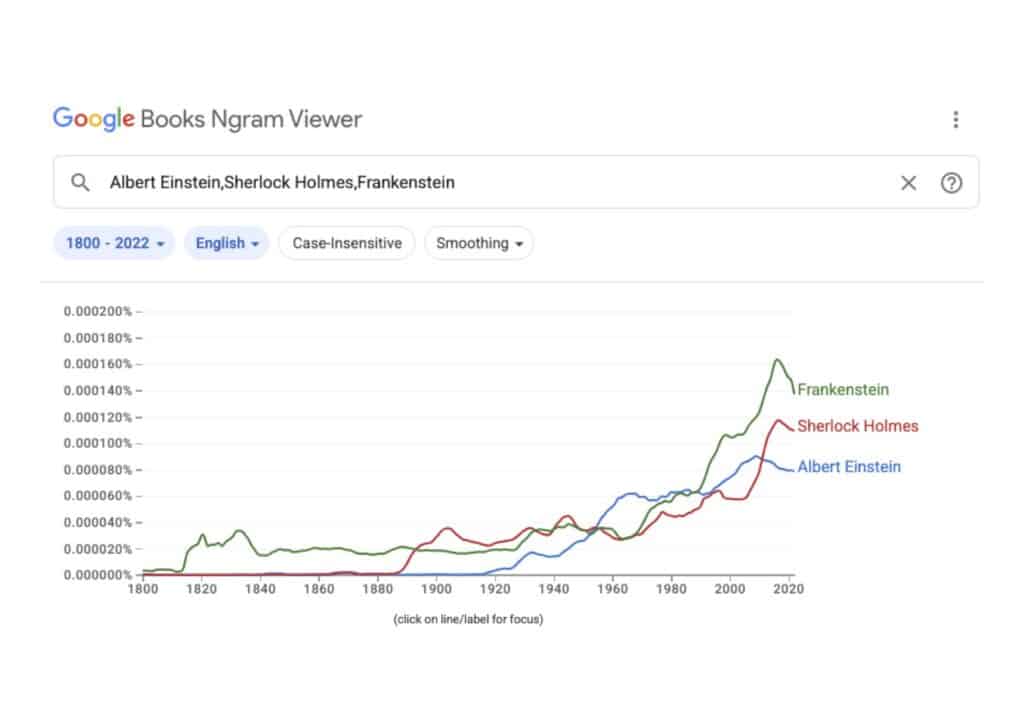
Ngram Viewer’s front page, as you can see below, demonstrates the historical use of Albert Einstein, Sherlock Holmes, and Frankenstein. You can play around with this toy at home. It’s fascinating for history buffs!
Credit: Google Ngram Viewer
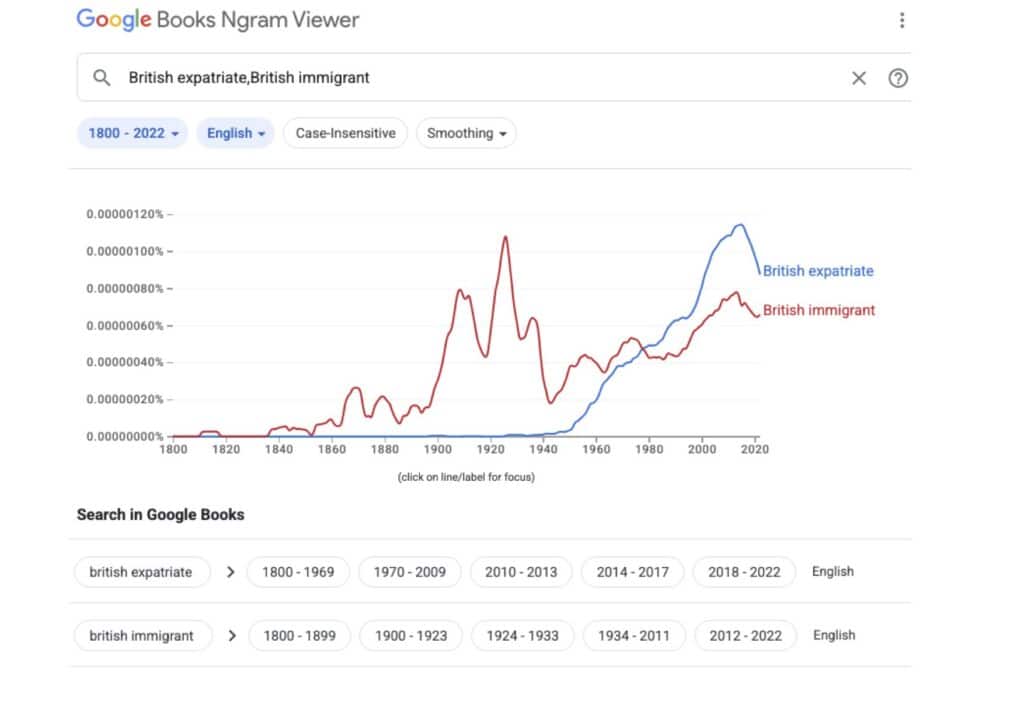
So, let’s apply the same science to the context of “British expatriates” and “British immigrants”:
Credit: Google Ngram Viewer
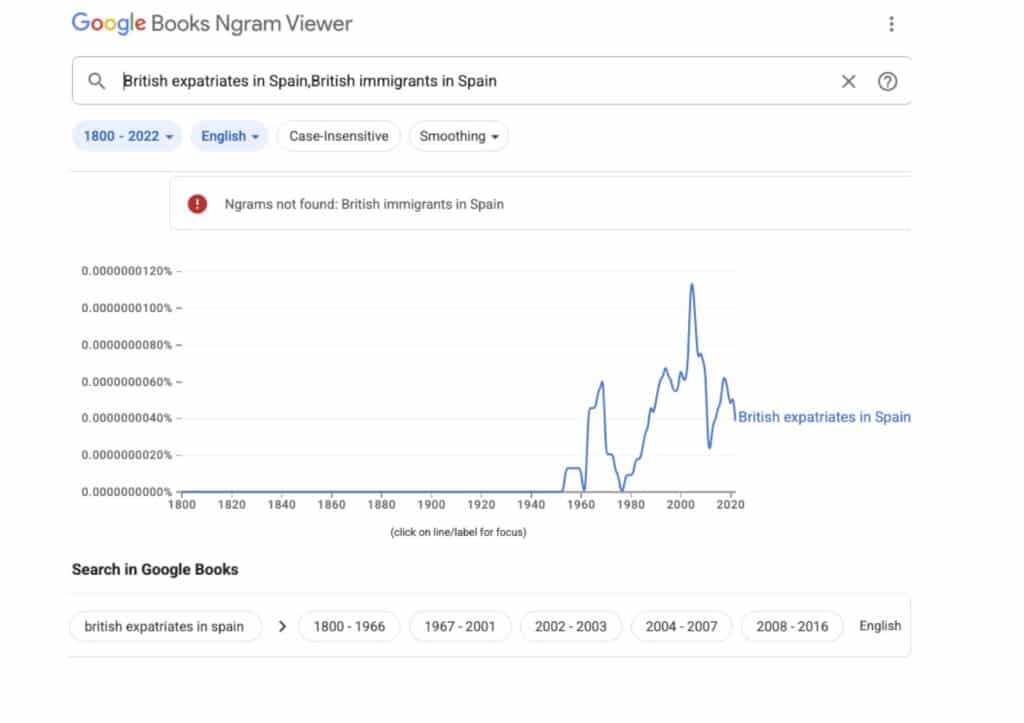
Ok, but language use depends on context. So, let’s add some context:
Credit: Google Ngram Viewer
British immigrants in Spain don’t even register as popular enough to appear on the graph.
English is a democratic language. That means the minority cannot decide what the correct term is in a community. Only the majority can do that. Cat, sky, person, … woman. We all know what those words mean because we live in the English-speaking community, and only the vast majority can ever democratically change words in community.
I rest my case, your honour.
How do other nationalities say “expat” instead of “immigrant? These are all terms the French use when talking to other French people, or Germans with fellow Germans, and so on. And “British expat” is a term British expats use when speaking to each other without meaning offence to anyone.
- French: expats (same word) or expatriés
- Germans: Auslandsdeutsche
- Italians: italiani all’estero
- Dutch: buitenland-Nederlanders or expats
- Swedes: utlandssvenskar
- Danes: udlandsdansker
- Norwegians: utlandsnorwegiere
- Indians: NRI (Non-Resident Indian)