Costa News Spain Breaking News | English News in Spain.

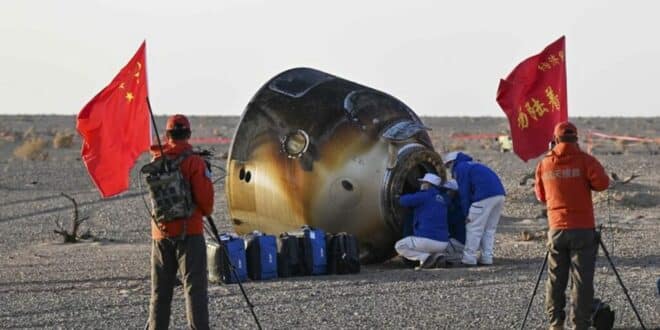
Rescue crews inspect the damaged Shenzhou-20 capsule following its return to Earth.
Credit X- Chinese Embassy of Switzerland
@ChinaEmbinCH
It was supposed to be a straightforward ride home – the kind astronauts dream of after months floating in a metal lab the size of a small flat. Three taikonauts on China’s Tiangong station were stuck in orbit when a piece high-speed debris struck their capsule and cracked a window.
Chen Dong and Chen Zhongrui had already said goodbye and were getting ready to hand the controls over to the newly-arrived Shenzhou-21 crew. The crew was due to return to Earth on the 5th of November. Just hours before the flight, everything changed.
The impact of a cracked window
According to officials in Beijing, the Shenzhou-20 spacecraft was hit by a small fragment of space debris, the sort of thing you can’t predict and can barely detect – until it slams into your ship at nearly 29,000 km/h.
A crack was left in the window of the capsule by the impact. This alone was enough to stop the mission. In space, a damaged window is not just a cosmetic problem; it can be life-threatening. The re-entry pod must be completely sealed or the cabin air will escape into the vacuum.
China’s space agency On 4 November the incident was confirmed. Weibo announced that teams were conducting “impact assessments and risk assessment” and that the crews’ return had been officially postponed. The message was clear: the taikonauts would not be returning in this spacecraft.
Forced to hitch home
Three astronauts, whose ship was compromised, had no choice but to leave Earth’s orbit aboard Shenzhou-21 – the capsule which only a few days ago had brought up a new crew.
No space agency wants to do this swap, as it leaves the station temporarily without an emergency escape vehicle. China had no option. State media later announced that the taikonauts were safely returned, and that this was the first successful “alternative” return procedure in the history the country’s programme for the space-station.
They also broke the record for the longest Chinese crewed orbital stay, but it is unlikely that the trio was celebrating as they decided who would be seated where on their unexpected return.
A space station with no way out – and a growing danger above Earth
This situation serves as a reminder that the threat of space debris is not a theoretical one. This debris is already causing problems to real missions. The Earth is now being bombarded by everything from paint flecks to rocket fragments.
China is not new to this issue. China’s 2007 antisatellite test produced the largest cloud of space debris recorded. More than 3,000 pieces are still in orbit.
Lincoln Hines, professor at Georgia Institute of Technology says that it is too early to tell if this incident will prompt Beijing to take more aggressive action. But he thinks it can be a real wake-up call.
“Incidents such as this show how crowded and hazardous low-Earth orbit is becoming,” he said. “And it’s not a problem that can be solved by one country alone.”