Costa News Spain Breaking News | English News in Spain.

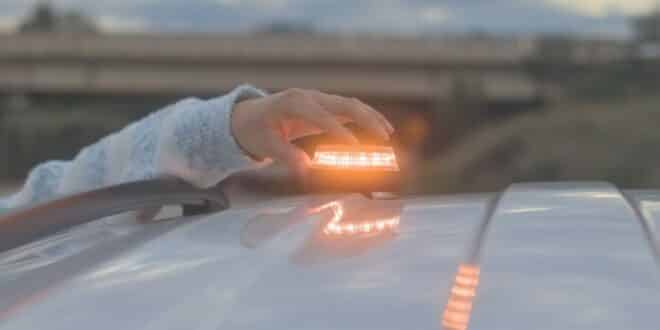
The DGT explains the use of the new V16 Emergency Beacon, which is mandatory as of 2026.
Credit : garciaadrian, Shutterstock
Upgrade your red triangles in the boot if you still have them. Spain’s Dirección General de Tráfico (DGT) has released a new infographic Explaining how to use a V16 connected emergency light, a small blinking light which will soon replace all the traditional triangles on every car in the country.
This is not another gadget you can add to your car’s glove compartment. In 2026, the V16 will be mandatory for all Spanish drivers. This will mark a significant change in how they respond to road accidents and breakdowns. The new visual guide from the DGT makes it impossible for drivers to be caught off guard.
Goodbye Triangles, Hello V16
DGT has a clear message for drivers: they will all need a V16 in their vehicles by the year 2026. This small yellow beacon is designed to replace the reflective triangles that many of us still use – and it’s much safer.
Why? You don’t have to get out of your vehicle to use it. The DGT reminds motorists that the V16 can be placed on top of the vehicle in just seconds. The beacon emits a 360-degree flashing, yellow light that is visible up to 1 kilometre away.
Each device comes with a battery that has a minimum life of 18 months, and is connected via an integrated GPS chip as well as a non-removable SIM. This ensures that your location can be transmitted to Spain’s connected traffic network – without any subscription or extra fees – for at least 12 years.
The V16 is not just a triangle replacement; it is a smarter and safer tool, which could save lives on the roadside.
Four scenarios to help you act in an emergency.
The DGT has published a useful guide to help clear up any confusion regarding the use of the new beacon. infographic It has an official X (formerly Twitter,) account. It describes four possible situations and how drivers can handle them safely.
If you’re able to keep driving, you should turn on your hazards and leave the road as quickly as possible. Use the right-hand side of the road until you find a safe exit.
If your vehicle breaks down, you should pull your car over to the side of the road, turn on your hazard warning lights, and activate the V16 signal. Then, place the V16 on your roof or on the most visible part.
If it’s dangerous to leave your vehicle, keep your seat belt fastened and stay in your car until conditions improve. You should only leave if you are able to reach a safe area without having to step onto the road.
When you need assistance, remember that the V16 does not automatically send out a distress signal. You will still need to use your mobile phone, or the built-in eCall feature of your vehicle if you have one.
DGT also reminds motorists to always have the V16 readily available, ideally in their glove compartment so that it is easy to grab when needed.
Not every V16 Beacon is legal – Here’s how to know
Before you buy one, it’s important to remember that not all V16 light on the market is approved.
You can also find out more about the following: DGT The DGT warns that, while many brands sell beacons claiming they are “connected”, from 2026 only those that have the official DGT certification can be used. Some models do not have the proper connectivity, or they don’t meet safety requirements. This means that they will no longer be legal.
DGT published a guide to help you avoid buying the wrong product. official list of approved V16 models on its website. Each authorized product comes with an downloadable certificate confirming its compliance with all technical requirements.
DGT has also clarified these devices must provide a minimum 12 years of connectivity, without the users paying extra. The SIM chip inside the device makes this possible. It is connected directly to Spain’s road safety platform.
Why the change matters – and why it’s safer
It’s not just about modernisation, but also about reducing roadside accident. Many drivers have suffered injuries or even died while walking on motorways to install warning triangles following a breakdown.
With the new system, you don’t have to step onto the road. You simply turn on the beacon and place it on the roof – all without leaving your seat.
It is visible for up a kilometre under ideal conditions. Visibility decreases when the weather is bad, such as in heavy rain or fog. It is still a better option than having to step into the traffic and set up traditional triangles.
DGT emphasizes the importance of always having the beacon charged and accessible. When seconds are crucial, the device could be the key to saving lives.
The future of driving in Spain is connected
By 2026, only the V16 emergency signal will be accepted on Spanish highways. It’s small, smart, and easy to use – and the DGT wants everyone to start familiarising themselves with it now.
Check your emergency kit next time and see if you can fit one of these beacons. It may be the most essential item you ever store in your glove compartment.
If you still have questions about how it works, then read on. This new infographic by the DGT is a great place to begin. Being prepared when it comes down to road safety is better than luck.